Fiction Books for Intermediate Readers (Ages 9-12) |
New York City has to be one of the greatest places in America, if not the world.
Luckily for us, many authors have chronicled The Big Apple's antics in a way just right
for kids.
Here are some of
the books available. This is not yet a complete list, but I'm adding
books to the list daily. If you wish to purchase any of these books, click on either the title or the book cover to be directed to Amazon.com. As a warning, I have put up pictures of the book covers to give you somewhat an idea of the style of each book (I know, I know. "Don't judge a book by its cover") so the pages may load slowly, depending on the speed of your internet connection.
The categories below are sorted by approximate age group and topical categories. Feel free to browse around. The same links are located on the left side of your screen. To return back to this page, simply click on the "Welcome" link on the left.
If this website came up without frames, click here to see the complete "New York City Books for Kids" website with frames.
Other Pages of Interest:
Fiction & Historical Fiction:
General Books About New York City (Nonfiction) |
Fiction NYC Picture Books and "Easy Reader" Stories (Ages 4-8) |
Fiction NYC Books (Ages 9-12) |
New York Fiction for Young Adults |
New York Historical Fiction (Colonial Period and Revolutionary War) |
New York Historical Fiction (Ellis Island & Immigration) |
New York Historical Fiction (Life in the 1800s) |
New York Historical Fiction (Life in the 1900s)
NYC History:
New York Biographies |
Native Americans from New York (History and Historical Fiction) |
New York History (Colonial Period and Revolutionary War) |
New York History (Immigration and Ellis Island) |
New York History (The 1800s) |
New York History (The 1900s) |
The World Trade Center and September 11, 2001 |
NYC Locations:
The Statue of Liberty |
The Empire State Building |
Central Park |
NYC Art Museums (Metropolitan Museum of Art, The Museum of Modern Art, etc.) |
NYC's American Museum of Natural History |
Harlem Books (Including books about the Harlem Renaissance) |
Chinatown Books |
Little Italy Books |
The New York City Subway System |
Brooklyn Books |
The Bronx Books |
Queens Books |
Staten Island Books |
Long Island Books |
Upstate New York Books |
New York State Books
Life and Travel in NYC:
Thanksgiving in New York City |
Christmas in New York City |
New York Sports Teams and Players
The NYC Fire Department (FDNY) and NY Police Department (NYPD) |
General Books About Cities |
New York City and New York State Test Preparation and Study Guides |
New York Regents Review Books |
Parenting in New York City |
New York Travel Guides for Families with Children
NYC Toys, Puzzles, and Games (For Kids & Adults) |
Amazon.com Coupon Codes
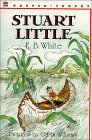
Stuart Little
By E. B. White
A paperback edition of E.B. White's classic novel about one small mouse on a very big adventure! With black and white illustrations.
Stuart Little is no ordinary mouse. Born to a family of humans, he lives in New York City with his parents, his older brother George, and Snowbell the cat. Though he's shy and thoughtful, he's also a true lover of adventure.
Stuart's greatest adventure comes when his best friend, a beautiful little bird named Margalo, disappears from her nest. Determined to track her down, Stuart ventures away from home for the very first time in his life. He finds adventure aplenty. But will he find his friend?
Beloved by generations,
Charlotte's Web and
Stuart Little are two of the most cherished stories of all time. Now, for the first time ever, these treasured classics are available in lavish new collectors' editions. In addition to a larger trim size, the original black-and-white art by Garth Williams has been lovingly colorized by renowned illustrator Rosemary Wells, adding another dimension to these two perfect books for young and old alike.
Whether you are returning once again to visit with Wilbur, Charlotte, and Stuart, or giving the gift of these treasured stories to a child, these spruced-up editions are sure to delight fans new and old. The interior design has been slightly moderated to give the books a fresh look without changing the original, familiar, and beloved format. Garth Williams's original black-and-white line drawings for the jacket of Stuart Little have also been newly colorized by the celebrated illustrator Rosemary Wells. These classics return with a new look, but with the same heartwarming tales that have captured readers for generations.
Description from Publisher
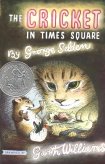
The Cricket in Times Square
By George Selden
Spanish Edition Also Available
After Chester lands, in the Times Square subway station, he makes himself comfortable in a nearby newsstand. There, he has the good fortune to make three new friends: Mario, a little boy whose parents run the falling newsstand, Tucker, a fast-talking Broadway mouse, and Tucker's sidekick, Harry the Cat. The escapades of these four friends in bustling New York City makes for lively listening and humorous entertainment. And somehow, they manage to bring a taste of success to the nearly bankrupt newsstand.
Description from Publisher
One night, the sounds of New York City--the rumbling of subway trains, thrumming of automobile tires, hooting of horns, howling of brakes, and the babbling of voices--is interrupted by a sound that even Tucker Mouse, a jaded inhabitant of Times Square, has never heard before. Mario, the son of Mama and Papa Bellini, proprietors of the subway-station newsstand, had only heard the sound once. What was this new, strangely musical chirping? None other than the mellifluous leg-rubbing of the somewhat disoriented Chester Cricket from Connecticut. Attracted by the irresistible smell of liverwurst, Chester had foolishly jumped into the picnic basket of some unsuspecting New Yorkers on a junket to the country. Despite the insect's wurst intentions, he ends up in a pile of dirt in Times Square.
Mario is elated to find Chester. He begs his parents to let him keep the shiny insect in the newsstand, assuring his bug-fearing mother that crickets are harmless, maybe even good luck. What ensues is an altogether captivating spin on the city mouse/country mouse story, as Chester adjusts to the bustle of the big city. Despite the cricket's comfortable matchbox bed (with Kleenex sheets); the fancy, seven-tiered pagoda cricket cage from Sai Fong's novelty shop; tasty mulberry leaves; the jolly company of Tucker Mouse and Harry Cat; and even his new-found fame as "the most famous musician in New York City," Chester begins to miss his peaceful life in the Connecticut countryside.
The Cricket in Times Square--a Newbery Award runner-up in 1961--is charmingly illustrated by the well-loved Garth Williams, and the tiniest details of this elegantly spun, vividly told, surprisingly suspenseful tale will stick with children for years and years. Make sure this classic sits on the shelf of your favorite child, right next to
The Wind in the Willows.
Description from Amazon.com
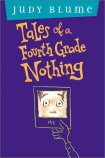
Tales of a Fourth Grade Nothing
By Judy Blume
Passed on from babysitters to their young charges, from big sisters to little brothers, and from parents to children, Tales of a Fourth Grade Nothing and its cousins (Superfudge, Fudge-a-mania, and Otherwise Known as Sheila the Great) have entertained children since they first appeared in the early 1970s. The books follow Peter Hatcher, his little brother Fudgie, baby sister Tootsie, their neighbor Sheila Tubman, various pets, and minor characters through New York City and on treks to suburbs and camps.
Tales of a Fourth Grade Nothing is the first of these entertaining yarns. Peter, because he's the oldest, must deal with Fudgie's disgusting cuteness, his constant meddling with Peter's stuff, and other grave offenses, one of which is almost too much to bear. All these incidents are presented with the unfailing ear and big-hearted humor of the masterful Judy Blume.
Description from Amazon.com
Superfudge
By Judy Blume
Sometimes life in the Hatcher household is enough to make twelve-year-old Peter think about running away. His worst problem is still his younger brother, Fudge, who hasn't changed a bit since his crazy capers in Tales of a Fourth Grade Nothing. If you ask Peter, Fudge is just an older — and bigger — pain.
Then Peter learns that his mom is going to have a baby and the whole family is moving to Princeton for a year. It will be bad enough starting sixth grade in a strange place and going to the same school as Fudge. But Peter can imagine something even worse. How will he ever survive if the new baby is a carbon copy of Fudge?
Description from Publisher
Double Fudge
By Judy Blume
Fans of Superfudge and Fudge-a-Mania will welcome the return of seventh-grader Peter Hatcher and his five-year-old brother, Fudge, who in this comical caper meet distant cousins from Hawaii. The two families unexpectedly encounter one another in Washington, D.C., where the New York City Hatchers have gone so that Fudge, who has developed an obsession with money, can visit the Bureau of Engraving and Printing. The Howie Hatcher clan proves an eccentric lot. Twins Fauna and Flora, unironicially nicknamed the Natural Beauties, would be in Peter's grade if they weren't home-schooled; apt to break into corny songs at any moment, they perform together as the Heavenly Hatchers. Their younger brother, who shares Fudge's real name (Farley Drexel), acts like a dog, growling and licking people. And their father won't stop calling Peter's dad "Tubby." Narrator Peter grits his teeth when the Honolulu Hatchers invite themselves to Manhattan to stay in his family's cramped apartment, where nestled in their sleeping bags on the living room floor they "slept flat on their backs, like a row of hot dogs in their rolls. All that was missing was the mustard and the relish." The boy is further appalled when the twins show up at his school and convene an assembly so that they can sing. Peter's wry reactions to the sometimes outsize goings-on, Fudge's inimitable antics and the characters' rousing repartee contribute to the sprightly clip of this cheerful read.
Description from Publishers Weekly
A worthy successor to Superfudge and Fudge-a-Mania. Peter Hatcher is now entering seventh grade and apprehensive that no one will remember him since his family spent the past year in Princeton, NJ. Five-year-old Fudge is obsessed with money-acquiring it, talking and singing about it, and counting it. He even creates his own currency, Fudge Bucks. To try to curb this fixation, the family takes a trip to Washington, DC, to visit the Bureau of Printing and Engraving, and runs into Mr. Hatcher's long-lost cousin. Howie, his wife Eudora, twin daughters Flora and Fauna, and four-year-old son Farley are traveling through the East Coast before moving to Florida. Of course, a visit to New York City is in their plans. A few weeks later, the relatives arrive and set out their sleeping bags. Two nights turn into four, then seven, and then Howie announces that he is subletting an apartment in the building for six weeks. It is a tough time for Peter, culminating at Halloween when Fudge and Farley are trapped in the building's elevator while trick-or-treating. Peter is a real 12-year-old with all the insecurities and concerns of that age. And nothing can suppress the personality of Fudge, who even renames Washington, Fudgington.
Description from School Library Journal

Harriet the Spy
By Louise Fitzhugh
Nickelodeon Movie Version Also Available
Harriet M. Welsch is a spy. In her notebook, she writes down everything she knows about everyone, even her classmates and her best friends. Then Harriet loses track of her notebook, and it ends up in the wrong hands. Before she can stop them, her friends have read the always truthful, sometimes awful things she’s written about each of them. Will Harriet find a way to put her life and her friendships back together?
Description from Publisher
Thirty-two years before it was made into a movie, Harriet the Spy was a groundbreaking book: its unflinchingly honest portrayal of childhood problems and emotions changed children's literature forever. Happily, it has neither dated nor become obsolete and remains one of the best children's novels ever written. The fascinating story is about an intensely curious and intelligent girl, who literally spies on people and writes about them in her secret notebook, trying to make sense of life's absurdities. When her classmates find her notebook and read her painfully blunt comments about them, Harriet finds herself a lonely outcast.
Fitzhugh's writing is astonishingly vivid, real and engaging, and Harriet, by no means a typical, loveable heroine, is one of literature's most unforgettable characters. School Library Journal wrote, "a tour de force... bursts with life." The Bulletin of the Center for Children's Books called it "a very, very funny story." And The Chicago Tribune raved, "brilliantly written... a superb portrait of an extraordinary child."
Description from Amazon.com
Harriet Spies Again
By Helen Ericson
Harriet M. Welsch has just received the best news of her eleventh year—Ole Golly is coming back! Harriet can still remember how sad she was when her beloved nanny married George Waldenstein and moved away. But the circumstances of Ole Golly’s return remain unclear. Where is George Waldenstein?
With Mr. and Mrs. Welsch living in France for three months, Sport confiding that he has a crush on a girl at school, and the arrival of a mysterious new neighbor, who’s going to require a whole lot of spying, Harriet already has her hands full. Then she overhears Ole Golly saying she’s innocent—but innocent of what? Harriet the Spy is on the case and ready to help Ole Golly in any way she can.
Description from Publisher
Purists may shudder, but Harriet the Spy is back--even though her original creator, Louise Fitzhugh, is long gone. Author Helen Ericson has developed an intriguing new episode in Harriet's life for her latest fans, many of whom were introduced to Harriet the Spy--the book--only after the movie.
When Harriet's former nurse, Ole Golly (who went off to live in Montreal last year after getting married to Mr. George Waldenstein), temporarily returns to her old post in the Welsch household, Harriet is deliriously happy. Unfortunately, Ole Golly is not acting like her brisk, no-nonsense self at all, and Harriet has been instructed to "expunge" the husband from her memory. What's up? This looks like a job for our girl sleuth extraordinaire! Side plots involving Harriet's friend Sport's impending puberty and a mysterious new neighbor keep things moving along at a rapid pace, but there's no denying it: it's just not the same. Ericson captures much of Harriet's essence, but she seems to be trying too hard. And the denouement (fairly easy to figure out early on) is downright odd. Still, for those who are hungering for more Harriet, this taste serves as a nice little snack.
Description from Amazon.com
With the approval of Louise Fitzhugh's (author of Harriet the Spy) estate, Ericson revisits the life of Harriet M. Welsch and the executors' trust was well placed. An author's note reports that Ericson became a fan when this self-styled young spy first appeared in 1964, and her affection for the feisty character comes through in this new misadventure. Even the young detective's fascination with words and her inclination to write her notebook entries in CAPITAL LETTERS endures. When Harriet's parents leave Manhattan to spend three months in Paris, her former nanny, "Ole Golly," returns from Montreal (where she had moved with her new husband) to stay with the soon-to-turn 12-year-old. Though Harriet's mother warns her that Ole Golly has asked that no one mention her husband's name, the curious sleuth sets out to discover what transpired in Montreal. Harriet, while eavesdropping, believes she hears Ole Golly announce that she's innocent, which leads the girl to conclude that the nanny accidentally killed her husband. Meanwhile, another mystery percolates in the townhouse across the street, where husband-and-wife doctors appear to be keeping a girl captive. As Harriet doggedly attempts to crack these cases, her processing of misinformation makes for some comical scenarios. Although the novel does not plunge directly into the mystery (as Fitzhugh's works did) and a few sluggish subplots including Harriet's creation of a timeline of her life bog down the pace, overall Ericson has shaped a spirited tale and gives her follow-up to Fitzhugh's novels a fittingly timeless feel.
Description from Publishers Weekly
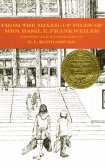
From the Mixed-Up Files of Mrs. Basil E. Frankweiler
By E. L. Konigsburg
Awards:
- Newbery Medal 1968
When Claudia decided to run away, she planned very carefully. She would be gone just long enough to teach her parents a lesson in Claudia appreciation. And she would go in comfort-she would live at the Metropolitan Museum of Art. She saved her money, and she invited her brother Jamie to go, mostly because be was a miser and would have money.
Claudia was a good organizer and Jamie had some ideas, too; so the two took up residence at the museum right on schedule. But once the fun of settling in was over, Claudia had two unexpected problems: She felt just the same, and she wanted to feel different; and she found a statue at the Museum so beautiful she could not go home until she bad discovered its maker, a question that baffled the experts, too.
The former owner of the statue was Mrs. Basil E. Frankweiler. Without her-well, without her, Claudia might never have found a way to go home.
Desciption from Publisher
Claudia is bored. She's ready for a big change, but wants to make sure she does it with style. When she decides to run away, Claudia plans to be a runaway with specific goals: to be comfortable, to be changed, and to be appreciated at home. She carefully appoints a partner (her younger brother), and selects a destination (The Metropolitan Museum of Art), but there are some adventures you simply can't plan in advance. Claudia and her brother Jamie are soon embroiled in an artistic mystery even the experts can't solve, but discovering a solution to this puzzle might just help Claudia find the answer to her personal quest.
Konigsburg's unique story, compelling style, and distinctive line drawings make this Newbery Medal-winner a book readers won't want to put down. Especially for children on the cusp of adolescence, Claudia's desire to be someone and her corresponding search for identity will ring true for those searching for their true selves.
Description from Amazon.com
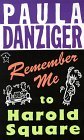
Remember Me to Harold Square
By Paula Danziger
This summer could be a disaster. Kendra's parents have invited Frank, a 15-year-old she's never met, to stay with them. And they've planned a goofy scavenger hunt for the kids, including Kendra's bratty younger brother. They have to race all around New York City and visit places like the Empire State Building and the United Nations to find answers. But once they get started, Kendra doesn't mind the scavenger hunt so much, mostly because Frank turns out to be just as interesting as all of the sights.
Description from Publisher
Danziger celebrates New York City in this story of a teenage girl (the only one of her gang spending the summer in the city), her brother Oscar (O. K.to his friends, age 10) and Frank Lee (he's 15, from a Wisconsin farm), who all embark on a six-week-long scavenger hunt devised by their parents. The threesome, nicknamed The Serendipities, are being offered, according to their parents, "an absolutely, wonderful, marvelous educational experience in which they will search for objects, facts, people, and places." If they complete the contract, the grand prize is a trip to England for the two families. With characteristic humor, tart language and quick phrasing, Danziger's teenagers not only share a summer getting to know each other but also explore the riches of a city often perceived as dirty and dangerous.
Description from Publishers Weekly
Kendra Kaye, 14, is not looking forward to spending the summer in New York City with her bratty little brother, Oscar (O.K.)until her parents announce that a 15-year-old farm boy from Wisconsin is going to live with them for the summer. Both sets of parents scheme up a scavenger hunt for the three kids which forces them to explore all of Manhattan. Frank turns out to be a good-looking guy (with a girlfriend back home), and the three set out to have a good time seeing the sights of New York City. By the end of the summer, Frank's girlfriend dumps him, and his and Kendra's friendship has grown to a very close relationship. Danziger has scored a hit again with her realistic characters, believable dialogue, and smooth style. As in This Place Has No Atmosphere, she makes good use of puns and seems to have fun in developing her characters. It's refreshing to read a book whose characters develop a special friendship without the subject of sex intervening. Readers will also learn many facts about New York City (through the scavenger hunt); Danziger incorporates these into the story without making it too heavy. An entertaining story.
Description from School Library Journal

Harry Kitten and Tucker Mouse
By George Selden
Meet Harry Kitten and Tucker Mouse. No one would ever dream that a cat and mouse could become friends, but that doesn't stop Harry and Tucker.
All they have is each other to depend on. Together they begin an exciting adventure throughout New York, searching for a home they can call their own. But the two friends run into some troublesome times in their journey around town. Is all hope lost? Where will they turn to next?
Description from Publisher
A tiny New York City mouse longs for a name and a home, finds both, and makes a friend. This early history of Tucker Mouse and Harry Kitten, that well-loved couple from
The Cricket in Times Square and other books, will attract new, younger readers in this attractive large format book. The story is not as compelling reading as the first books, but never mind. For example, Tucker and Harry become friends at Harry's encouragement in order not to make life worse for each other by fightingphilosophically admirable, but dramatically ineffective. However, in the end the two show their old moxie in an exciting confrontation with three tough rats. Dialogue, rather than action, is at the fore, which limits the book's movement. It's a little slow, but children should still enjoy the characters; the pictures in the familiar Williams style, beautifully inked and sharply contrasted against the milky-bright pages with wide margins and eye-easy type; and the humorous dust jacket.
Description From School Library Journal
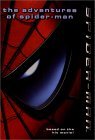
The Adventures of Spider-Man
By Michael Teitelbaum
When a genetically enhanced spider escapes from a laboratory cage and bites Peter Parker, his normal teenaged life is transformed. Suddenly, Manhattan has its own superhero -- one that can climb walls, soar through the air, and shoot spider-webbing from his hands! But danger lurks in the streets of the city -- the Green Goblin wants to take over the world, starting with New York City! Can Spider-Man keep the city safe? Or will the Green Goblin squash him like a bug?
Description from Publisher
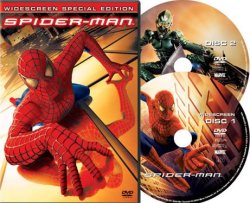
DVD Also Available
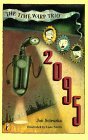
2095
By Jon Scieszka
Zapped into the 21st century by The Book, the Time Warp Trio find that their future is definitely worth waiting for. Actually, waiting forever would be okay: 3-D ads attack them on the street, ray-gun toting robots demand their ID numbers--or else. And a meeting with their great-grandkids could knock out the old family tree at the roots. Will the trio's future mix-up wipe out their past?
Description from Publisher
This installment of the adventures of the Time Warp Trio has Fred, Joe and Sam blasting into the future when they get bored during a class trip to the museum. They find themselves ill-prepared for the future-they don't know how to evade the Sellbot threatening them with its laser, they don't have antigravity disks, and they aren't dyed unusual colors like the other New Yorkers they find. At least Ray's Pizza is the same. How will they return to 1995? And who are those three girls who keep chasing them? Each chapter ends in a cliffhanger that will urge the most reluctant reader to forge ahead.
Description from Children's Literature
The Time Warp Trio is back--to the future, this time, as Joe, Fred, and Sam travel to the year 2095, again courtesy of Uncle Joe's magic book. Launching their trip from the 1920s room in the Natural History Museum, the boys arrive in the future's museum, where they see the 1990s showcased in an exhibit of the past. Such ironies of time travel abound as the three encounter their great-grandchildren, who rightly strive to return their ancestors to the past. Scieszka writes with a kid's perspective at all times, blending a warp-speed pace with humor that ranges from brainy riddles to low brow upchuck jokes. Although the plot is a bit thin and meandering, readers will find sufficient distraction in the robots and levitation footwear of the future. Smith targets the audience equally well with black pencil illustrations brimming with zany, adolescent hyperbole.
Description from Booklist
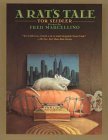
A Rat's Tale
By Tor Seidler
Montague Mad-Rat lives a solitary existence in the sewers of New York City. His only delights are scavenging in Central Park for feathers and berries for his mother, and painting the seashells his aunt brings him. One day, he rescues the beautiful Isabel Moberly-Rat and, upon escorting her home, is introduced to a world he never knew existed. For she lives at the wharves, in a spacious crate, among rats who look down on those--like him--who make things with their paws. Suddenly Montague is ashamed. So when he hears about the campaign to save the wharves from human destruction, he does all he can to help. But how much can one rat really do, especially when he's an outcast?
Description from Publisher
Set on the wharfs and in the sewers of New York City, this story features young Montague Mad-Rat, a rat among rats in one of the most original, imaginative stories to appear this season. Montague, painfully shy, spends his days collecting feathers and berries for his mother to make hats from; he also paints tiny, exquisite pictures on seashells brought to him by his seafaring aunt. Montague's adventure begins when he rescues Isabel Moberly-Rat from nearly drowning in a gutter. Escorting her home, he learns that her exclusive address (Wharf 62) and family name (her father is one of ratdom's leading citizens) are far superior to his ownhe hadn't realized that some rats were "better" than others. Meanwhile, the whole rat population is being threatened with extinction from poisoning, thanks to a land-development scheme. Mr. Moberly-Rat organizes a massive RRR campaign (Raising the Rat Rent)a ransom to the humans so they'll stop the poison. Teaming up with his uncle Monty (a drunken outcast from rat society), Montague embarks on a courageous quest among humans to raise the money, and in the bittersweet finale saves the kingdom and wins the girl. Beautifully told, Seidler's fantasy never falters; it's a love story, a coming of age tale and a grand adventure. all rolled into one. Marcellino makes his debut in children's books; his wonderfully understated pencil drawings add humor and much atmosphere to the tale. If readers can get past the fact that the book's hero is a sewer rat (a not immediately lovable creature), or if they aren't bothered by the crowd scenes (the thought of a million rats gathered in Central Park may make some readers squeamish), they'll be treated to a memorable story. Adults will appreciate its humor and biting social commentary, though the subtleties won't be lost on young readers.
Description from Publishers Weekly
This whimsical adventure tale with a moral underpinning introduces Montague Mad-Rat, a young rat living with artistic and absent-minded parents in the sewers beneath New York City. His sheltered life is changed when he finds that the huge population of his fellow rats occupying the abandoned piers at the waterfront are in danger of total extermination; the crisis makes him doubt his self-worth, even as he tries to cope with the further discovery that a drunken uncle of his has made their name a standing joke in the rat world. Little does he realize that the salvation of ratdom depends on his own unappreciated talents as well as the despised uncle. The gentle satire of the charming story casts familiar human foibles in rodent form (his potential girlfriend's pleasingly plump mother has taken up petal arranging to take her mind off cheese), and there are some poignant scenes. Although seemingly light entertainment, the novel tackles such topics as death, strength of character, and self-acceptance, and handles them well. The book is handsomely designed, with clean bordered pages of text and expressive illustrations in tones of gray to complement Seidler's well-delineated characters.
Description from School Library Journal
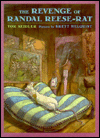
The Revenge of Randal Reese-Rat
By Tor Seidler
Sequel to A Rat's Tale.
In A Rat's Tale, Montague Mad-Rat saved the day for the wharf rats of New York City and won the affection of the she-rat of his dreams, the lovely Isabel Moberly-Rat. All ratdom hailed Montague as a hero — except for the rat whose story is at the center of this captivating sequel. A rodent of impeccable breeding and exquisite personal hygiene, Randal Reese-Rat is mad with jealousy, believing Montague has stolen his former bride-to-be. His jealousy is no secret on his wharf, and when an unthinkable crime is perpetrated against Izzy and Monty on their wedding night, Randal is the prime suspect. Now on the lam, with a price on his head and thugs on his tail, Randal involves secret friends of his in a perfect and horrible revenge on the whole rat colony, Izzy and Monty included. But his plans are hopelessly complicated when a new rat enters his life, an exotic she-rat who also happens to be the cousin of his nemesis, Montague.
Description from Publisher
The story opens in Africa, where Aunt Elizabeth has traveled to bring her daughter, Maggie, to New York City for the wedding of her cousin, Montague. Monty became a hero in the inaugural novel when his hand-painted seashells fetched a handsome sum, large enough to save the rodent community's wharf. On the wedding night of Monty and his fetching bride, Isabel, an arsonist sets a fire in their home and Randal Reese-Rat is the chief suspect. A "citywide rathunt" ensues, and the jealous (and, as it turns out, innocent) Randal seeks revenge on the rat community that has turned against him.
Description from Publishers Weekly
In this sequel to A Rat's Tale, Montague Mad-Rat is to be married to Isabel Moberly-Rat as soon as his aunt and cousin arrive from Africa. The wedding is a grand affair, but Randal Reese-Rat, Isabel's old beau, is consumed with jealousy, so when an arson fire nearly kills the newlyweds, everyone is certain that Randal is the culprit. The simple yet evocative language and the warmly depicted characters make this fantasy a delight. Randal's obsession with wild animals reveals unsuspected depths to his soul, and Cousin Maggie's songs are funny and touching. The many black-and-white illustrations, full of detail, make it clear that these lithe, sociable New York rodents have busy lives and unique personalities. This chronicle of their adventures is sure to win new fans and please old ones.
Description from School Library Journal
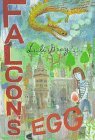
Falcon's Egg
By Luli Gray
Awards:- ALA Notable Book
- School Library Journal's Best Books of the Year
An enchanting world of secrets and magical creatures awaits readers in this charming story that begins with 11-year-old Falcon's happening upon a very unusual egg in Central Park. Knowing her mother would never let her keep it, Falcon confides, instead, in her neighbor Ardene Taylor and her great-great-aunt Emily, whose ornithologist friend soon becomes involved. The suspense builds as the four gather in Ardene's apartment every chance they get to keep watch on the egg, speculating about when, or if, it will hatch, and what kind of creature is inside. Not quite halfway through the book, the egg hatches, but the remainder of the story isn't anticlimactic. Actually, it's after the hatching that the adventure really begins. Gray has created a magical fantasyland of such realism that children will easily slip inside along with Falcon and linger even after the final page of the book has been turned.
Description from Booklist
When eleven-year-old Falcon finds a glowing red egg in Central Park, she decides to keep it. Falcon's book-illustrator mother is none too dependable, especially when a deadline looms, and so Falcon enlists the help of her great-great-aunt Emily, as well as one of her neighbors and an ornithologist at the Museum of Natural History - who comes in handy when what hatches out of the egg is a dragon. Falcon also acts as mother to her little brother, Toody, so she must work to balance caring for both Toody and Egg . As Egg grows, the adults around Falcon rally to provide her with the care and support she needs. The book ends on a note of parallel maternal love - as Falcon loves Egg, so her mother loves Falcon. Any tale of a resourceful girl living in New York City and aided by a collection of eccentric adults brings to mind E. L. Konigsburg's stories, but Falcon's struggle to raise and keep Egg - and, finally, to let Egg go - is wholly her own.
Description from Horn Book
Targeted to middle-grade children, this novel will intrigue them with a mythic creature who is the story's the centerpiece. The heroine, Emily Falcon Davies, has resiliently made her own path to compensate for her illustrator-mother's benign neglect. Falcon steers her younger brother Toody and herself through Manhattan locales, finding nurture from respectful adults who understand her needs and growing pains. One day she discovers a warm egg in Central Park that hatches into a dragon. Much intrigue and organizing is needed to hide a dragon in New York. As the hatchling grows, it must be moved continually and its ever-increasing appetite and need to fly become problematic. Falcon juggles the magic of the secret dragon with an unsatisfying school life, becomes closer to the adults who partake with her in the mystery of watching a dragon's life unfold, and finally, struggles to let the dragon live its own life. The story blends reality, myth, and magic in a plausible way.
Description from Children's Literature
A compelling rite-of-passage tale that moves right along to a satisfying conclusion. It's not unusual for a falcon to have an egg unless Falcon is an 11-year-old girl in New York City and the egg is red, hot, and discovered in Central Park. Falcon enlists the help of an older friend and neighbor to hide it until it hatches, fearing that her mother won't let her keep it. Soon elderly Aunt Emily; her ornithologist friend, Fernando Maldonado; and Falcon's younger brother join the cozy group that gathers to ponder the egg. When Egg hatches, she is a dragon. A solution to where she is to live works for a while, but in time Falcon realizes that Egg has to be free to look for others of her kind if indeed there are any. Each of the characters is rich in wit, wisdom, and human foibles. Clearly Falcon needs a little magic in her life as her artist mother is often totally absorbed in her work and the girl has to take responsibility for the household and her brother. Egg is the magic she needs but must give up. Though for a younger crowd than Anne McCaffrey's dragon books, this one is equally enticing and leaves readers longing for just a few minutes with a dragon. The real world blends well with the fantasy elements as tidbits of lore and locale are woven seamlessly. A book for any library serving young readers and dreamers.
Description from School Library Journal
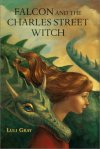
Falcon and the Charles Street Witch
By Luli Gray
Since Egg flew off into the night more than a year before, Falcon fears she will never see her dragon again. Her mother wants to forget that Egg ever existed and her father never believed in dragons at all. But the magic finds Falcon again. First she leaps out of a plane after her younger brother, Toody. Then, blown to safety on a current of dragonsbreath, Falcon lands in an enchanted garden on Charles Street in New York City where she is greeted by the wonderfully peculiar Blinda Cholmondely. With the help of an ancient doggerel-spouting dragon named Dirus Horribilus, the rakish Saint George, and the astonishing Charles Street Witch, Falcon sets out to rescue Toody. In this rollicking tale of adventure and surprise, not only will Falcon see her beloved Egg again, she will also discover her own extraordinarily courageous self.
Description from Publisher
When 12-year-old Falcon and her little brother fall out of a jumbo jet, Falcon wafts down to the residence of Ms. Cholmondely (pronounced Chumley), a witch who helps her locate Toody. He has ended up in Australia with a young dragon named Egg, previously introduced in Falcon's Egg. The girl's efforts to fetch her sibling are complicated by Dirus, a sleepy old rhyming dragon; an accidental detour to an alternate New York City where animals talk; and the discovery of Egg by a horrified world. Except for the inexplicable airplane accident and an unconvincing confrontation with a bad guy at the end, this fantasy flows smoothly, with plenty of eccentric characters and interesting situations. Ms. Cholmondely's unique brand of slapdash magic and Egg's habit of speaking solely in mangled Shakespearean quotes will delight readers, but probably won't engage their emotions. A fun and fast read for fantasy fanatics.
Description from School Library Journal
In Falcon's Egg, young Falcon released Egg, the baby dragon who hatched under her care, into the skies over New York City. Now, a year later, Falcon and her little brother, Toody, are returning from visiting their dad in Australia when Toody's desperate need for the airplane bathroom leads them to meet up again with Egg in a most unusual way. Of course, much is unusual about this lively and unsentimental fantasy in which a witch on Charles Street in Greenwich Village works spells that go awry in pleasing ways and a dragon's fart can color sunsets for weeks. Egg herself speaks mostly in mangled Shakespearean quotes (correct ones appear at the end); distracted parents, cynical TV anchors, and a fair amount of trans-oceanic dragon travel come in for arch description. Wordplay abounds, mirth runs free, and gentle skewering is the order of the day. It will delight readers who want to know what happened to Falcon's Egg, and charm those new to the characters.
Description from Booklist
n a sequel to the beguiling Falcon's Egg, Gray continues her sweetly old-fashioned fantasy about a girl and her dragon. After a visit to their divorced father in Australia, 12-year-old Falcon and her little brother Toody are saved by Egg, Falcon's erstwhile pet dragon, from what could have been a tragic (if implausible) accident. When Falcon turns to an ingratiatingly eccentric witch and another (elderly) dragon to locate her accidentally mislaid brother, the misadventures begin. Falcon and company are swept off to a fantastic alternative New York, while her father and his aboriginal allies attempt to protect Egg from the triple menace of sightseers, the military, and (most sinister) a blowhard talk-show host. Eventually, the villains are routed, the grownups learn to believe in magic, and serious-minded Falcon achieves a new degree of self-confidence. Leavening a riotous imagination with a delightful practicality (flying dragonback still requires bathroom breaks), and chock-full of allusions to children's and world literature (the dragons speak in mangled classical quotations), Gray's style is reminiscent of the lighthearted charm of Edward Eager. But lacking his subtly dark infrastructure, the author's fluffy souffle of a plot eventually collapses under the weight of its own whimsy, degenerating into a confusing anticlimactic confrontation and lowbrow jokes about dragon flatus. Still, Falcon is an engaging heroine, and middle-school readers will no doubt look forward to her further adventures. Sources for the quotations, along with a cookie recipe, are included in the endmatter.
Description from Kirkus Reviews
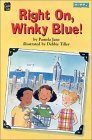
Right On, Winky Blue!
By Pamela Jane
Illustrated by Debbie Tilley. Rosie is thrilled when her pet parakeet, Winky Blue, wins a talk show quiz on WFUN radio show in New York City. But when her beloved bird is disqualified and her best friend's pet gerbil gets stranded on top of the Empire State Building, it looks as though Rosie's hopes -- and Cinnamon the gerbil, are in for a big fall!
Description from Publisher
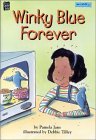
Winky Blue Forever!
By Pamela Jane
Rosie plans to make her parakeet Winky Blue famous forever through a series of television commercials, but her hopes are crushed when he is lost on the way into New York City.
Description from Publisher

P.C. Hawke Mysteries #1
The Scream Museum
By Paul Zindel
P.C. Hawke and his partner-in-sleuthing, Mackenzie Riggs, are shocked to learn that their friend, Tom, a custodian, is accused of murdering the chief biologist at the Museum of Natural History. As P.C. and Mackenzie dig deeper into the strange story, they discover a stolen world-famous necklace, an anthropologist trained in Indonesian medicine and hypnosis, and a fat, hairy tarantula named Aristotle.
Description from Publisher

P.C. Hawke Mysteries #4
The Lethal Gorilla
By Paul Zindel
P.C. Hawke is a 15-year-old high-school student cum private detective. He gets access to murder cases through his best friend and detective partner, Mackenzie Riggs, whose mother is the New York City coroner. This new P. C. Hawke mystery involves the death of a much-hated celebrity scientist at the Bronx Zoo. The victim was first chewed on by a jaguar and finished off with a transfusion of gorilla blood. In the course of their investigations, P. C and Mackenzie are menaced by a dominant silverback gorilla, chased by a madman with a titanium machete, and cornered by a group of jaguars before they are rescued and solve the crime. P. C. describes all of this in a first-person voice that combines contemporary teen jargon with the traditional, super-cool delivery of the hardboiled detective. The contrivances may disappoint some readers, but the exotic zoo setting and exciting action scenes will hook others.
Description from Booklist

P.C. Hawke Mysteries #5
The Square Root of Murder
By Paul Zindel
When aptly named calculus teacher Professor Dunaway is found pinned to her chalkboard by a crossbow bolt, amateur sleuth P. C. Hawke and sidekick Mackenzie Riggs, already in a "freakazoid frame of mind," find themselves up against both a clever killer and an obtuse police lieutenant with zero sense of fashion. Zindel's plot won't hold water for a moment, but he piles on suspects and red herrings, sends Hawke and Mac from the Bronx to JFK Airport hunting clues, throws in an embezzlement scheme to further muddy the waters, and brings the investigation to a suspenseful climax with a wild, spooky chase through an unlit classroom building basement. P. C. narrates, but Mac has an equal and active role in this helter-skelter whodunit, aimed at Hardy Boys/Nancy Drew grads.
Description from Booklist
Once again, P. C. and his friend Mackenzie stumble into a murder and onto the murderer. When their nasty calculus teacher at Columbia University is pinned to the blackboard with an arrow shot from a crossbow, the two friends begin to investigate their eclectic collection of classmates. Some attend the college, but others, like Mac and P. C., are high school students taking advanced classes. A visit to a medieval weaponry collector's makeshift torture chamber, a careening taxi ride across New York City, and the final, hair-raising chase through the darkened halls of the university add excitement to this basic whodunit.
Description from School Library Journal

P.C. Hawke Mysteries #7
The Gourmet Zombie
By Paul Zindel
The most famous chefs in New York are dropping like flies—each seeming to die accidentally. But P.C. and Mac notice a bizarre connection: every one has met his maker courtesy of his signature dish! Who is killing the cooks of Gotham, and, whats more, will there be a decent cook left alive to cater P.C. and Mac's joint sixteenth-birthday bash?
Description from Publisher
P. C. and his friend Mackenzie live in Manhattan and solve murder cases in their free time. In this installment in the series, the 16-year-olds happen upon several classy New York chefs who seem to be dropping dead in very peculiar ways. The sleuths manage to solve the crimes in a single weekend, beating the cops to the punch. Teens should be thrilled with the freedom these kids have. School is still in session, yet they have no homework, and their parents are nonexistent. However far-fetched the story line might be, it makes good escapist fare for preteens and reluctant older readers. It's fast paced, and the heroes win in the end.
Description from School Library Journal
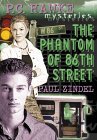
P.C. Hawke Mysteries #8
The Phantom of 86th Street
By Paul Zindel
Serena hasn't been herself lately. She has been having sudden lapses of memory and acting like a completely different person — one she doesn't like very much. To add to her confusion, she knows that someone has been following her. It all started the night an elderly woman helped her. Now Serena is beginning to wonder, who was that woman? And what has she done to Serena?
Description from Publisher
The School Story
By Andrew Clements
Don't mess with Zee Zee Reisman from the Sherry Clutch Literary Agency. Especially when she's promoting the hot new novelist Cassandra Day. New York's publishing scene is familiar with tough players like Zee Zee, and impressed by the book she's pushing... but stunned when they find out Zee Zee and Cassandra are both 12-year-old girls. Zee Zee is really Zoe, fiercely loyal and self-assured best friend to Natalie Nelson, a.k.a. Cassandra Day. When Natalie writes a story, a really good story, Zoe is determined to let the whole world know. Using her formidable wits and all the resources available to a well-to-do New York City girl, Zoe, along with their timid English teacher, Ms. Clayton, proceeds to chip away at the challenge. The catch? The editor Natalie wants happens to be her own mother, an editor at Shipley Junior Books. But Natalie wants her authorship to remain a secret to her mom so that she'll get a fair shake. What ensues is a masterfully elaborate plot to get the manuscript in the right hands--and away from the arrogant, unfriendly editor in chief.
A highly original plot with plenty of intriguing side stories makes this a thoroughly satisfying read, especially for future novelists, agents, and editors. The publishing world is explored in just enough detail to gently banish romantic notions, but not to quell enthusiasm. The subplot around Natalie's father, who died four years earlier, is an almost silent but strong undercurrent to the story. This graceful and enjoyable novel from Andrew Clements (the bestselling author of The Janitor's Boy, Frindle, and The Landry News) is illustrated with rather gloomy, yet strangely funny black-and-white drawings from Brian Selznick.
Description from Amazon.com
Clements's (Frindle) absorbing novel centers on Natalie, a 12-year-old aspiring author who, since her father died in an automobile accident, lives alone with her mother, Hannah, a children's book editor for a New York City publisher. As the book opens, Natalie's best friend, Zoe, is reading the novel that Natalie is writing. The impulsive, take-charge Zoe decides it is good enough to be published and hatches a scheme to ensure that it is. The path from manuscript to bound book takes some funny turns, as the girls elicit the aid of their English teacher, who rents office space that serves as the faux headquarters of Natalie's self-appointed agent: Zoe. Clements strikes a poignant note with his plot within a plot, since the youngster's novel tells of a girl whose father stands up for her always even when she is caught cheating in school. Through the use of alternating perspectives, he characterizes the two seventh graders as very different but equally likable parties in a "push-and-pull friendship." Though Natalie's is, indeed, a "school story," it is at heart a tale about the love between a father and daughter. In Zoe's eyes, "the book was like a good-bye poem from Natalie to her father," whom she misses enormously. Hannah, explaining to Natalie how she can recognize the rare gem of a manuscript among the many submissions she receives, says, "The good ones stand out like roses in a snowbank." This is one such standout.
Description from Publishers Weekly

One Small Dog
By Johanna Hurwitz
The prolific author of humorous, easy chapter books offers a serious commentary on the subject of dog ownership. Fourth-grader Curtis has always wanted a pup, and after his parents file for divorce, his mother reluctantly agrees. They visit an animal shelter, where Curtis selects a small, black, friendly-looking cocker spaniel. Unfortunately, things go badly from the start. Sammy chews up Curtis' new sneakers, creates a disturbance at Dad's apartment (where dogs are forbidden), and bites anyone who tries to take food away from him. Finally, Mom concludes that Sammy must go, and a sadder-but-wiser Curtis (sporting 10 stitches in his hand) agrees. Hurwitz, who knows her audience well, manages to make her point without ever becoming didactic. Kids are sure to appreciate the story's many lighter moments, too, such as Sammy, hidden in a canvas bag, barking loudly in a New York City taxi. This will be popular with Hurwitz's fans and parents of readers who are convinced that a dog will fix everything. A note from dog trainer Larry Berg explains what went wrong.
Description from Booklist
Not your usual boy-and-his-dog story, this tale comes with a few hard-earned lessons about responsible pet ownership. Fourth-grader Curtis lives in an apartment with his recently separated mother and younger brother, Mitchell. To help compensate for the pending divorce, Curtis's mother goes against her better judgment and allows him to select a puppy from an animal shelter. The one he chooses turns out to be a chewer. Having owned the dog only two weeks, Curtis's mother decides they cannot keep Sammy after he bites her and Mitchell. While attempting to run away with his pet, Curtis is bitten. After six stitches, he realizes that his mother is right, and his father gives Sammy to a friend who has the time and patience to train him. Hurwitz's story has no happily-ever-after ending but makes a strong statement about the consequences of taking a responsibility too lightly. DeGroat's realistic drawings are a bonus. A good message for aspiring or prospective pet owners.
Description from School Library Journal

Maximum Boy
The Hijacking of Manhattan:
How I Became a Superhero
By Dan Greenburg
Max Silver is just an ordinary kid. Until one fateful day, he touched some radioactive space rocks in a museum. Now Max can do things most boys can¹t. Like fly. Still, it isn¹t easy being a superhero. Max¹s sister is jealous of the attention he gets. His father is determined to beat him at arm-wrestling. His mother just wants him to be in bed on time. And—uh, oh!—the President is asking him to save Manhattan!
Description from Publisher
Life as a superhero isn't as glamorous as one might think. In fact, Maximum Boy, a.k.a. Max Silver, sometimes thinks it's a big pain in the butt. His teenage sister is jealous, his dad's always bugging him to lift up the car when the jack is broken, and his mother just wants him to eat his veggies and get home early on school nights--even if Max is chained in a dungeon in Antarctica, being slowly squeezed and devoured by a python. Still, a superhero's gotta do what he's gotta do. And 11-year-old Maximum Boy, ever since he accidentally touched blue space rocks at the air and space museum, is definitely a superhero. He even belongs to the League of Superheroes (although he finds most of them snotty and gossipy). When the president of the United States calls Maximum Boy for help in saving Manhattan, which has been cut loose from the other boroughs and is being motored out to the middle of the Atlantic, this young hero is duty bound to lend a hand. But can he save the island from being flushed down the ocean? Max doesn't even like putting his face in the water.
Description from Amazon.com
Over the Wall
By John H. Ritter
Anger is a bombshell exploding. And for 13-year-old Tyler, the baseball field has become a battlefield laced with landmines. He tries to watch his step, but every time he thinks he has his temper under control, boom!, he winds up in a fight. If he isn't careful, his dreams of making the All-Star team and being noticed by a scout are going to blow up as well. But Tyler's coach isn't about to let that happen. A Vietnam War veteran, Coach Trioli has seen anger destroy enough people. He knows that Tyler is fighting a war that has no winner. And if Tyler is ever going to be the ballplayer he dreams of becoming, he'll have to learn to fight his battles with his glove, his bat, and his love for the game--not with his fists.
Description from Publisher
John Ritter follows his critically acclaimed debut novel, Choosing Up Sides, with Over the Wall, a metaphorically complex treatment of the Vietnam War, emotional alienation, rage, and the catastrophic familial effects of a child's death, all of which are played out in the uniquely American crucible of a baseball field. Thirteen-year-old Tyler Waltern, leaves his mother and distant father, emotionally shattered since the accidental death of Tyler's older sister some nine years earlier, to spend the summer in New York City with his uncle, aunt, and cousins. Tyler's considerable athletic prowess on a Central Park Little League team is overshadowed by his propensity for uncontrollable temper tantrums. A firm but sympathetic coach, the attention and help from his sagacious teenage cousin Brina, and several pilgrimages to the Vietnam War Memorial in Washington, D.C. contribute to Tyler's revelatory growth and redemption. Narrator Johnny Heller is superb and completely natural in his seamless boyish vocal execution of Tyler while also providing a mature dimension to the adult characters. An added bonus is the concluding interview with author who discusses, among other topics, the novel's multidimensional themes and structure. Imbued with passion, absolution, and grace, this beautiful story beautifully told is destined to become one of the year's best.
Description from School Library Journal
Pushcart War
By Jean Merrill
The pushcarts have declared war! New York City's streets are clogged with huge, rude trucks that park where they want, hold up traffic, and bulldoze into anything that is in their way, and the pushcart peddlers are determined to get rid of them. But the trucks are just as determined to get rid of the pushcarts, and chaos results in the city.
The pushcarts have come up with a brilliant strategy that will surely let the hot air out of their enemies. The secret weapon--a peashooter armed with a pin; the target--the vulnerable truck tires. Once the source of the flat tires is discovered, the children of the city joyfully join in with their own pin peashooters. The pushcarts have won one battle, but can they win the war against a corrupt mayor who taxes the pins and prohibits the sale of dried peas?
Description from Publisher

I'm Out of My Body... Please Leave a Message
(Zack Files)
By Dan Greenburg
Zack's friend Spencer suggests they try astral travel. But there's one problem with out-of-body travel: once you've been to the zoo, seen the Statue of Liberty and flown into your teacher's bedroom without taking your body along - how do you get back in?
Description from Publisher
Hang a Left at Venus
(Zack Files)
By Dan Greenburg
When Zack and his dad come upon an alien whose spacecraft is running on empty in Central Park, it's easy enough to find more fuel (mayonnaise!), but retrieving the craft from the NYPD is quite a different story!
Description from Publisher

Evil Queen Tut and the Great Ant Pyramids
(Zack Files)
By Dan Greenburg
While on a class picnic in Central Park, ten-year-old Zack gets a chance to study ants close up and personal when he uses way too much of a classmate's diet powder and shrinks to the size of an ant.
Description from Publisher
How I Went from Bad to Verse
(Zack Files)
By Dan Greenburg
When Zack is bitten by a tick during a class trip to Central Park he succumbs to Rhyme Disease, which causes him to speak only in rhymes and to float like a helium balloon.
Description from Publisher

Greenish Eggs and Dinosaurs
(Zack Files)
By Dan Greenburg
Oops! Zack's in trouble again! He buys a large, green, weird-looking egg at a flea market, then the housekeeper inadvertently does the exact thing she was told not to do: she microwaves it. Suddenly he's taking care of a very strange reptilian something. It might be a plesiosaur, it appears to be growing quickly, and one thing's for sure-it's not going to fit in Zack's small Manhattan apartment for long!
Description from Publisher
Yikes! Grandma's a Teenager
(Zack Files)
By Dan Greenburg
A trip to New York City to celebrate her 89th birthday--and participate in a Rockettes reunion at Radio City Music Hall--leaves Zack's Grandma Leah feeling younger than springtime. And she's looking that way too, since a strange trip through an airport metal detector turned back the hands of time and is making Grandma grow younger and younger!
Description from Publisher
The "Zack Files" include 18 different books. Each follows Zack, an eleven-year-old boy, as he tries to explain the strange and weird events that happen to his family. How can Grandma keep getting younger? It doesn't seem possible, but every morning she looks and acts younger than the day before. This can prove to be quite embarrassing when she visits Zack's classroom in a leather motorcycle jacket and a leopard printed miniskirt for Grandparents Day. Everyone else had normal-looking grandparents that look and act their age, but on this day, Zack discovers what Grandma was like as a teenager. She even gets sent to the principal's office for starting a food fight. Can this reverse aging be stopped? Discover how Zack gets Grandma back to her old self. I read this book to my class and they loved it. I even had a request to read another one in the "The Zack Files" series.
Description from Children's Literature

The Young Unicorns
By Madeleine L'Engle
A plot to rule New York City places the Austin family in terrifying danger.
Description from Publisher
Just Ask Iris
By Lucy Frank
There are many adjectives that could be used to describe Frank's (I Am an Artichoke) 12-year-old narrator, Iris Pinkowitz. Spunky, enterprising and braless (until she can earn enough money to buy the much-needed article of clothing) are just a few words that fit the bill. As the story opens, Iris has just moved from the Bronx to Manhattan with her Latina mother and older brother, Freddy; her father has stayed behind. She'll be starting a new junior high come fall; and she really needs to buy that bra soon. While she's supposed to be spending her summer learning to type in preparation for computer school, she instead climbs the fire escape outside her building in search of a particular cat. During her quest to find "Fluffy," Iris meets various neighbors and starts a business doing odd jobs for them. There's the Avon saleslady, Daisy, who needs Iris to baby-sit her grandchildren; Mr. Gordon, who wants his dog walked; the brutish Tattoo Man, whom Iris tries to avoid; Willy, a boy in a wheelchair with a chip on his shoulder; and the Cat Lady, an eccentric old woman on the top floor, who might be Fluffy's owner. Through hilarious and poignant moments, Iris adroitly charts her growing pains and her budding friendships. Packed with action, lively dialogue and engaging personalities, this slice of urban life is thoroughly entertaining.
Description from Publishers Weekly
Iris Diaz-Pinkowitz, her older brother, and their mother have recently moved to a new apartment in New York City. Two things are worrying the 12-year-old-she needs to start wearing a bra, but her mother is too busy working to take her shopping, and she needs to practice typing before beginning Computer School in the fall. One bright note in her life is the cat that has been visiting her every morning. One day, it doesn't show up. As she tries to find Fluffy, she hears about the Cat Lady who lives at the top of her building. Climbing up the fire escape (the hallways are too scary and the elevator is broken), she meets some of her new neighbors: 13-year-old Will Gladd, who is wheelchair-bound; Daisy Cuevas and her three grandchildren; elderly Luisa Serrano; and Yolanda Alvarez. And she finds Fluffy (along with dozens of other felines) with the Cat Lady. Iris starts "Just Ask Iris," an errand/dog-walking/baby-sitting service, and earns money to buy herself a bra. When the Cat Lady is threatened with eviction, Iris is able to get the apartment residents to pull together and stop the action. She is also instrumental in getting the long-out-of-service elevator repaired. Frank tells this appealing contemporary story with a light touch and plenty of humorous dialogue. She has created a likable, resourceful heroine who knows how to take care of business and how to be a good friend.
Description from school Library Journal
Iris and her family recently moved into a tall, narrow apartment house. Her mother won't let her out of the building so she finds her adventures on the "inside." Iris makes her way up the fire escape and meets a ferocious dog, Brutus (whom she tames with hot dogs and dog biscuits), Will, only a year older but in a wheelchair due to a car accident, the supervisor of the building, two families, and the cat lady¾an eccentric with cats too numerous to count. Because the elevator is broken, Will is stuck in his room, the dog on the sixth floor only makes it to the third landing to pee, and others don't want to climb up and down the stairs to get supplies. Iris also needs to earn money so she can buy a bra. She opens a business doing odd jobs such as running errands, baby-sitting and dog walking. This story is humorous and full of human drama and caring. In the end, all of the tenants pull together to clean up the cat lady's room, disperse the cats, trick the landlady and convince her to fix the elevator just in time for Will to start school.
Description from Children's Literature
My Chimp Friday: The Nana Banana Chronicles
By Hester Mundis
Inspired by a chimpanzee raised by the author in a Manhattan apartment, this diverting if outlandish story centers on a baby chimp who comes to live with sixth-grader Rachel Stelson's New York family. Not long after fidgety scientist Bucky Greene furtively drops off Friday in the middle of the night, and begs them to keep him for a week and to say nothing, Greene is reported dead. Rachel soon realizes that someone knows Friday is residing with the Stelsons and wants to get hold of the chimp. Mundis, a comedy writer, is at her best with descriptions of the chimp: Friday turns out to be prodigiously gifted. He quickly learns to play solitaire on the computer, solve Rubik's Cube and dial the phone. And he causes merry mayhem in the school gym and at a toy store on several occasions when Rachel sneaks him out of the apartment in her backpack. The plot grows goofier, linking Friday's intelligence to genetically engineered bananas and Greene's death to the evil motives of his bosses at the Bio-Allmeans research lab. Balancing the effective humor, a wistful undercurrent Rachel's mother died three years earlier fans into a bittersweet conclusion. A good choice for animal lovers.
Description from Publishers Weekly
An entertaining and heartfelt urban "Curious George" for middle-grade readers. When Bucky Greene unexpectedly drops off a chimp at the Stelsons' Manhattan apartment at 2 a.m. and instructs the family to keep the animal's presence a secret, they are confused, to say the least. The mystery deepens after the eccentric scientist who entrusted Friday to their care is found dead. Eventually, it is revealed that he was working on a genetically engineered banana that greatly increased the chimp's intelligence. Now, the man's enemies are after his prize creature. Rachel, 12, and her brother, Jared, 9, become increasingly attached to the animal that can solve a Rubik's Cube, play solitaire, and use a computer. The kids are determined to protect Friday and keep him as their own, but, in the end, they realize that the city is not the proper environment for him, and learn what it means to sacrifice for the good of another. As outlandish as this plot seems, the novel is based on the author's experience of raising a chimp in New York City. The ending is surprisingly poignant and will resonate with readers who have had to bid farewell to a cherished pet. With the right mix of adventure and humor, this tale is likely to be popular with independent readers and as a read-aloud.
Description from School Library Journal
When her dad's friend, an eccentric scientist, drops off a chimpanzee as part of a top-secret mission, Rachel Stelson and her family can't help but wonder what's really going on. But Friday the chimp steals his way into all their hearts with his loving ways, amazing antics, and apparently keen intelligence. They have fun with him as he enjoys MTV, gives the dog tummy rubs, makes a memorable guest appearance at school, and cavorts around with ape-like grace. Friday's unique attributes definitely have a down side: they've made him vulnerable to kidnapping by evil-minded corporate thieves. A couple of hair-raising kidnapping attempts ensue, and the action heats up in a suspenseful race to figure out who is trying to steal Friday and why. The bad guys lose, of course, and Friday goes on to greater achievements. Lots of readers will go ape over Friday and this fun read.
Description from Booklist
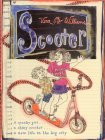
Scooter
By Vera B. Williams
Elana is thrilled to be living all the way up on the eighth floor of 514 Melon Hill Avenue, an apartment building in New York City. But with her new life come changes -- and challenges. Is her shiny scooter up to the crags and potholes of city sidewlks? Will she be able to make new friends? Can she find a way to help out little Petey, who everyone says doesn't talk? And will the kids from Melon Hill win any blue ribbons at the Borough-Wide Field Day? As Elana coasts toward discoveries and surprises in her new home, she keeps one thing in mind: Anything can happen as long as you have a winning attitude -- and a cool set of wheels!
Description from Publisher
Elana Rose Rosen describes her first "2 months + 1 week or 9 weeks + 6 days or...5,961,600 seconds" in Melon Hill, an urban complex where she and her mom share one-room apartment 8E. From the first day ("I don't know any of those kids...I'm not moping") to the Labor Day celebration when Elana and the kids she's gotten to know--plus her best friend/cousin, visiting from Toronto--shine in their individual ways, Williams builds a sense of a particular community with every casual-seeming detail. Many of these relate to little Petey, who has selfish, inept parents and has never spoken until he whispers an important message to Elana; to old Mrs. Greiner ("the Whiner"), who turns out to be lovable as well as capable; and to Elana's hard-working mom, who goes to school and holds down a job. The rough marginal illustrations, while credibly childlike, deftly capture both character and action; with creative dexterity, Williams also varies the format with lists, charts ("Diagram of the Zig Zag Day'' of trials and triumphs), healthful recipes (a soup from leftovers could be adapted to any refrigerator's contents), and succinct themes built on initials from chapter titles ("Petey": "Petey doesn't/Ever/Talk/Even when he wants to--/Y?"). Disarming in its apparent simplicity, an upbeat, innovative, delightfully engaging, and beautifully crafted first novel about everyday life in the inner city.
Description from Kirkus Reviews
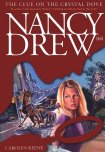
Nancy Drew:
The Clue on the Crystal Dove
By Carolyn Keene
A cunning thief is desperate to wreck the opening of a historic landmark -- and Nancy is his target! On Gramercy Park in New York City, the magnificent Van Hoogstraten mansion with its priceless collection of glass birds is about to open to the public. Nancy, Bess, and George are invited, but a series of sinister events puts everything in chaos. When the centerpiece of the collection, a beautiful crystal bird, is stolen, Nancy gets on the case. From family members with motives to keep the house, to an antiques dealer with a personal grudge, suspects abound. And when Nancy goes to the family's abandoned camp in the Adirondack forest, she zeroes in on the truth. In a violent nighttime thunderstorm on a solitary lake, Nancy confronts the culprit. The case is solved -- if she can get to shore alive!
Description from Publisher
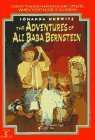
The Adventures of Ali Baba Bernstein
By Johanna Hurwitz
Eight-year-old David Bernstein discovers life is much more exciting when he calls himself Ali Baba Bernstein. Only Ali Baba would have dared to grab the class snail and escape to the boys' room for his own magic experiment. David would never have invited every David Bernstein in the New York Telephone Directory to his ninth birthday party -- or find himself hailed as a great detective -- or discover adventures and misadventures everywhere he went. But Ali Baba Bernstein does!
Description from Publisher

The One Hundredth Thing About Caroline
By Lois Lowry
When their mother starts to date the mystery man on the fifth floor of their Manhattan apartment building who has been instructed by his agent to "eliminate the children" by the first of May, eleven-year-old Caroline and her genius brother think he is going to try to kill them.
Description from Publisher
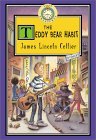
The Teddy Bear Habit or How I Became a Winner
By James Lincoln Collier
Twelve-year-old George Stable wants to be a rock star someday, but he gets horrible stage fright - unless he has his old teddy bear with him. Hiding the teddy in his guitar seems like a brilliant idea until George discovers that someone has hidden jewels in the stuffing of his beloved bear. Quirky yet believable characters and a funky setting make this one a winner all around.
Description from Publisher
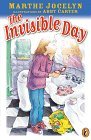
The Invisible Day
By Marthe Jocelyn
In the Booklist interview, Anne Fine speaks about how children today can never get away from adults, "there's no longer that sense of safety and freedom." Here, first-novelist Jocelyn dramatizes that dependence in a funny story about a fifth-grader in Manhattan who can get no peace from her overprotective single mother ("Bathrooms were the only place where a kid can be alone"). When Billie finds a magic makeup kit that makes her invisible, she can, for the first time in her life, walk alone on the street and ride the subway all by herself. She feels like an alien. Kids will enjoy the fantasy as Billie evades her hovering mother, tricks her teachers and the classroom bully, and travels across town to a teenage inventor, who makes her visible again. Her adventure is also a celebration of New York City, with all the riches of its crowded streets. Readers will be touched by the ending, when Billie and her mother recognize what was sometimes "invisible": how much they love each other and how Billie must learn to be on her own, even in a dangerous world.
Description from Booklist
Fifth-grader Billie Stoner longs for more freedom. Her days and nights are carefully monitored by her mother, and shared with her younger sister since New York City is a place of "countless dangers." While on a family excursion to Central Park, Billie discovers a mysterious cosmetics bag that she quietly secrets away. At school the next day, she samples one of the powders in it and becomes invisible. Her ability to move through her school and throughout the city unseen proves to be both humorous and challenging. Not only must she outsmart her teacher, but also her mother, who is the school librarian. With the help of her friend Hubert, Billie travels uptown to the home of an eccentric teenage scientist, Jody, the owner of the cosmetics bag and the only one who can help Billie regain visibility. The story has a predictable plot, but children will find it intriguing. The girl learns some lessons in her travels, and comes to appreciate and miss her family. Some characterization is rather shallow. Still, the story keeps a good, fresh pace, and the ending is neatly tied up with a bowthe class bully's attempts at plagiarism are thwarted, Billie becomes visible, and she finally gains some freedom from her mother. Her first-person narrative gives the book a chatty, comfortable tone. Children will readily identify with Billie's thoughts, motives, actions, and language.
Description from School Library Journal
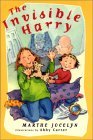
The Invisible Harry
By Marthe Jocelyn
What’s more fun – and more hard work – than a puppy? An invisible one!
Author Marthe Jocelyn takes readers back to Manhattan to meet up once again with Billie Stoner in her follow-up to The Invisible Day. Billie has always wanted a puppy, but her mother and father both agree: No dog! No problem, thinks Billie, who turns to her mad scientist friend Jodie for a plan to make her new pet invisible! The plan works, but soon Billie finds that keeping her invisible dog, Harry Houdini, under wraps isn’t as easy as she planned, especially in a tiny apartment. To begin with, he still smells like a puppy, feels like a puppy, and worst of all, sounds like a puppy. What’s more, her arch enemy Alissa is beginning to catch on to the secret. Just how long can Billie keep Harry concealed?
Description from Publisher
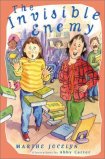
The Invisible Enemy
By Marthe Jocelyn
In this sequel to The Invisible Day and The Invisible Harry, sixth-grader Billie Stoner's enemy, Alyssa, steals her backpack on a class trip to the Cloisters in northern Manhattan, snoops through her stuff, and uses up an entire dose of Vanishing Powder. The invisible Alyssa, now more beastly than ever, forces Billie to help her return to normal, but not before they spend a torturous night at Billie's home, right under the nose of her librarian mom. The only person who can make the girl reappear is the brilliant high-school student who invented the potion and its antidote, which is made of something foul (including dog food and bubble-gum juice). This story focuses on the girls' relationship and gives possible cause as to what makes Alyssa so nasty. It is slow in parts, but fans of the previous books will enjoy the contemporary lingo and identify with the middle-schooler's angst over friends, family, and boys. Carter's amusing, full-page, black-and-white wash illustrations are scattered throughout.
Description from School Library Journal

Your Friendly Neighborhood Spider-Man
By Kitty Richards
Spider-Man'sarchenemy, the Green Goblin, wants to take over the world -- and he's starting with New York City! Spider-Man is the only one who can stop the Green Goblin's terrible plan -- unless the Green Goblin stops Spider-Man first!
Description from Publisher
DVD Also Available
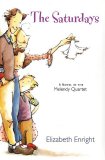
The Saturdays
y Elizabeth Enright
Four New York City siblings decide to pool their resources so that each can do a special thing on the Saturday that is his turn to receive the combined allowance.
Meet the Melendys! Mona, the eldest, is thirteen. She has decided to become an actress and can recite poetry at the drop of a hat. Rush is twelve and a bit mischievous. Miranda is ten and a half. She loves dancing and painting pictures. Oliver is the youngest. At six, he is a calm and thoughful person. They all live with their father, who is a writer, and Cuffy, their beloved housekeeper, who takes on the many roles of nurse, cook, substitute mother, grandmother, and aunt.
Description from Publisher
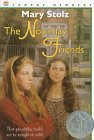
Noonday Friends
By Mary Slattery Stolz
Awards:
- 1966 Newbery Honor Book
- Notable Children's Books of 1965 (ALA)
- Children's Books of 1965 (Library of Congress)
- "City" Books of the Sixties (The Instructor)
Eleven-year-old Franny Davis and her best friend share school and family problems in this realistic, often humorous story set in New York's Greenwich Village.
Description from Publisher
Franny and her twin brother live in a home where every dollar counts, and Franny resents having to get a pass for a free lunch. She dreams of bringing her lunch to school just like her rich classmate Lila. Even though she has responsibilities after school, caring for her younger brother and getting dinner started, her friend Simone who comes from a large immigrant family seems to understand, but wouldn't it be nice if they could just be girls without too many cares. It is a warm story of family, friends and coming to an understanding of that which is truly important in life.
Description from Children's Literature
Over the Wall
By John H. Ritter
John Ritter follows his critically acclaimed debut novel, Choosing Up Sides, with Over the Wall, a metaphorically complex treatment of the Vietnam War, emotional alienation, rage, and the catastrophic familial effects of a child's death, all of which are played out in the uniquely American crucible of a baseball field. Thirteen-year-old Tyler Waltern, leaves his mother and distant father, emotionally shattered since the accidental death of Tyler's older sister some nine years earlier, to spend the summer in New York City with his uncle, aunt, and cousins. Tyler's considerable athletic prowess on a Central Park Little League team is overshadowed by his propensity for uncontrollable temper tantrums. A firm but sympathetic coach, the attention and help from his sagacious teenage cousin Brina, and several pilgrimages to the Vietnam War Memorial in Washington, D.C. contribute to Tyler's revelatory growth and redemption. Narrator Johnny Heller is superb and completely natural in his seamless boyish vocal execution of Tyler while also providing a mature dimension to the adult characters. An added bonus is the concluding interview with author who discusses, among other topics, the novel's multidimensional themes and structure. Imbued with passion, absolution, and grace, this beautiful story beautifully told is destined to become one of the year's best young adult audiobooks.
Description from School Library Journal
Ritter (Choosing Up Sides) again draws parallels between baseball and social issues as he explores the struggles of a 13-year-old boy on and off the field. There are many "walls" in Tyler's life: the outfield wall he dreams of clearing with a hard hit; the Vietnam monument bearing the name of his grandfather; and the invisible barrier Tyler's father has built around himself since the accidental death of Tyler's older sister nine years earlier. Spending the summer in New York City with his cousins, Tyler is determined to make an all-star baseball team. But Tyler's talent doesn't impress his coaches as much as his explosive temper does, and he is told to "shape up or ship out." Led by a tough but sensitive coach, a Vietnam vet, and by his pretty eighth-grader cousin, trained in "peer arbitration" at her private school, Tyler learns to control his anger and understand his so-called enemies. The author tackles tough subjects relating to violence in sports, religious hypocrisy and the Vietnam War while creating layers of metaphors that neatly unfold as the story progresses. Although Ritter stacks the deck a little obviously, his powerful lesson in compassion will likely reverberate for readers.
Description from Publishers weekly
Stucksville
By Sheila Greenwald
When her fourth-grade class is assigned to write an essay entitled "My New York," Emerald Costos has no idea what to write. After all, New York City is only one of half-a-dozen places she and her actor parents have lived since she was born, and they are already looking forward to their next move. When bossy Angel Montero, who lives in her building, suggests that they build models of their apartments instead of writing an essay. Emerald is even more unsure. However she soon finds that she enjoys working on the miniature re-creation of the tiny apartment that she and her parents call "Stucksville." She also begins to take an interest in her other neighbors, watching them through the window and offering anonymous tips to help them out of trouble, sometimes with humorous results. Gradually, Emerald discovers that she does have a New York of her own, one that she is reluctant to leave. Greenwald does a good job of capturing the detachment and insecurities of a girl who is always moving and trying to fit in, and the supporting characters are believable and likable. This is a fun book to use in the classroom, and should inspire students to create their own models of home.
Description from School Library Journal
Frankenstein Moved In on the Fourth Floor
By Elizabeth Levy
What is the matter with Mr. Frank, the man who has moved into Sam and Roberts building? Why is he so nasty? Why does he use so much electricity? And why are those odd moans and groans coming from his apartment.
Sam and Robert think they know the answer. Together they reread one of Sam's horror books. Just as they thought, there are an awful lot of similarities between Mr. Frank and the man in the story, Too many to be just a coincidence.Could it be true? Is Frankenstein really living on the fourth floor of their building? Sam and Robert aren't sure but they're determined to find out!
Description from Publisher
Monkey Island
By Paula Fox
Eleven-year-old Clay Garrity is on his own. His father lost his job and left the family. Now Clay's mother is gone from their welfare hotel.
Clay is homeless and out on the streets of New York. In the park he meets two homeless men. Buddy and Calvin become Clay's new family during those harsh winter weeks. But the streets are filled with danger and despair.
If Clay leaves the streets he may never find his parents again. But if he stays on the streets he may not survive at all.
Description from Publisher
A fine author considers what it means to be a homeless 11- year-old in N.Y.C. Clay Garrity's dad, an art director, was out of work; Clay's mother trained for a good job--but it wasn't enough, especially with a baby coming. Unable to cope, Dad disappeared; now, without warning, Clay's distraught mother has also abandoned him, leaving him in an unsavory welfare hotel. When a neighbor suggests calling the police, Clay bolts, afraid that becoming a foster child would mean losing his mother forever. He lands in a park with Buddy, a hard-working young black man who can't earn enough for a rent deposit, and with Calvin, a retired teacher who lost everything in a fire. Weeks later, their fragile existence is destroyed by an invasion of raging toughs ("the stump people") who demolish their meager, hard-won amenities and scatter the park's inhabitants. Indirect results include Calvin's death; Clay, weak from malnutrition and exposure, is hospitalized. Focusing on a child who has been secure and well-loved intensifies the impact of his deprivations and suggests that Clay's cruel experiences could happen to anyone. It also allows a subtly upbeat ending: herself again after the baby's birth, Clay's mother finds him, and he begins to forgive her. Exquisitely crafted with spare but resonant detail (like describing, with wry wit, but not quoting the angry four-letter words of the stump people--and contrasting them to Clay's reiterated graffiti: "Stop!")--an absorbing, profoundly disturbing but ultimately hopeful story.
Description from Kirkus Reviews
Fox (Newbery Award Winning The Slave Dancer) has written a quietly terrifying, wholly compelling novel about the urban homeless, filtered through the experience of an 11-year-old boy. Clay's middle-class existence begins to shred when his art-director father loses his job and, eventually, his connection to his wife and child. He leaves without a word one day, and Clay and his pregnant mother end up in a welfare hotel, a place "where people in trouble waited for something better--or worse--to happen to them." And happen it does, for Clay's mother soon disappears as well, and Clay takes to the streets, to be befriended by two homeless men and reunited with his mother only after great tribulation.
Once again Fox displays her remarkable ability to render life as seen by a sensitive child who has bumped up against harsh circumstances. Her understanding of Clay is keenly empathic and intuitive, and it seems near-total: she is as finely attuned to the small, surprising eddies of his thoughts as to their larger and more obvious stream. It is precisely this attention to the quiet, easily lost insight that gives her account its veracity and force. For example, one night Clay and a friend break into a church basement, and Clay spies a bulletin board. He is "faintly surprised. I can read, he thought"--a small jolt that shows us just how far from the world of school and homework he has traveled. Fox neither preaches about nor attempts to soften the stark realities of the life that is, temporarily, thrust upon Clay. Clear-eyed and unblinking as ever, she shows us the grit, misery and despair of the homeless, along with occasional qualified, but nonetheless powerful redemptive moments--the sharing of an apple or kind word by those with little to spare; for Clay, the bright smile of his newborn sister.
Description from Publishers Weekly
{This is a} delicate and moving novel, one of the first describing middle-class homelessness for young readers. The sight of homeless people . . . hasbecome a fact of life, and for children they are the ultimate representation of a terrifying fantasy--of parents leaving, of loss and displacement. How does a writer make the unbearable bearable without violating the basic truth of the situation? . . . {Ms. Fox} has written a relentless story that succeeds inconveying the bitter facts. She depicts life in a welfare hotel precisely. .. . Although the focus of Ms. Fox's story is a middle-class family, she neverlets us forget the way race and class affect destiny. . . . Young readers need--and deserve--to understand homelessness. . . . {This novel} attempts an accurate picture and succeeds in moving us.
Description from The New York Times Book Review
Web Warriors: Memories End
By James Luceno
CYBERSPACE—THE REAL FINAL FRONTIER
The place: New York City.
The time: any day now.
Tech and Marz are brothers, orphans, and misfits just about everywhere—except on the Virtual Network, where their monster gaming skills leave challengers choking on their datatrails; and their hacking expertise earns them serious cash as freelance cyber-sleuths, running down lost information and missing persons on the Web. The more extreme the cyber-sport, and the tougher the security codes, the better Tech and Marz like it.
A mean game of Death Run is nothing for Tech and Marz. But almost getting killed—for real—on a routine virtual mission is a whole different deal. And that’s exactly what a shapeless, demonic cyber-thing tries to do when Tech accidentally frees a mysterious kidnap victim deep inside a government database. The run-in leaves the brothers with a ton of fried hardware and too many unanswered questions. But they’re heading into the dark and dangerous underbelly of the virtual world to do some extreme detective work—and crack what could be the motherboard of all mysteries. And this death run is no game.
Description from Publisher
The Planet of Junior Brown
By Virginia Hamilton
Awards:
- A Newbery Honor Book
- ALA Notable Children's Books
Already a leader in New York's underground world of homeless children, Buddy Clark takes on the responsibility of protecting the overweight, emotionally disturbed friend with whom he has been playing hooky from eighth grade all semester.
Description from Publisher

My Fabulous New Life
By Sheila Greenwald
Shaken by her family's move from a wealthy suburban house to a cramped apartment on the Upper West Side of Manhattan, 11-year-old Alison finds the beggars and crazies on the crowded city streets "disgusting." She longs for the time when she knew nothing about the homeless, when everyone in her neighborhood looked "normal." Then gradually, as she makes friends and begins to feel at home, she tries to find a way to help the poor people around her. Greenwald raises important issues that concern kids everywhere, and she does it without heavy preaching or sentimental resolution. Alison's first-person narrative is funny and honest. When she collects money in her building to buy food for the street people, she wonders whether she's using other people's bad luck to make herself important. She sees that her do-gooder activist friend is impossibly self-righteous, even if she does have some good ideas. The characters are interesting, the brand names and slang contemporary, and the irony nearly as strong about the do-gooders as about the snobs. Underneath it all is the fear we all recognize: What if I were homeless?
Descripiton from Booklist

Wishing on a Star
(Cheetah Girls, No. 1)
By Deborah Gregory
Straight out of the "jiggy jungle" ("a magical place inside every big city where dreams really come true-and every cheetah has its day") comes a new series just for "divettes-in-training" ("girls who can't afford Prada or Gucci-yet"). Galleria, named after a famous shopping mall, and her friend Chanel live in New York City and dream of becoming famous. They decide that two singers are not enough and convince three other girls to join them. Most of the plot centers around forming a group, booking a gig at the Kats and Kittys Halloween Bash, designing costumes, and practicing for the big event. Along the way, the five girls learn about one another, quarrel, and, of course, forgive. They are true series characters, growing just enough to leave room for more stories. Gregory's playful use of language is consistent and fun. For other "peeps" (people), a handy glossary is appended. Cameo photos of young models posing as the characters grace the front and back covers. The Cheetah Girl Credo is printed at the beginning of the book and is spoken on the mini-CD that accompanies the book. The credo suggests all Cheetah Girls are created equal, but not alike, and is upheld by the characters, who are mixed-race African American, Italian, and Dominican. A light read for young teens who dream of stardom
Description from School Library Journal
It's Like This, Cat
By Emily Cheney Neville
Awards:
- 1964 Newbery Medal
- ALA Notable Children's Books 1940-1970
My father is always talking about how a dog can be very educational for a boy. This is one reason I got a cat.
Dave Mitchell and his father disagree on almost everything: Dave's music, his hair, even what makes a better pet, a dog or a cat. Dave's father thinks that a dog could be very educational. So dave gets Cat.
Cat is a strong-willed tomcat who loves adventure almost as much as Dave does. With Cat around, Dave meets lots of new people - like Tom, a young dropout on his own in the city, and Mary, the first girl he can talk to like a real person.
As things change, Dave starts to understand his father a little better. They still don't see eye-to-eye on a lot of things, but there is one thing they can both agree on: Having a cat can be very educational, too - especially when it's one like Cat.
Description from Publisher
This is superb — the best junior novel I've ever read about big-city life.
Description from The New York Times Book Review
Alphabet City Ballet
By Erika Tamar
Awards:
- 1996 America’s Commended List (CLASP)
"A dream isn't about things," Marisol argues, "a dream is who you want to be." And when the 10-year-old wins a scholarship to the Manhattan Ballet School, she discovers that her dream is to be a dancer. Unfortunately, her much loved older brother, Luis, has a more dangerous dream: to go to work for the neighborhood drug lord. Tamar's novel about the struggles of a single-parent Puerto Rican family to survive in New York City is saved from problem-novel predictability by the strength of its characterizations, the believably guarded friendship that develops between Marisol and a Haitian girl who lives in a nearby shelter, and the nicely realized details of the mean streets-Lower East Side setting.
Description from Booklist
Marisol has always loved to dance—to the salsa at family parties, to the boom boxes on Loisada Avenue. Then she wins a scholarship to ballet school and discovers an inspiring new world of beauty and discipline. But when violence erupts in Alphabet City, Marisol’s dream starts to slip away. To keep dancing she must make heartbreaking choices—perhaps impossible ones.
Description from Publisher
Ten-year-old Marisol Perez has lived with her father and older brother Luis in New York City's Lower East Side, (often called Alphabet City) all of her life. This lower middle class neighborhood is fairly safe during the day, but becomes dangerous and sinister at night, when the prostitutes, drunks, drug users and dealers, come out. When Marisol and a Haitian refugee classmate, Desiree, are suddenly chosen to receive scholarships to the prestigious Manhattan School of Ballet, she enthusiastically tries to follow a new and often difficult path to a better and more fulfilling life. Marisol and her Puerto Rican family are appealing and believable, and the author does a good job depicting the discipline and fascination of the ballet world.
Description from Children's Literature
New York City is an exciting place, even for motherless Marisol. A spirited 10-year-old, she loves dance, especially the dances of her Papi's native Puerto Rico. Movement and music allow her to forget the small apartment, the street with its drugs and poverty, and her worries about her older brother Luis. When Marisol is offered a scholarship to ballet school, her world opens up. Along with Desire, a recent Haitian immigrant, she finds a new love, but fears the loss of her brother to Tito, the drug dealer. Tamar depicts the city with an expert hand; street scenes come to life with the language, movement, and music of a vibrantly alive place. Spanish phrases enrich this realistic depiction. Marisol could be any child with her excitement and desire for a dream come true. A father's struggle to maintain his home and family, a brother's wish for adulthood, and the challenge of living in an urban center with its myriad tensions are all effectively portrayed. Plot and characters are carefully developed and create a sense of energy that catches readers and holds them to the final page. Good booktalk potential.
Description from School Library Journal
Harry Cat's Pet Puppy
By George Selden
"Get that thing out of here!" Tucker shouted.
Tucker Mouse was waiting impatiently in the drainpipe in the Times Square subway station where he and his friend, Harry Cat, made their home. And when Harry finally came home, he was dragging with him what looked like a dirty dish mop. It was a puppy.
"It's staying for supper?" asked Tucker incredulously.
Huppy was to stay a good deal longer than that, and Tucker and Harry were kept busy seeing to the needs of their new pet. As their fondness for Huppy grew, so did the dog, until the day came when he no longer fitted into the drainpipe. A new home had to be found for him-but where? Surely not with Max, leader of the Bryant Park pack of strays! If only Miss Catherine, the high-toned Siamese cat of Mr. Smedley, the music teacher, could be persuaded to accept an addition to the family . ..
Description from Publisher
Jennifer, Hecate, MacBeth, William McKinley and Me, Elizabeth
By E. L. Konigsburg
Elizabeth is the loneliest only child in the whole US of A until she discovers Jennifer. Of course, Jennifer isn't a friend, really. Witches don't make friends, and Jennifer is a witch. Elizabeth becomes her apprentice, however, and in the process of learning how to become a witch herself, she also learns how to eat raw eggs, how to cast short spells, and how to get along with Jennifer, among other things.
The relationship lasts from fall into spring. The girls meet each Saturday at the library and go from there to the park where they hold special ceremonies and read books on Witchcraft. The climax of their joint effort is to be a flying ointment, but it is here that trouble crops up.
Though this story is set in suburban New York City, it could happen anywhere, for Elizabeth's problem, and Jennifer's problem, the need for a friend, can happen to anyone.
Description from Publisher
Bluish: A Novel
By Virginia Hamilton
Bluish is unlike any girl 10-year-old Dreenie has ever seen. At school she sits in a wheelchair, her skin so pale it's almost blue. Dreenie, herself new to the New York City magnet school, is fascinated by her, but wary as well. Unaware that the name Bluish could have derogatory connotations ("Blewish," for Black and Jewish), she fixates on the moonlight blue skin tones of this curiously fragile child. Together with Tuli, a bi-racial girl who pretends to be Spanish (often with poignantly comical results), the three carefully forge a bond of friendship, stumbling often as they confront issues of illness, ethnicity, culture, need, and hope.
Description from Amazon.com
At first, Dreenie doesn't know what to make of Natalie, the sick girl in a wheelchair who is part of her fifth-grade class in a New York City magnet school. The kids call Natalie "Bluish," not because of her ethnicity (her dad's black and her mom's Jewish) but because her pale skin has a bluish tint caused by all the chemotherapy she's had for cancer. Dreenie tries to be nice, but she's scared ("What if she dies? What if I die?"), and Bluish demands respect, not pity; she hates people who hover like a helicopter. Hamilton tells rather than shows Dreenie's growing bond with Bluish, but through Dreenie's eyes--in journal entries and sharp vignettes--we watch Bluish becoming part of the dynamic classroom. What's best is the funny, touching portrait of another classmate, Tuli, who is so needy that she pretends to be Spanish ("Hokay, ho-ney, we take care. Cuidado!"). She desperately wants to be Dreenie's best pal, and Dreenie is sorry for Tuli, but it's Bluish who is Dreenie's soulmate. Hamilton gets the way kids talk. Like Bluish, she makes us "stop and look." Many readers will be caught by the jumpy, edgy story of sorrow and hope, of kids trying to be friends.
Description from Booklist
A child coming off chemotherapy wins new friends and acceptance from her class in this short, upbeat tale from Hamilton (Second Cousins, 1998, etc.). At first, Dreenie doesn't know what to make of the girl, Natalie, who is in a wheelchair and knit cap, and who is called ``Bluish'' by the fifth graders not because she's black and Jewish (as Natalie's mother assumes), but because her skin is translucent. New herself, Dreenie quickly finds the right mix of distance and intimacy to be comfortable around her moody, fragile classmate, and soon others are gathering, tooespecially after Natalie presents everyone with a wool cap like hers. Hamilton tells the tale from Dreenie's point of view, moving back and forth between first and third person, sketching feelings and reactions in quick, vivid strokes: ``[Bluish] made me care about what was all so scary, so sad and so hurt with her too. To me she is just Bluish child, Bluish ill serious. Bluish close with us. Someday Bluish just like us./Maybe.'' While Natalie's future remains clouded, the story's tone is set by the pains, and the pleasures, of the moment: exchanging gifts, banter, friendship, and respect. The three children in Leo and Diane Dillons' jacket painting are misleadingly grave, but the designs in their knit caps and scarves evoke the author's poetic, richly textured prose.
Description from Kirkus Reviews

A Nose for Adventure
By Richard Scrimger
In this hilarious sequel to The Nose from Jupiter, Alan is to take his first airplane ride. He is off to New York, where his father will meet him for some “quality time” together. There are one or two snags, though. First, his father isn’t at the airport. Then there’s his cranky seatmate, Frieda, who is almost kidnapped while she’s waiting for her wheelchair at the baggage claim. Sally, an abandoned mutt, joins the scene. And finally, Norbert is back. He is an alien from Jupiter who had previously taken up residence in Alan’s nose when he was on a fact-finding mission to Earth. Alan had been, to say the least, an unwilling host to Norbert, but when you’re lost in New York City being chased by bad guys, you need all the help you can get!
Description from Publisher
Norbert, the nostril-dwelling alien who starred in The Nose from Jupiter, is back, along with 13-year-old Alan, his former "host." Alan, who lives in Canada, is flying to New York City to visit his father. He is convinced the plane is about to crash and his seatmate, Frieda, a 14-year-old girl who is on her way home, is alternating between making fun of his clothes and accent and trouncing him at arm wrestling. When they finally land, Alan's Dad fails to show up at the airport and Frieda is nearly kidnapped by crooks who seem unusually interested in her wheelchair. Alan helps her escape and the two kids find themselves adrift in New York. In answer to Alan's cries for help, Norbert magically appears on the scene; he has now taken up residence in the nostril of a street mutt. After a dramatic trek across the city, the alien and earthlings uncover a crime ring masterminded by a shady Egyptologist whose underlings have smuggled an artifact into the country by hiding it in Frieda's wheelchair, and Norbert tricks him into admitting his guilt. The pacing is lively and the dialogue is brisk and humorous, with Norbert's sarcastic comments adding spice. Familiarity with the first book is helpful but not necessary. Readers who like their science fiction mixed with a touch of whimsy will appreciate this Pinkwateresque story.
Description from School Library Journal
Timid 13-year-old Alan Dingwall is traveling alone to New York City, where his father is to meet him at the airport. Seated beside him on the plane is Frieda Miller, 14, a sassy, city-smart New Yorker returning from one of many visits to doctors in Toronto. Even though Frieda's "legs are a mess," she doesn't let her wheelchair stop her. Unfortunately, when the teens arrive at the airport, smugglers who have hidden a valuable Egyptian artifact in Frieda's wheelchair greet them. Also in the airport is Sally, a stray dog whose nose has become the new home of Norbert, the diminutive alien from Jupiter first introduced in The Nose from Jupiter. A hilarious, exciting roller coaster of evasions, captures, and escapes ensues, as Frieda, Alan, Sally, and Norbert take on the crooks. Snappy dialogue, humor, and clever plotting provide a rollicking adventure, with a subtext reminding readers to be sensitive to the feelings, concerns, and abilities of others.
Description from Booklist
Orange Outlaw (A to Z Mysteries #15)
By Ron Roy
O is for Orange. . . .
An art thief is on the loose! Dink, Josh, and Ruth Rose are visiting Dink’s Uncle Warren in New York City when several paintings are stolen from his apartment building. A trail of orange peels, a missing pie, and an orange hair are the only signs that someone was there. Do the kids have enough clues to catch this crafty—and hungry—crook?
Description from Publisher
This story is the most recent in a mystery series for middle readers, the "A to Z Mysteries." Three friends team up to follow clues and solve crimes. In this episode, the children visit a relative in New York to attend a block party. During the party, a valuable painting is stolen from the apartment and some rather interesting clues are left behind. Dink, Josh and Ruth Rose won't sit idly by while the police take their time to investigate. Instead, they take matters into their own hands and set up a sting operation to catch the thieves. The story reads quickly and will appeal to the mystery crowd.
Description from Children's Literature

Tell It To Naomi
By Daniel Ehrenhaft
Dave Rosen has a secret. “Naomi,” the wise, witty, always-on-target, female writer behind his high school’s hit advice column, is, well, him. A native New Yorker who likes secondhand CD shops, The Simpsons, and meatball heroes.
A kid like him doesn’t have all the answers. He doesn’t even have most of the answers. Dave only got himself dragged into this fiasco to help out his older sister, the real Naomi—and because he let himself be convinced that it might, in some lunatic way, enable him to meet his dream girl, the senior who gets his weak little sophomore heart racing: Celeste Fanucci. If he could get Celeste to write in and open up her soul to “Naomi,” he could use this secret knowledge to transform himself.
He could bridge the unbridgeable chasm between sophomore boys and senior girls. It’s a grand, grand scheme. And it’s about to go haywire.
Description from Publisher

Invasion of the Nose Pickers
By Gordon Korman
Devin and his alien exchange student, Stan, are heading up to camp with their class. Their plans go awry, however, when Stan finds out that there is a mischievous alien on the loose in New York City. Stan uses his special nose computer to change the class's destination to the Big Apple and soon the class is camping out in Central Park!
Description from Publisher
The main gag in the whole series is that the aliens look like they are picking their noses, but they are really operating internal nose computers. Stan (the alien from planet Pan) and Devin (the earth boy) have a class camping trip but Stan uses his nose computer to change the location of the trip to NY city. Soon they are camping in Central Park, but there is a 200-foot green robot on the loose sucking power from the planet Pan's main energy source. Their mission is to stop the giant robot!
Description from Amazon.com Customer Review
So You Want to Be a Wizard
(The First Book in the Young Wizards Series)
By Diane Duane
In the spirit of Madeleine L'Engle's classic A Wrinkle in Time, this is a fascinating and powerfully involving story about two lonely kids who are inadvertently caught up in the never-ending battle between good and evil. The problems of everyday adolescent life and the mysteries of magic are perfectly blended, along with plenty of humor and suspense. In a starred review, School Library Journal wrote, "well-structured and believable... this fantasy should have wide appeal." Horn Book wrote, "a splendid, unusual fantasy... an outstanding, original work."
Description from Amazon.com
Something stopped Nita's hand as it ran along the bookshelf. She looked and found that one of the books had a loose thread at the top of its spine. It was one of those So You Want to Be a...books, a series on careers. So You Want to Be a Pilot, and a Scientist,...a Writer. But his one said, So You Want to Be a Wizard.
I don't belive this, Nina thought. She shut the book and stood there holding it in her hand, confused, amazed, suspicious-and delighted. If it was a joke, it was a great one. If it wasn't?...
Description from Publisher
When they embark on a mission to locate an ancient book that holds the key to preserving the universe, Nita Callahan and her pal Kit discover an eerie alternate Manhattan, populated with eating helicopters, wolflike creatures, and a dragon.
The Jaguar's Jewel
By Ron Roy
Dink, Josh, and Ruth Rose visit New York City! Dink's uncle is the curator of a museum with a dazzling new treasure--a statue of a jaguar cradling an emerald between its front paws. But when it's discovered that the emerald has been replaced with a fake, Dink's uncle is the chief suspect. He'll go to jail if Dink, Josh, and Ruth Rose can't uncover the real thief!
Description from Publisher
New in New York
By Sandra Bartholomew
New in New York is an exciting story of one girl's struggles to fit in when she moves out of her comfortable surroundings in Maine. The delightful photographs of the doll characters acting out the story make this an especially unique way to examine some important issues.
New in New York is the second in a series of stories about challenges faced by young people today. In this book, Christi Mancini is forced to examine her reliance on appearances, and look at things with a new perspective. In one exciting chapter, Christi is frightened by a would-be abductor, and learns that one close friend is more valuable than being "popular."
Description from Publisher

New York, Here We Come (Generation Girl #1)
By Melanie Stewart
Life couldn't be more exciting for Barbie. She's fifteen, has just moved to New York, started a fabulous new high school, and made friends with five of the coolest girls around. Better yet, Barbie's dream of becoming an actress may soon come true! See what adventures Barbie has in store for her.
Description from Publisher

Singing Sensation (Generation Girl #4)
By Melanie Stewart
Just when things are going great for Chelsie---she loves New York City, her new friends, and her latest challenge - writing the songs for the upcoming class musical--she learns that her parents might send her to boarding school in England. It's the last thing she wants to do, but will she have a choice?
Description from Publisher
Secrets of the Past (Generation Girl #6)
By Melanie Stewart
Nichelle gets her first big break, modeling sundresses in the middle of Central Park, for a magazine. But soon a mystery unfolds. Something is not right about the new construction site downtown. Rumors say it was once an African-American burial ground. Nichelle works to find out the real deal.
Description from Publisher
The Witch of Fourth Street and Other Stories
By Myron Levoy
Cathy Dunn knew that if shed id not give her penny to the witch, the old lady would turn her into a lizard. Ora goat. Or a spider so small Cathy's mother would step on her. But one day Cathy decided that she would not give up her penny, and that was the day she came down with a fever.Cathy is just one of the many children who came to New York City with their parents seekin g a better life. There is Keplik the Match Man, who builds masterpieces from used matchsticks; Noreen Callahan, who is ashamed to work in her father's smelly fish store; and even a Hanukkah Santa Claus!
Descripiton from Publisher
What makes this such a good book is the author'scompassion, imagination, and humor. A first book forchildren by a first-rate writer.
Description from Book World
Sudden Death in New York City
(Screech Owls #13)
By Roy MacGregor
Nish has done some crazy things – but nothing to match this! At midnight on New Year’s Eve he’s planning to “moon” the entire world.
The Screech Owls have come to New York City for the Big Apple International Peewee Tournament. They’ll be playing in Madison Square Garden, home of the New York Rangers, and on New Year’s Eve they are going to Times Square for the biggest party in history. The countdown to midnight will be broadcast live on a giant TV screen and beamed around the world by a satellite. But Data and Fahd figure out that with just a laptop computer and video camera they can interrupt the broadcast – and Nish will have pulled off the most outrageous stunt ever.
Travis, Sarah, and the others have heard it all before. They are more interested in playing in the tournament and exploring the most exciting city on Earth. But no one anticipated just how exciting New York can be. Just hours before midnight, the Owls discover that terrorists plan to disrupt the New Year’s celebration in a more dramatic way than even Nish could have imagined.
Sudden Death in New York City is the thirteenth book in the Screech Owls Series.
Description from Publisher
Speechless in New York
By Ellen Dreyer
The Going to...Series introduces an exciting new concept in young adult books with these wonderful adventure stories. These books are an entertaining way to orient kids before a trip or simply acquaint them with some of the most visited land marks in the world for future knowledge.
Each set in a popular travel destination, the stories are told by the central character, who encounters mishaps, thrills and sometimes frights while visiting the major landmarks of each featured city. The stories themselves incorporate the food, lifestyle and slang of each region, and in some cases, include a glossary of local terms.
A map of the city, is included, showing the path of the characters as they visit each attraction. The map is followed by a personalized guide to each landmark, which includes a short description of the attraction.
Jesse has come to New York City with her high school chorus to participate in a youth chorus festival, but a series of mishaps threaten to ruin her experience. With the help of a classmate and her aunt in Brooklyn, Jesse's near disaster becomes a learning experience about music and facing and conquering real problems.
Description from Publisher
New in New York : Christi Changes
By Sandra Bartholomew
New in New York is the second in a series of stories about challenges faced by young people today. In this book, Christi Mancini is forced to examine her reliance on appearances, and look at things with a new perspective. In one exciting chapter, Christi is frightened by a would-be abductor, and learns that one close friend is more valuable than being "popular." The delightful photographs of the doll characters acting out the story make this an especially unique way to examine some important issues.
Description from Publisher

Bright Lights
By Sarah Mountbatten-Windsor York (Sarah Duchess Of York Ferguson)
Princess Amanda is thrilled to visit her look-alike friend, Emily Chornak, in New York City. The girls are scheduled to tour all the sights of the Big Apple by limousine, and what's especially exciting is that they'll have the chance to hear their favorite band perform at a benefit concert.
At an elegant party before the concert, Emily and Amanda overhear a plan for a robbery. They know they must stop the crime, but what can two eleven-year-old girls do? And how can they help their new friend, a homeless boy, get off the streets of New York?
Description from Publisher

Stacey's Mistake
(Baby-Sitters Club #18)
By Ann Matthews Martin
Jessi's Big Break
(Baby-Sitters Club #115)
By Ann Matthews Martin
After a thrilling three-week dance program in New York City, Jessi is invited to join the Dance NY education program full-time. Is she ready to leave Stonybrook and all her friends behind?
Description from Publisher
New York, New York
(Baby-Sitters Club Super Special #6)
By Ann Matthews Martin
Thinking she made a mistake in inviting her fellow club members to a weekend in New York City, Stacey is dismayed by the fights that break out, but the trip proves successful during a gala evening at a Broadway show.
Description from Publisher
Karen's Turkey Day
(Baby-Sitters Little Sister, #67)
By Ann Matthews Martin
Anticipating all the Thanksgiving festivities, including a visit by her grandparents and the New York City parade, Karen fears things are going from bad to worse when Grandad gets sick and her parents become occupied with grownup things.
Description from Publisher

Amy Dunn Quits School
By Susan Richards Shreve
Shreve (The Flunking of Joshua T. Bates) chronicles the day-long rebellion of an 11-year-old protagonist, who, through her mother's pressures, has always seemed perfect: she gets A's in school, plays on the soccer team, and takes ballet, acting and piano lessons--even though, we soon learn, she hates them all. On Halloween, Amy ``resigns from the world'' to avoid having to wear the Halloween costume her mother made for her in the school parade; none of the kids Amy's age are going in costume. In this tenderly told story of a girl's loving yet guilt-ridden relationship with her single mother, Shreve portrays a familiar and believable psychological situation: each character is scared of hurting the other's feelings with an admission of their differences. While some readers will find the ending pat ("You have been too good for too long," Amy's mother says; "And you have been trying so hard to do the best thing," says Amy), many, especially girls, will appreciate the realistic, indirect form Amy's rebellion against her mother takes. Actual spots in New York City, such as Washington Square Park and the Upper West Side, form a distinctive narrative backdrop.
Description from Publishers Weekly
Nicole Dunn is the prototypical supermom who manages her home and her job with flawless precision and makes up for being a single parent by spending all her free time with her daughter. Unfortunately, she also runs 11-year-old Amy's life. For her part, Amy manages to stay a top student and suffers through myriad abhorrent activities to avoid disappointing the well-meaning Nicole. When Nicole sews Amy a gorgeous costume for the school Halloween parade, an outfit that Amy feels she is too grown-up to wear, Amy finally rebels--by cutting school and doing exactly what she wants for a change. What she doesn't know is that Nicole has paid a surprise visit to school to see her in her costume. The windup is too neat (though Amy does get an inkling that freedom has a price), the story a bit too purposive, and readers will naturally be more interested in Amy's portion of the alternating narrative than in Nicole's. But Shreve invests her characters with an appealing warmth and gives us a credible glimpse of what it can be like to live in a single-parent household and how easily affection can be dulled by "good intentions."
Description from Booklist

Perfect Girls (Replica #4)
By Marilyn Kaye
Amy Candler heads to New York as a National Spelling Bee finalist. She wants to win, and she's psyched that her friends Tasha and Eric are coming along. The trip is going to be a blast--in more ways than one. Wait till Amy discovers that correct spelling isn't what the organizers have in mind. Wait till she meets her "perfect" competitors. Wait till she fights to save them from themselves. Amy can spell escape--now she needs to find a way out!
Description from Publisher
Amy recently entered an essay contest,and she's a finalist!So now she gets to go to New York City with the other finalist from her school,Jeanine Bryant. Ughhhhhh,that's the only bad part about the trip,but Amy and Tasha convince their parents that the should go to New York too! Amy is so pysched!She's going to New York with her best friends,she doesn't have to worry about organization that's after her,what could go wrong? Well, shortly after ariving in the city, Amy mysteriously loses conciousness,and is rushed to the hospital. When she wakes up she's in a room with 7 other girls named Amy. On the outside her friends aren't allowed to see her,they are told Amy is still asleep,but they wonder if thats really the truth. Amy herself begins to wonder what is real and what is not...
Description from Amazon.com Customer Review
Godzilla
By James Preller
Is it Thunder-or Footsteps?
- A devastating, blinding flash lights up the sky above a Polynesian atoll. The island is no more. All that is left is a towering mushroom cloud that slowly drifts away.
- The Pacific Ocean boils and churns though there is no storm in sight. A fish-processing ship goes down, leaving only a single survivor: a catatonic sailor, too terrified to speak.
- Gigantic footprints plow an ominous path through the Panamanian rain forest, crossing the isthmus from west to east and disappearing into the Atlantic Ocean.
- Off the North Carolina coast, a ship suddenly capsizes and is dragged under the sea.
An inexorable wave of destruction, incessant and mysterious, is heading north, toward a tiny, densely populated island called Manhattan!
In the motion picture event of the decade, the blockbuster filmmaker Dean Devlin adn Roland Emmerich bring the biggest monster of all time to the screen: Godzilla! As the towering terror methodically dismantles Manhattan, nuclear scientist Nick Tatopolous is called in to do what the combined forces of the U.S. Army and Air Force can't. Stop him!
Nick's only hope -- and New York's last chance -- is to join forces with Phillipe Roache, an enigmatic insurance investigator leading a team of odd characters who are assessing the damages even as they occur. Neither team leader trusts the other, but they must bury their differences fast, before the marauding monster buries Manhattan under its own rubble. For like a genie from the bottle, Godzilla came to life with three wishes and all three are coming true: Destroy! Destroy! Destroy!
Capturing all the terror and grandeur of the spectacular film from the creators of the smash hit Independence Day, this exciting novelization straight from the screenplay brings to life the most awesome movie monster ever. Godzilla is here in all his gruesome glory. He's about to reach out and touch someone. Pray it isn't you.
Description from Publisher

The Mystery in New York (Boxcar Children #13)
By Gertrude Chandler Warner
Before the end of their first day of fun in New York City, the Boxcar Children find themselves tracking clues through the city to solve the theft of a priceless diamond from their friend, Mr. Pound. Includes a fun-filled activity section with puzzles, crafts, and recipes.
Description from Publisher
The Mystery of the Purple Pool (Boxcar Children #38)
By Gertrude Chandler Warner
Grandfather takes the Alden children to New York City, where they find excitement right in their hotel when someone switches the salt and sugar in the coffee shop, steals from the guests, and dyes the swimming pool purple.
Description from Publisher

Big Idea
(West Side Kids)
By Ellen Schecter
In another installment in the West Side Kids chapter-book series, a spunky Hispanic girl living in an inner city is determined to transform a vacant, junk-filled lot near her home into a community garden. Luzita's vision is fed by memories of her grandmother's garden back in Puerto Rico--the lovely flowers, the birds, the tree frogs, and the games they once played. Her mother is reluctant to let her tackle such a project, but Luzita manages to enlist her father's support. She wants her best friend's help, too, but Rosie is moving soon and doesn't want to invest in something she won't be around to see. The vigorous first-person narrative develops the sturdy determination of the lively eight-year-old, who eventually seeks the help of Green Giants, an organization that sponsors city projects. Readers will appreciate Luzita's triumph as the garden finally comes together and her neighbors, brother, and even her best friend succumb to her joyful dream.
Description from Booklist
Mandie and Jonathan's Predicament
(Mandie Book, 28)
By Lois Gladys Leppard
Mandie couldn't have been more excited when her mother said she could travel to New York City with Celia and Jane Hamilton to visit Jonathan Guyer and his father for the Thanksgiving holidays.
Arriving by train with a firm grip on Snowball, Mandie is overwhelmed by the city's monstrous buildings and people racing everywhere. When Mr. Guyer insists that they stay at the Guyer mansion, it's even better because now they'll be close to Jonathan.
But there are strange things going on at Jonathan's house. Who is the strange girl who demands that Jonathan give her the stray dog they found in the Guyer backyard? And who is the foreign-speaking man whom Mandie discovers meeting in secret with the butler? What's really going on behind all the closed doors of the mansion?
The strange man leads them far from home. Is it a trap?
Description from Publisher
Mandie and the New York Secret
(Mandie Book, 36)
By Lois Gladys Leppard
After a visit to Mandie’s Cherokee kinpeople, Mandie, Celia, and Joe prepare for their trip to New York to visit Jonathan Guyer. Just before they leave, though, Mandie receives an urgent wire from Jonathan: "Hurry on to NY. I have just discovered a great big secret from long ago." Mandie is wild with curiosity. But when they finally get to New York, Jonathan has gone to Long Island and won’t be back till the next day! Can Mandie wait another day to learn the secret? What on earth could it be?
Description from Publisher
What Every Girl (Except Me) Knows: A Novel
By Nora Raleigh Baskin
Twelve-year-old Gabby Weiss is in the market for a stepmother. If only her father would cooperate, Gabby would have someone to tell her what is and isn’t happening to her body. For awhile her father’s girlfriend, Cleo, forms a bond with Gabby. But when the adults break up, Gabby’s hopes for a stepmother are shattered. Still, sharing feelings with a woman has awakened Gabby’s curiosity about her own mother’s mysterious death. Once and for all, Gabby is determined to discover the truth.
Description from Publisher
Gabby, the sixth-grade narrator of this bittersweet, emotionally complex first novel, ardently wishes she had someone to teach her how to be more like a girl ("or womanly or girlish or feminine, whatever you want to call it"). Gabby was three when her mother died, and she doesn't get much guidance from her art professor dad or older brother. Her father's girlfriend, Cleo, seems to be teaching Gabby a lot, but the more Gabby learns about girlhood, the more complicated life gets. Will Gabby measure up to the standards of Mrs. Tyler, mother of Gabby's new best friend? As Cleo and her dad get engaged, can Gabby call Cleo "Mom"? Then there are even more disturbing puzzles, such as why Cleo suddenly breaks up with Gabby's father, and why the subject of Gabby's mother is always carefully avoided. Possessing a keen understanding of pubescent concerns and a good ear for "tween" talk, Baskin sensitively renders the tumultuous period between childhood and adolescence. Although the author focuses on conflicts specific to girls, she also pays close attention to shaping the males in her book, making them three-dimensional, sympathetic characters, who, readers will sense, have stories as complex as Gabby's. Resolutions are not sugar-coated, and the light at the end of Gabby's journey into womanhood seems real.
Description from Publishers Weekly
Baskin has created a thoroughly likable and credible character in this candid, lively, and absorbing story. Like most 12-year-old girls, Gabby focuses on becoming a woman, but she's not really sure what that means. Her mother died when Gabby was three and she's been researching the question for herself. She feels doubly cheated because, unlike her older brother Ian, she has no memory of her mother, and her father won't talk about her. Gabby remains a well-adjusted, keenly observant, capable adolescent. She stands up for and befriends a new girl in sixth grade and hopes that her father will marry his new girlfriend. Finally, in an attempt to trigger her memory about her mother's death, she is determined to take a train to New York City to see the apartment where they lived at the time. Gabby's emotional discovery about the circumstances of her mother's death brings the story to a dramatic conclusion, but readers will feel confident that she will get through it and thrive. The author has created an engrossing coming-of-age story peopled with characters about whom it is easy to care, and Ian's empathy when he realizes his sister's needs is beautifully developed. This is a fine novel that offers a perceptive and positive look at dealing with loss.
Description from School Library Journal
Big Idea
(West Side Kids)
By Ellen Schecter
In another installment in the West Side Kids chapter-book series, a spunky Hispanic girl living in an inner city is determined to transform a vacant, junk-filled lot near her home into a community garden. Luzita's vision is fed by memories of her grandmother's garden back in Puerto Rico--the lovely flowers, the birds, the tree frogs, and the games they once played. Her mother is reluctant to let her tackle such a project, but Luzita manages to enlist her father's support. She wants her best friend's help, too, but Rosie is moving soon and doesn't want to invest in something she won't be around to see. The vigorous first-person narrative develops the sturdy determination of the lively eight-year-old, who eventually seeks the help of Green Giants, an organization that sponsors city projects. Readers will appreciate Luzita's triumph as the garden finally comes together and her neighbors, brother, and even her best friend succumb to her joyful dream.
Description from Booklist
Luz lives in a large city where it's hard for her to find any sign of spring. One day, as she gazes at a vacant lot on her block, she fondly remembers her grandfather's garden in Puerto Rico and is inspired to turn the deserted eyesore into an oasis. A police officer tells her of a local group, the Green Giants, who investigate the property and help her begin the long process. She finds that getting people to help her do the work is even harder than gaining permission to try. But she perseveres, and as the garden begins to take shape, more and more neighbors pitch in. The story is primarily a vehicle to promote Schecter's advocacy of turning vacant lots into gardens; there is even an address given at the end for people interested in doing so. Nevertheless, the story is entertaining, and it carries a good message. The author does not gloss over the amount of work involved or the difficulty of finding willing participants.
Description from School Library Journal

Men in Black: A Novelization
By J. J. Gardner
Two members of Men in Black (or MiB), a top-secret organization responsible for monitoring alien activity on Earth, race against time to stop intergalactic terrorists and prevent the destruction of the planet.
Description from Publisher
Men in Black: A Storybook
By Jane B. Mason
Two members of Men in Black (or MiB), a top-secret organization responsible for monitoring alien activity on Earth, race against time to stop intergalactic terrorists and prevent the destruction of the planet.
Description from Publisher
Men in Black: Official Agents' Handbook
By Dawn Margolis
Based on the blockbuster movie starring Will Smith and Tommy Lee Jones, this official MIB agents' employee handbook includes: field placement evaluation forms; alien penal codes; arrest protocols; transportation and weapons catalogues; official MIB dress code; a fully illustrated list of America's "mos wanted" aliens; immigration polices and procedures; and office protocols, including expense report forms and work schedules.
Description from Publisher

Men in Black II: The Movie Novel
By Michael S. Teitelbaum
The men in the crisp black suits and the really cool shades are back to keep the aliens from overrunning planet Earth. It's been five years since Agents Jay and Kay saved the world from a very big bug. Now a new alien menace is threatening to destroy the Earth -- unless it's given the Light of Zartha. There's one problem: Only one person on Earth knows where the Light has been hidden -- that person is Agent Kay.
Description from Publisher
Men in Black II: The Return of Jay and Kay
By Leslie Goldman and Robert Gordon
Here come the Men in Black!
They're not part of society or of government.
They are over the law. Beyond it. Above it. They are the Men in Black -- and they're back!
Aliens are running loose in the streets of New York City. It's up to Agents Jay and Kay to stop them. If they don't succeed, it could be the end of planet Earth for good!
Description from Publisher

Men in Black II: Back in Black
By Z. L. Katz
Agent Jay has had a lot of partners, but only one knew how to defeat evil alien Serleena. Too bad Agent Kay's memory was erased! Can Jay convince Kay to come back to the Men in Black and save the world?
Description from Publisher
Men in Black II: The Alien Handbook
By Michael S. Teitelbaum
"This handbook does not exist!"
-- Agent Zed
But if it did, it would be very helpful in identifying alien beings living on Earth.
From evil Serleena to the wily Worm Guys, this book features photos and fun facts about our planet's resident aliens. With a section on popular alien phrases and a useful "Are You an Alien?" quiz, this handbook is a perfect primer for future Men in Black agents.
Description from Publisher
Stone Warriors Rule!
(Gargoyles, #1)
By Paul Mantell
Frozen statues by day and dedicated protectors by night, the gargoyles of medieval Scotland are placed under a spell for one thousand years, and when the spell is broken, the Gargoyles are called upon to protect modern-day New York City.
Description from Publisher
Demona's Revenge
(Gargoyles, #2)
By Francine Hughes
A vengeful Gargoyle tries to destroy the clan's only human friend, Elisa, a night-shift detective for the New York Police Department.
Description from Publisher
Cyberquest: The Complete Virtual Adventure
By Sigmund Brouwer
The year is 2096 A. D….following the Great Water Wars, the Earth is a hostile place and Christianity has been outlawed. Two classes of people have emerged; wealthy Technocrats and the poverty-stricken Plebots. In Old Newyork, hundreds of thousands live no better than animals. The World Government is about to reclaim these slums by emptying them with a heat bomb, but a secret resistance committee has a plan to stop the slaughter and bring hope. All they need is a hero. Enter Mok, a Plebot with knowledge of the "Galilee Man."
This previously released series of six books follows the quests of Mok as he travels through virtual time-now combined in one volume.
Description from Publisher

Dancing to America
By Ann Morris
Anton Pankevich is sixteen and a ballet dancer. He began training in Leningrad where he was born, but at twelve he came with his family to America. He is now a student at the School of American Ballet in New York City, and is Dancing to America. Morris's text does not minimize the difficulties that Anton has had in the US, but she emphasizes that he can do here exactly what he wants to do-dance. Kolnik's pictures are fantastic. It's definitely refreshing to see a young man in ballet training. Girls aren't the only ones who can dance!
Description from Children's Literature
This beautifully photographed, informative book tells the story of Anton Pankevich, a Russian ballet dancer, and his immigration to the U.S. at the age of 12. Morris chronicles the boy's life in Leningrad, his study at the Vaganova Academy, and his decision to seek freedom of expression in America. An interesting author's note tells of the political and social climate in Anton's homeland before and after his departure. Also described are his travels around this country and his acceptance into the School of American Ballet in New York. Kolnik's lovely full-color photographs show the young dancer not only at ballet class, but also in school at the Professional Children's School, at home, seeing the sights, and even at play in the park. The culminating pictures of him performing in The Nutcracker at the State University of New York convey the excitement and emotion of a young person fully dedicated to his art. An excellent companion to Morris's On Their Toes.
Description from School Library Journal
Good Dog, Bonita
By Patricia Reilly Giff
Attending an art show with artist Senora Sanchez, where she is featured in one of the artist's paintings, Sarah is dismayed when Senora Sanchez's dog runs away in the middle of everything, setting off a search through New York City
Description from Publisher
Favorite children's author, Giff, has once again written a jewel. This easy-to-read chapter book is a charming story about a young girl who goes to New York City with a neighbor, Senora Sanchez, to the opening of her art show at an art gallery. Senora Sanchez dog, Bonita, goes along also and a humorous adventure begins. This book is a great way to introduce young readers to Spanish.
Description from Children's Literature
Sam's Gift
By Ann Edwards Cannon
Six-grader Sam really misses Salt Lake City when he and his family move to New York, but a variety of experiences both in school and at home eventually help him adjust to his new surroundings.
Description from Publisher

Horse Show
(Saddle Club Series #8)
By Bonnie Bryant
Stevie, Carole, and Lisa are thrilled when they get the chance to attend the American Show in New York City with Mrs. Reg and their teacher Max. Not only is it the most important horse show in the country, but Max's ex-student Dorothy DeSoto is going to compete, and the girls are invited backstage. They have fun exploring Greenwich Village, where Lisa gets a sophisticated new haircut, and also go riding in Central Park. Lisa finds herself coming to the rescue of an inexperienced rider--who turns out to be their all-time favorite teen heartthrob, Skye Ransom!
Skye is practicing for a scene in his new movie where he has to ride a horse... and he's terrified. Can the Saddle Club teach him to ride before the cameras start rolling?
Description from Publisher
Hard Hat
(Saddle Club Series #97)
By Bonnie Bryant
Stevie's on the loose in New York City!
Stevie Lake thinks she knows everything there is to know about getting along in New York City -- until she meets Regina Evans. Regina is the daughter of a New York friend of Stevie's mom. When Stevie and her mother visit the city, Mrs. Lake and Mrs. Evans catch up on old times -- while Regina introduces Stevie to her friends and their favorite hangouts.
It's a lot of fun until an accident leaves Regina and Stevie in real danger. But just when things look worst, Stevie gets a chance to prove that a horse can always save the day -- even in New York City
Description from Publisher

Lost in Cyberspace
By Richard Peck
Who says that humor and science fiction don't mix? Peck pulls together threads from these and several other genres (problem novel, time travel fantasy, ghost story) to weave his own pattern of adventure and comic relief. Josh, a sixth grader at a private school in New York City, is barely coping with his parents' separation and the stream of unsuitable au pairs his mother hires. When his best friend, Aaron, merges two computers into a time machine, it seems an unwanted complication, but visitors from the past have an unexpected impact on the present--and possibly the future. Josh and Aaron endure the discomfort of molecular reorganization to experience the thrill of time travel, but the most memorable scenes occur when they bring people from the past into the present. Elements of the plot may intrigue those who wonder about the nature of time, but most readers will be happy reading this witty, fast-paced novel just to see what happens next.
Description from Booklist
The Great Interactive Dream Machine: Another Adventure in Cyberspace
By Richard Peck
When New York City prep-schooler Josh meddles with his best friend Aaron's computer project, a dinosaur presentation becomes a wish-granting program. The boys, first seen in Peck's Lost in Cyberspace, tap into the wishes of those around them: Josh's airhead sister wants to go to the Hamptons, a grumpy old spinster wants to go back in time, and the shih tzu downstairs just wants to go out. Josh and Aaron's wish, to be bigger and stronger than the class bully, yields wildly funny results. Individual episodes will provoke laughter and even thought, but a predictable plot involving a threatening cyber-spy fails to provide dramatic tension. Aaron's technical jargon sheds no light on the logic of the "dream machine" and his lengthy discourses may bore some readers: "Josh," he says, "the past, the present and the future are a multiple program running concurrently, with peripherals." Although the sentimental conclusion carries little emotional weight, the story's fast pace and clever one-liners make it an enjoyable light read for science fiction fans.
Description from Publishers Weekly
The continuing adventures through time, space, and middle school of Josh Lewis and Aaron Zimmer, first introduced in Lost in Cyberspace. Techno-nerd Aaron has found a formula that allows cyberspace travel through cellular reorganization. Unfortunately, there are bugs in the program that turn the computer into an uncontrollable wish-granting time-travel machine. The boys shun soccer camp, instead attending summer school for history at their exclusive New York City private school. Their study of World War II has surprising results for their 80-year-old lonesome neighbor, Miss Mathers. Humor, fantasy, science fiction, and even a touch of mystery all cleverly combine to make this book a guaranteed fun, fast-paced adventure.
Description from School Library Journal
Makeup Shake-Up: A Novelization (Mary-Kate and Ashley in Action)
By Eliza Willard & Mary-Kate and Ashley Olsen
FROM: The Agency
TO: Special Agents Misty and Amber
LOCATION: New York City, Fashion Week
PROBLEM: New York City's top supermodels are making funny faces and turning cartwheels as they strut down the runway! Makeup millionaire and super-villain Renee La Rouge has been spotted in the area.
YOUR MISSION: Fly to New York immediately and find out what is causing the fashion model meltdown!
Description from Publisher
Nancy Drew Notebooks:
Trouble Takes the Cake
By Carolyn Keene
Nancy's aunt Eloise in New York City invites her, Bess, and George to spend the weekend. After a long day of sightseeing, the group ends up at Haunted Harriet's, a spooky theme restaurant. But real horror begins when a birthday cake explodes and oozes green slime, rubber worms, and fake spiders--and Nancy gets blamed for it! With one illustration per chapter, these easy-to-read stories for kids in grades two through four revolve around events and feelings that the kids easily understand.
Description from Publisher

Nancy Drew:
Mystery of the Brass-Bound Trunk
By Carolyn Keene
From the moment Nancy Drew boards an ocean liner leaving for New York, she becomes involved in a new and dangerous mystery. A man on the pier gestures to someone on board in the sign language of the deaf. Beware of Nancy Drew and NE, he signals. Who is NE? Can it be Nelda Detweiler, A young South African who shares a cabin with Nancy, Bess, and George? When Nancy learns that Neida has been accused of stealing a diamond bracelet in South Africa, she wonders whether the girl is a thief or the innocent victim of a vicious plot.
Description from Publisher
Nancy Drew:
Mystery of the Fire Dragon
By Carolyn Keene
Nancy investigates two mysteries. In New York she seeks a missing Chinese girl who is in danger. She also goes to Hong Kong to find several missing beneficiaries to a will.
Description from Publisher
The plot is Nancy's aunt had a pair of new neighbors who moved in her building. They were an elder chinese man and his grown daughter Chi Che. Chi Che went missing one day and in an effort to track her down, Nancy (the redhead) and her two constant companions Bess (the blonde) and George (the brunette) stumbled upon a smuggling ring. The action eventually took them to Hong Kong....not before someone threw a flowerpot at Nancy, Bess was abducted, Aunt Heloise' oven exploded, and George have to undergo Oriental drag. And oh yes....Nancy's hot beau Ned Nickerson is revealed to be able to speak Chinese. How convenient.
Overall, this is one of the better Nancy Drew mysteries... considering that this book was written in the 1950s/60s, its depiction of its Asian characters are surprisingly non stereotypical; none of them acted like buffoons or know karate. Which is very refreshing.
Description from Amazon.com Customer Review
The Hardy Boys:
Attack of the Video Villains
By Franklin W. Dixon
With more than six million copies in print, the Hardy Boys Mystery Stories is a huge success. Joe, Frank and Chet attend a national Hack Attack tournament in New York City and get involved in a deadly video game mystery!
Description from Publisher
The Taxi Navigator: A Novella
By Richard Mosher
First time novelist Richard Mosher has conjured up a Frank Capra-like story filled with joy and wonder that contains all the ingredients for true kid appeal. Kid Kyle wishes he could navigate his Uncle Hank's taxi cab all the time as they cruise through New York looking for fares and an adventure here and there. Soon they join three quirky downtown witches to form their own unconventional family.
Description from Publisher
Nine-year-old Kyle enjoys being with his taxi-driving uncle; Kyle doesn't like being at home with his parents, especially his father, who drinks too much while waiting to learn if he'll be made a partner in his law firm. Together Kyle and Uncle Hank cruise the greater New York area, and one day they meet up with an old lady roller blader named Marcella, who claims to be a witch. Through Marcella, Kyle and Uncle meet two more bewitching creatures, Lydia, who steals Uncle's heart, and her seven-year-old daughter, Ruby, who drives Kyle crazy--and steals his heart. First-time novelist Mosher has a way with characters. This is a delightfully off-center group, with a richness of spirit that will appeal to a wide age range.
Description from Booklist
ntimate knowledge of real-life New York taxi-driving by first-time novelist Mosher is crucial to building the atmospheric setting in this story of a nine-year-old boy, Kid Kyle, whose Uncle Hank literally drives him away from trouble. While Kid's parents wrangle with marital problems, Uncle Hank takes Kid driving and skating. On one such outing they befriend an old woman, Marcella, who identifies herself as a witch, and who in turn introduces them to Lydia and seven-year-old Ruby, also alleged witches. The witchcraft element remains in the sphere of self-description; the magic here isn't hocus-pocus, but in the friendships that keep Kid warm and safe as his parents' marriage shatters. While some of the story careens down scary roads (Kid's dad is a drunk who hits his wife and says he's "sick of that kid") or roars off improbable cliffs (in the end, Kid and the others hop a ship to Morocco), the central message, about the power of love to get people through hard times, is winningly told. For example, a street corner Santa, picked up in the cab, listens to Kid talk about his parents' divorce, then wipes his glasses and replies: "I have helpers all over New York-in all five boroughs-who keep an eye on all the children to see who's been naughty or nice. And they told me . . . this divorce is not your fault. Not one bit." For all its eccentricity, the core of this story is solemn and wise.
Description fromPublishers Weekly
While it isn't unusual, living through the divorce of one's parents isn't easy. Kyle is lucky; he has unconventional Uncle Hank who drives a taxi in New York City. They spend lots of time together and meet a fascinating group of people, including an old woman who skates in Central Park, her granddaughter Ruby, and her Moroccan mother Lydia. As Hank and Kyle drive around town, their lives intertwine with these new friends, and they discuss the meaning of life and death. It is both amusing and poignant.
Description from Children's Literature
The Other Shepards
By Adele Griffin
The specter of the other Shepards hangs over the Greenwich Village townhouse of Holland Shepard and her younger sister, Geneva. The obsessive compulsive Geneva and Holland, who watches over her but borders on similar behavior, live with the knowledge that before they were born, three older siblings died in a car crash on an island in the Bahamas. It is this singular fact that seems to affect everything in their family's lives. Then Annie arrives. The girls find her in the kitchen starting a mural that their father has ordered for their mother's birthday. From the first, Annie's take on life, so different from the fear-based philosophy of the Shepards, beckons them, and before long the girls are doing things they never dreamed of. For Geneva, there is the experience of riding on the germ-riddled subway in order to see an art exhibit; for Holland, it is finding the courage to meet a new boy--and what a boy. Ultimately, the girls take a trip to the island where their siblings died in an effort to make sense of their lives. The hub around which all these spokes spin is Annie, and Griffin does a marvelous job of bringing readers to the slow realization that Annie is not the painter she seems but rather the spirit of the Shepards' older sister, come to shake up the moribund family. Equally successful is the way Griffin mingles the mystical with the commonplace. She paints Annie so carefully she seems as real as a kiss from a first boyfriend, and what can be more real than that? Carefully crafted both in plot and language, this book shows the heights that popular literature can scale.
Description from Booklist
A mesmerizing novel about healing and emotional survival. Geneva Shepard and her older sister, eighth-grader Holland, have lived their lives in the shadow of a memory-that of their three siblings who were tragically killed in a car accident 20 years earlier. Geneva, in particular, has been affected and suffers from nearly debilitating psychological difficulties. Then one day, an artist arrives to paint a mural in their home. Part therapist, part friend, part angel, Annie transforms their lives and allows the girls to begin a much-needed healing process after years of perceived secondary importance to their parents. This is a stunning, quietly moving novel that shows the far-reaching aftermath of tragedy in one family's lives. Reminiscent of Judith Guest's Ordinary People but with an air of the supernatural, this touching story is told with insight and tenderness. The probable identity of Annie, saved until the last chapters, is a particularly satisfying twist. The story is told with skill and packs emotion, imagination, and sensitivity into its pages.
Description from School Library Journal
New York Ninjas (American Chiller, #4)
By Jonathan Rand
My brother and I, along with Sarah Wheeler, were going to go trick-or-treating. Sarah and her family just moved into the house across the street. We live in Albany, New York, which is about one hundred and fifty miles north of New York City. That's where Sarah and her family moved from. She's becoming a good friend, and the three of us had been hanging out together.
After trick-or-treating, we were all going to go to the big Halloween party in the school gym.
We would never make it.
In just a few short hours, we would be running down sidewalks, house to house, ringing doorbells and knocking on doors. The usual Halloween stuff.
Only, tonight would be different.
Tonight wouldn't go as planned.
Tonight, Brad, Sarah and I would find something that would lead to the scariest night of our lives.
Description from Publisher
Going to See Grassy Ella
By Kathryn Lance
Going to See Grassy Ella is the heart-warming story of two young girls who accomplish great things through determination, perseverance, and faith.
Going to See Grassy Ella is a fast-paced thriller. The narrator is Annie, Watson to her sister Peej's Holmes. Peej is a 12-year old with cancer. She has read about Graciela...a spiritualist who heals people. As the opening line states, the girls are instrumental in bringing kidnappers and drug dealers to justice. At the end something healing happens.
Description from Publisher
When Annie West's terminally ill younger sister, Peej, first unveils her plan to travel to New York City to see a mystic healer, Annie hopes that Peej isn't serious. Despite some setbacks, once in New York, the girls get along well. The suspenseful novel is so well constructed and so matter-of-factly told that it succeeds admirably. Peej is a wonderful character -- intelligent, practical, and spunky.
Description from Horn Book
Annie and Peej travel to New York City to meet a faith healer, hoping that her powers will cure Peej's cancer. Left home while their parents attend a three-day conference, the girls lie to their neighbor, cut school, and fly from Ohio to New York. Peej has planned the trip carefully, but their plans quickly go awry when their backpacks are stolen. Recklessly chasing the thief into the subway tunnels, they meet Ivory, the daughter of a rich mobster. Ivory lives in the subway tunnel but calls her father's limousine to take the sisters to see Graciella, stopping to see a Mets game at Shea Stadium along the way. There, the three are separated, and Annie and Peej are mistakenly kidnapped by a couple of hoodlums who want Ivory in order to keep her father from turning state's evidence. All ends well. The girls get home safely, and their parents are understanding, grounding them for a month, but taking them back to New York to testify.
Description from School Library Journal
If My New York Mama Ran the World!
By Carole Marsh
This is a touching, funny, poetic look at the world if run by the lady who tucked you in as a child. Justice, health, happiness, cleanliness, manners, jobs, ethics, safety, peace & all the other important things that would truly get taken care of if your mama ran the world! Follow-up activities include glossary, Ode to Mama, Think Tank discussion questions, Quotes From Famous Mothers and a Certified Mommy Dictionary. Reads like old fashion motherly advice. Free teacher's guide gives specific suggestions and instructions on how to get max educational value from this book. Probably the book we get the most love it! feedback on.
Description from Publisher

New York's Unsolved Mystery Van Takes Off!: Includes Scientific Information and Other Activities for Students
By Carole Marsh
The van comes from a camp for special-needs kids, and its occupants are a group of handicapped kids who have important individual goals to achieve at different points throughout New York. This is a book for anyone who has ever been concerned by the lack of children's material on disabilities! It is a combination book/role-playing game - kids will identify with the characters because the readers play the characters and control what happens through clues, phone calls, bulletin board notes, letters, luck & other educational, entertaining literary devices. Lots of writing and imagination activities, and kids will learn geography as they follow the Mystery Van around the state. Free teacher's guide gives specific suggestions and instructions on how to get max educational value from this book.
Description from Publisher
Joseph: G-d's Super Hero
By Kay Arthur
Aunt Sherry has an assignment in the city known as "The Big Apple." Max and Molly and Sam (the great detective beagle) are coming along -- and so are you! Amazing Comics is developing a new comic book on the life of Joseph -- one of G-d's superheroes in the Old Testament -- and Aunt Sherry is going to write it. But first there's some research to be done. Who was Joseph anyway? What makes him so special? Could he run faster than a speeding bullet like Superman? Or was he an ordinary man whom God used to accomplish extraordinary feats? So get ready to head to New York City to learn how to make a comic book while you discover just what it was that made Joseph G-d's superhero.
Description from Publisher
The Genie of Sutton Place
By George Selden
Awards:
A School Library Journal Best Book of the Year
Horn Book Fanfare Honor List
IRA/CBC Children's Choice Award
Library of Congress Children's Book of the Year
In this favorite New York City-based tale, 13-year-old Tim discovers the magic words that set a wish-granting genie free. "Rollicking . . . The speedy action and clever dialogue in this witty book are sure to entice readers."--School Library Journal, starred review.
Description from Publisher

Dancing with Great-Aunt Cornelia
By Anne Quirk
This breezy, lighthearted romp is "Auntie Mame" recast in a children's book. Thirteen-year-old Connie's annual trek from Queens to Manhattan for her birthday-tea celebration with her eccentric and wealthy Great-Aunt Cornelia, for whom she's named, is the beginning of a summer that opens a closet of family secrets. As her great-aunt acculturates Connie to Manhattan's wonderful art scenes, the lively plot elements include a Russian wolfhound named Rasputin, two teen geniuses, the modern-art world, dancing skills, Connie's sister Eleanor (a psychic hotline addict), and inheritance money. A party for Connie culminates in a showdown of characters and events where Eleanor's persistence at untangling a genealogical mystery uproots the real family tree. Interspersed are barbs at NYC snobberies (e.g., New Jersey and Queens are the same; all New Yorkers wear black) and references to famous sites. A "quirky" family farce with comedy, romance, intrigue, and self-realization that's ripe for a movie script.
Description from School Library Journal
In her first book, Quirk proves herself smart and funny as she establishes and then parodies Manhattan high life as experienced by a teenager from Queens.
Connie O'Malley's Great-aunt Cornelia is larger than life and twice as batty. Filthy rich, she travels in a stretch limo, at least until her equally eccentric chauffeur gets himself hauled off to jail. Undaunted, Cornelia learns to take taxis and continues her energetic support of the Museum of HyperModern Art, retains her membership in the Manhattan Beanstalk Club, dines with her Russian wolfhound at the table, and invites Connie to venture in from Queens to spend the summer with her in Manhattan. Connie's parents aren't thrilled with the idea, but they agree to a two-week visit. A whirlwind tour of high society ensues, culminating in an extravagant party that reveals some surprising truths about Connie's family. There are many amusing moments in this spoof on the haves and the will-have-nots of modern New York City. The writing is tightly timed and riddled with humor as Quirk pokes fun at everything from nouvelle cuisine to dysfunctional families.
Description from Kirkus Reviews
The Other Shepards
By Adele Griffin
The specter of the other Shepards hangs over the Greenwich Village townhouse of Holland Shepard and her younger sister, Geneva. The obsessive compulsive Geneva and Holland, who watches over her but borders on similar behavior, live with the knowledge that before they were born, three older siblings died in a car crash on an island in the Bahamas. It is this singular fact that seems to affect everything in their family's lives. Then Annie arrives. The girls find her in the kitchen starting a mural that their father has ordered for their mother's birthday. From the first, Annie's take on life, so different from the fear-based philosophy of the Shepards, beckons them, and before long the girls are doing things they never dreamed of. For Geneva, there is the experience of riding on the germ-riddled subway in order to see an art exhibit; for Holland, it is finding the courage to meet a new boy--and what a boy. Ultimately, the girls take a trip to the island where their siblings died in an effort to make sense of their lives. The hub around which all these spokes spin is Annie, and Griffin does a marvelous job of bringing readers to the slow realization that Annie is not the painter she seems but rather the spirit of the Shepards' older sister, come to shake up the moribund family. Equally successful is the way Griffin mingles the mystical with the commonplace. She paints Annie so carefully she seems as real as a kiss from a first boyfriend, and what can be more real than that? Carefully crafted both in plot and language, this book shows the heights that popular literature can scale.
Description from Booklist
Adele Griffin's delicately nuanced portrait of a family whose tragic past weighs inexorably on its present is profoundly moving.
Description from The New York Times Book Review
Clueless: Cher Negotiates New York
By Jennifer Baker
One of this year's hippest movies, Clueless, along with its star, Alicia Silverstone, have become national media icons. Now Silverstone's character, Cher, along with girlfriends Dionne and Tai, are about to set the world on fire--or at least set it straight--with a little Beverly Hills attitude in this new book.
Description from Publisher
City of Light, City of Dark: A Comic Book Novel
By Avi
Complications abound in a graphic novel related in brief narrative boxes plus dialogue (some of it in both Spanish and English) in hundreds of b&w comic-book frames. Sarah has been told (falsely) that her mother died; Carlos can't understand why an old blind man is so interested in a subway token he's found. The two kids team up and eventually learn the truth: the evil Mr. Underton was blinded by Sarah's mother 11 years ago when he tried to steal the token that's the source of power for the metropolis (N.Y.C.), which will freeze if the token isn't delivered to safekeeping each December 21 by Sarah's mother (and, someday, by Sarah). With neat feats of derring-do but uncharacteristically lumpy plotting and motives (Stubbs hides from his wife for 11 years, fearing she'll hate him--to keep her love, he leaves her?), this isn't quite fish or fowl. Still, robust spirits run appealingly amok until the expected triumph of good. Author (and publisher) get high marks for experimenting with a new genre, though this may not be the book to make it fashionable. A bold venture that will probably entertain the young more than their elders.
Description from Kirkus Reviews

Jungle 2 Jungle
By Nancy E. Krulik
When a New York commodities broker arrives in the Amazon jungle to finalize his divorce with his wife, he discovers that a son he never knew he had is being raised by the local Indians.
Description from Publisher
The Great Summer Camp Catastrophe
By Jean Van Leeuwen
Further adventures of Merciless Marvin the Magnificent and his gang, three mice who live in Macy's toy department but here suddenly find themselves wrapped up with a care package of goodies and shipped to a camp in Vermont. These city mice manage to cope with the rigors of life in the wild--they outrun a hungry owl, outwit the camp dog, even learn to canoe and water-ski; at summer's end, they cleverly engineer a return to New York. Lighthearted b&w drawings capture the action's high spots. Fans of the trio's earlier adventures (The Great Christmas Kidnapping Caper) will find this amusing romp perfectly consistent in tone and style with its award- winning predecessors.
Description from Kirkus Reviews
Merciless Marvin the Magnificent and his gang, Raymond and Fats, are New York City mice through and through. But while raiding Macy's deli one day, they're suddenly gift-wrapped and shipped in a care package to a ten-year-old boy at Camp Moose-a-honk. Can they survive the wilds of Vermont?
Descripton from Publisher
Escape to New York (Sweet Valley University, No 41)
by Laurie John & Francine Pascal
Jessica Wakefield is on the loose in the city that never sleeps! Her horrible memories of boot camp disappear when she's shopping at exclusive Madison Avenue boutiques and partying at wild downtown nightclubs. But will she give up the high life in order to help her sister?
With the off-Broadway debut of her play just around the corner, Elizabeth Wakefield hasn't a nail left to chew--because her lead actress is a disaster! Can she convince Jessica to step in for opening night?
Tom Watts has finally found the journalism job he's been dying for. But now his boss wants him to review Elizabeth's play! Will Tom find a way to give it a thumbs-up? Or will he be forced to report the cold, hard facts?
Join Elizabeth, Jessica and their friends as they seek out new thrills and excitement during their summer break from Sweet Valley University.
Description from Publisher

Just the Two of Us
By Jan Greenberg
While they're laughing at the funny incidents in Holly's life, readers will certainly empathize with the heroine, whose mother wants to take her from New York City and the life she's always known to the hinterlands: Des Moines, Iowa. Never having been assertive, Holly strives to find a way to remain by herself in the city, but it's her friend Max Applebaum, always scheming, who arranges for his glamorous parents to keep Holly with them for the summer. The kids cook up a party service, Parties with Pizzazz, and the experiences that they have are very funnyand very believable. But as she observes that lives in other people's homes aren't always what they appear, and that there's no such thing as the perfect situation or perfect parents, Holly longs for her mother and regrets her own lack of loyalty to her. She even looks forward to resuming relations with the father from whom she's been alienated since her parents' divorce three years ago. While entertaining reading, this book is strong on values that should appeal to both kids and adults. Some characters are a little too zany to be believable, but that adds to the enjoyment.
Description from School Library Journal

Mr. Chas and Lisa Sue Meet the Pandas
By Fran Lebowitz
The two pandas that Lisa Sue and Mr. Chas find wandering around their New York City apartment building have a problem. As city pandas, they want to enjoy a city life, but they fear they'll be caught and put in the zoo. The dog suits they wear when they go out in public fool people, but the costumes limit the pandas to areas where dogs are allowed. The pandas need Mr. Chas and Lisa Sue's help to raise enough money to get to Paris--where dogs can go everywhere people can. The black-and-white drawings add a nice informal touch to the plot, which moves along at a fast pace and has a few really exciting moments.
Description from Booklist
When two children find two pandas, named Pandemonium and Don't Panda to Public Taste, in their New York apartment building, they offer to help them get to Paris where, dressed as dogs, the pandas hope to inconspicuously enjoy city life. The precocious seven-year-old narrator has a distinctive voice; but the book's humor is smug and largely over the heads of child readers.
Description from Horn Book
What's Worrying Gus?: The True Story of a Big-City Bear
By Henry Beard
Does a bear sit in the woods? Not if you're a polar bear named Gus, you don't. What you do instead is pack your bags, say so long to the Northern Lights, and head for the really bright lights - the lights of Broadway! Gus, of course, is that Gus - the star attraction of New York's Central Park Zoo whose bout with neurosis shortly after moving to the Big Apple made headlines around the world. Now, in a tale as timeless as Eloise at the Plaza, we follow the triumphs and misadventures of Gus as he discovers what most of us already know - that New York City can be a real zoo.
Description from Publisher
Back to "New York City Books for Kids"
Still can't find what you're looking for? Search Amazon.com's database directly.
©2002-2003
(NOTE: The advertisements below have not been placed on the site by its owners. We are not responsible for their content.)
If this website came up without frames, click here to see the complete "New York City Books for Kids" website with frames.
Other Pages of Interest:
Fiction & Historical Fiction:
General Books About New York City (Nonfiction) |
Fiction NYC Picture Books and "Easy Reader" Stories (Ages 4-8) |
Fiction NYC Books (Ages 9-12) |
New York Fiction for Young Adults |
New York Historical Fiction (Colonial Period and Revolutionary War) |
New York Historical Fiction (Ellis Island & Immigration) |
New York Historical Fiction (Life in the 1800s) |
New York Historical Fiction (Life in the 1900s)
NYC History:
New York Biographies |
Native Americans from New York (History and Historical Fiction) |
New York History (Colonial Period and Revolutionary War) |
New York History (Immigration and Ellis Island) |
New York History (The 1800s) |
New York History (The 1900s) |
The World Trade Center and September 11, 2001 |
NYC Locations:
The Statue of Liberty |
The Empire State Building |
Central Park |
NYC Art Museums (Metropolitan Museum of Art, The Museum of Modern Art, etc.) |
NYC's American Museum of Natural History |
Harlem Books (Including books about the Harlem Renaissance) |
Chinatown Books |
Little Italy Books |
The New York City Subway System |
Brooklyn Books |
The Bronx Books |
Queens Books |
Staten Island Books |
Long Island Books |
Upstate New York Books |
New York State Books
Life and Travel in NYC:
Thanksgiving in New York City |
Christmas in New York City |
New York Sports Teams and Players
The NYC Fire Department (FDNY) and NY Police Department (NYPD) |
General Books About Cities |
New York City and New York State Test Preparation and Study Guides |
New York Regents Review Books |
Parenting in New York City |
New York Travel Guides for Families with Children
NYC Toys, Puzzles, and Games (For Kids & Adults) |
Amazon.com Coupon Codes
Stuart Little
By E. B. White
A paperback edition of E.B. White's classic novel about one small mouse on a very big adventure! With black and white illustrations.
Stuart Little is no ordinary mouse. Born to a family of humans, he lives in New York City with his parents, his older brother George, and Snowbell the cat. Though he's shy and thoughtful, he's also a true lover of adventure.
Stuart's greatest adventure comes when his best friend, a beautiful little bird named Margalo, disappears from her nest. Determined to track her down, Stuart ventures away from home for the very first time in his life. He finds adventure aplenty. But will he find his friend?
Beloved by generations,
Charlotte's Web and
Stuart Little are two of the most cherished stories of all time. Now, for the first time ever, these treasured classics are available in lavish new collectors' editions. In addition to a larger trim size, the original black-and-white art by Garth Williams has been lovingly colorized by renowned illustrator Rosemary Wells, adding another dimension to these two perfect books for young and old alike.
Whether you are returning once again to visit with Wilbur, Charlotte, and Stuart, or giving the gift of these treasured stories to a child, these spruced-up editions are sure to delight fans new and old. The interior design has been slightly moderated to give the books a fresh look without changing the original, familiar, and beloved format. Garth Williams's original black-and-white line drawings for the jacket of Stuart Little have also been newly colorized by the celebrated illustrator Rosemary Wells. These classics return with a new look, but with the same heartwarming tales that have captured readers for generations.
Description from Publisher
The Cricket in Times Square
By George Selden
Spanish Edition Also Available
After Chester lands, in the Times Square subway station, he makes himself comfortable in a nearby newsstand. There, he has the good fortune to make three new friends: Mario, a little boy whose parents run the falling newsstand, Tucker, a fast-talking Broadway mouse, and Tucker's sidekick, Harry the Cat. The escapades of these four friends in bustling New York City makes for lively listening and humorous entertainment. And somehow, they manage to bring a taste of success to the nearly bankrupt newsstand.
Description from Publisher
One night, the sounds of New York City--the rumbling of subway trains, thrumming of automobile tires, hooting of horns, howling of brakes, and the babbling of voices--is interrupted by a sound that even Tucker Mouse, a jaded inhabitant of Times Square, has never heard before. Mario, the son of Mama and Papa Bellini, proprietors of the subway-station newsstand, had only heard the sound once. What was this new, strangely musical chirping? None other than the mellifluous leg-rubbing of the somewhat disoriented Chester Cricket from Connecticut. Attracted by the irresistible smell of liverwurst, Chester had foolishly jumped into the picnic basket of some unsuspecting New Yorkers on a junket to the country. Despite the insect's wurst intentions, he ends up in a pile of dirt in Times Square.
Mario is elated to find Chester. He begs his parents to let him keep the shiny insect in the newsstand, assuring his bug-fearing mother that crickets are harmless, maybe even good luck. What ensues is an altogether captivating spin on the city mouse/country mouse story, as Chester adjusts to the bustle of the big city. Despite the cricket's comfortable matchbox bed (with Kleenex sheets); the fancy, seven-tiered pagoda cricket cage from Sai Fong's novelty shop; tasty mulberry leaves; the jolly company of Tucker Mouse and Harry Cat; and even his new-found fame as "the most famous musician in New York City," Chester begins to miss his peaceful life in the Connecticut countryside.
The Cricket in Times Square--a Newbery Award runner-up in 1961--is charmingly illustrated by the well-loved Garth Williams, and the tiniest details of this elegantly spun, vividly told, surprisingly suspenseful tale will stick with children for years and years. Make sure this classic sits on the shelf of your favorite child, right next to
The Wind in the Willows.
Description from Amazon.com
Tales of a Fourth Grade Nothing
By Judy Blume
Passed on from babysitters to their young charges, from big sisters to little brothers, and from parents to children, Tales of a Fourth Grade Nothing and its cousins (Superfudge, Fudge-a-mania, and Otherwise Known as Sheila the Great) have entertained children since they first appeared in the early 1970s. The books follow Peter Hatcher, his little brother Fudgie, baby sister Tootsie, their neighbor Sheila Tubman, various pets, and minor characters through New York City and on treks to suburbs and camps.
Tales of a Fourth Grade Nothing is the first of these entertaining yarns. Peter, because he's the oldest, must deal with Fudgie's disgusting cuteness, his constant meddling with Peter's stuff, and other grave offenses, one of which is almost too much to bear. All these incidents are presented with the unfailing ear and big-hearted humor of the masterful Judy Blume.
Description from Amazon.com
Superfudge
By Judy Blume
Sometimes life in the Hatcher household is enough to make twelve-year-old Peter think about running away. His worst problem is still his younger brother, Fudge, who hasn't changed a bit since his crazy capers in Tales of a Fourth Grade Nothing. If you ask Peter, Fudge is just an older — and bigger — pain.
Then Peter learns that his mom is going to have a baby and the whole family is moving to Princeton for a year. It will be bad enough starting sixth grade in a strange place and going to the same school as Fudge. But Peter can imagine something even worse. How will he ever survive if the new baby is a carbon copy of Fudge?
Description from Publisher
Double Fudge
By Judy Blume
Fans of Superfudge and Fudge-a-Mania will welcome the return of seventh-grader Peter Hatcher and his five-year-old brother, Fudge, who in this comical caper meet distant cousins from Hawaii. The two families unexpectedly encounter one another in Washington, D.C., where the New York City Hatchers have gone so that Fudge, who has developed an obsession with money, can visit the Bureau of Engraving and Printing. The Howie Hatcher clan proves an eccentric lot. Twins Fauna and Flora, unironicially nicknamed the Natural Beauties, would be in Peter's grade if they weren't home-schooled; apt to break into corny songs at any moment, they perform together as the Heavenly Hatchers. Their younger brother, who shares Fudge's real name (Farley Drexel), acts like a dog, growling and licking people. And their father won't stop calling Peter's dad "Tubby." Narrator Peter grits his teeth when the Honolulu Hatchers invite themselves to Manhattan to stay in his family's cramped apartment, where nestled in their sleeping bags on the living room floor they "slept flat on their backs, like a row of hot dogs in their rolls. All that was missing was the mustard and the relish." The boy is further appalled when the twins show up at his school and convene an assembly so that they can sing. Peter's wry reactions to the sometimes outsize goings-on, Fudge's inimitable antics and the characters' rousing repartee contribute to the sprightly clip of this cheerful read.
Description from Publishers Weekly
A worthy successor to Superfudge and Fudge-a-Mania. Peter Hatcher is now entering seventh grade and apprehensive that no one will remember him since his family spent the past year in Princeton, NJ. Five-year-old Fudge is obsessed with money-acquiring it, talking and singing about it, and counting it. He even creates his own currency, Fudge Bucks. To try to curb this fixation, the family takes a trip to Washington, DC, to visit the Bureau of Printing and Engraving, and runs into Mr. Hatcher's long-lost cousin. Howie, his wife Eudora, twin daughters Flora and Fauna, and four-year-old son Farley are traveling through the East Coast before moving to Florida. Of course, a visit to New York City is in their plans. A few weeks later, the relatives arrive and set out their sleeping bags. Two nights turn into four, then seven, and then Howie announces that he is subletting an apartment in the building for six weeks. It is a tough time for Peter, culminating at Halloween when Fudge and Farley are trapped in the building's elevator while trick-or-treating. Peter is a real 12-year-old with all the insecurities and concerns of that age. And nothing can suppress the personality of Fudge, who even renames Washington, Fudgington.
Description from School Library Journal
Harriet the Spy
By Louise Fitzhugh
Nickelodeon Movie Version Also Available
Harriet M. Welsch is a spy. In her notebook, she writes down everything she knows about everyone, even her classmates and her best friends. Then Harriet loses track of her notebook, and it ends up in the wrong hands. Before she can stop them, her friends have read the always truthful, sometimes awful things she’s written about each of them. Will Harriet find a way to put her life and her friendships back together?
Description from Publisher
Thirty-two years before it was made into a movie, Harriet the Spy was a groundbreaking book: its unflinchingly honest portrayal of childhood problems and emotions changed children's literature forever. Happily, it has neither dated nor become obsolete and remains one of the best children's novels ever written. The fascinating story is about an intensely curious and intelligent girl, who literally spies on people and writes about them in her secret notebook, trying to make sense of life's absurdities. When her classmates find her notebook and read her painfully blunt comments about them, Harriet finds herself a lonely outcast.
Fitzhugh's writing is astonishingly vivid, real and engaging, and Harriet, by no means a typical, loveable heroine, is one of literature's most unforgettable characters. School Library Journal wrote, "a tour de force... bursts with life." The Bulletin of the Center for Children's Books called it "a very, very funny story." And The Chicago Tribune raved, "brilliantly written... a superb portrait of an extraordinary child."
Description from Amazon.com
Harriet Spies Again
By Helen Ericson
Harriet M. Welsch has just received the best news of her eleventh year—Ole Golly is coming back! Harriet can still remember how sad she was when her beloved nanny married George Waldenstein and moved away. But the circumstances of Ole Golly’s return remain unclear. Where is George Waldenstein?
With Mr. and Mrs. Welsch living in France for three months, Sport confiding that he has a crush on a girl at school, and the arrival of a mysterious new neighbor, who’s going to require a whole lot of spying, Harriet already has her hands full. Then she overhears Ole Golly saying she’s innocent—but innocent of what? Harriet the Spy is on the case and ready to help Ole Golly in any way she can.
Description from Publisher
Purists may shudder, but Harriet the Spy is back--even though her original creator, Louise Fitzhugh, is long gone. Author Helen Ericson has developed an intriguing new episode in Harriet's life for her latest fans, many of whom were introduced to Harriet the Spy--the book--only after the movie.
When Harriet's former nurse, Ole Golly (who went off to live in Montreal last year after getting married to Mr. George Waldenstein), temporarily returns to her old post in the Welsch household, Harriet is deliriously happy. Unfortunately, Ole Golly is not acting like her brisk, no-nonsense self at all, and Harriet has been instructed to "expunge" the husband from her memory. What's up? This looks like a job for our girl sleuth extraordinaire! Side plots involving Harriet's friend Sport's impending puberty and a mysterious new neighbor keep things moving along at a rapid pace, but there's no denying it: it's just not the same. Ericson captures much of Harriet's essence, but she seems to be trying too hard. And the denouement (fairly easy to figure out early on) is downright odd. Still, for those who are hungering for more Harriet, this taste serves as a nice little snack.
Description from Amazon.com
With the approval of Louise Fitzhugh's (author of Harriet the Spy) estate, Ericson revisits the life of Harriet M. Welsch and the executors' trust was well placed. An author's note reports that Ericson became a fan when this self-styled young spy first appeared in 1964, and her affection for the feisty character comes through in this new misadventure. Even the young detective's fascination with words and her inclination to write her notebook entries in CAPITAL LETTERS endures. When Harriet's parents leave Manhattan to spend three months in Paris, her former nanny, "Ole Golly," returns from Montreal (where she had moved with her new husband) to stay with the soon-to-turn 12-year-old. Though Harriet's mother warns her that Ole Golly has asked that no one mention her husband's name, the curious sleuth sets out to discover what transpired in Montreal. Harriet, while eavesdropping, believes she hears Ole Golly announce that she's innocent, which leads the girl to conclude that the nanny accidentally killed her husband. Meanwhile, another mystery percolates in the townhouse across the street, where husband-and-wife doctors appear to be keeping a girl captive. As Harriet doggedly attempts to crack these cases, her processing of misinformation makes for some comical scenarios. Although the novel does not plunge directly into the mystery (as Fitzhugh's works did) and a few sluggish subplots including Harriet's creation of a timeline of her life bog down the pace, overall Ericson has shaped a spirited tale and gives her follow-up to Fitzhugh's novels a fittingly timeless feel.
Description from Publishers Weekly
From the Mixed-Up Files of Mrs. Basil E. Frankweiler
By E. L. Konigsburg
Awards:
- Newbery Medal 1968
When Claudia decided to run away, she planned very carefully. She would be gone just long enough to teach her parents a lesson in Claudia appreciation. And she would go in comfort-she would live at the Metropolitan Museum of Art. She saved her money, and she invited her brother Jamie to go, mostly because be was a miser and would have money.
Claudia was a good organizer and Jamie had some ideas, too; so the two took up residence at the museum right on schedule. But once the fun of settling in was over, Claudia had two unexpected problems: She felt just the same, and she wanted to feel different; and she found a statue at the Museum so beautiful she could not go home until she bad discovered its maker, a question that baffled the experts, too.
The former owner of the statue was Mrs. Basil E. Frankweiler. Without her-well, without her, Claudia might never have found a way to go home.
Desciption from Publisher
Claudia is bored. She's ready for a big change, but wants to make sure she does it with style. When she decides to run away, Claudia plans to be a runaway with specific goals: to be comfortable, to be changed, and to be appreciated at home. She carefully appoints a partner (her younger brother), and selects a destination (The Metropolitan Museum of Art), but there are some adventures you simply can't plan in advance. Claudia and her brother Jamie are soon embroiled in an artistic mystery even the experts can't solve, but discovering a solution to this puzzle might just help Claudia find the answer to her personal quest.
Konigsburg's unique story, compelling style, and distinctive line drawings make this Newbery Medal-winner a book readers won't want to put down. Especially for children on the cusp of adolescence, Claudia's desire to be someone and her corresponding search for identity will ring true for those searching for their true selves.
Description from Amazon.com
Remember Me to Harold Square
By Paula Danziger
This summer could be a disaster. Kendra's parents have invited Frank, a 15-year-old she's never met, to stay with them. And they've planned a goofy scavenger hunt for the kids, including Kendra's bratty younger brother. They have to race all around New York City and visit places like the Empire State Building and the United Nations to find answers. But once they get started, Kendra doesn't mind the scavenger hunt so much, mostly because Frank turns out to be just as interesting as all of the sights.
Description from Publisher
Danziger celebrates New York City in this story of a teenage girl (the only one of her gang spending the summer in the city), her brother Oscar (O. K.to his friends, age 10) and Frank Lee (he's 15, from a Wisconsin farm), who all embark on a six-week-long scavenger hunt devised by their parents. The threesome, nicknamed The Serendipities, are being offered, according to their parents, "an absolutely, wonderful, marvelous educational experience in which they will search for objects, facts, people, and places." If they complete the contract, the grand prize is a trip to England for the two families. With characteristic humor, tart language and quick phrasing, Danziger's teenagers not only share a summer getting to know each other but also explore the riches of a city often perceived as dirty and dangerous.
Description from Publishers Weekly
Kendra Kaye, 14, is not looking forward to spending the summer in New York City with her bratty little brother, Oscar (O.K.)until her parents announce that a 15-year-old farm boy from Wisconsin is going to live with them for the summer. Both sets of parents scheme up a scavenger hunt for the three kids which forces them to explore all of Manhattan. Frank turns out to be a good-looking guy (with a girlfriend back home), and the three set out to have a good time seeing the sights of New York City. By the end of the summer, Frank's girlfriend dumps him, and his and Kendra's friendship has grown to a very close relationship. Danziger has scored a hit again with her realistic characters, believable dialogue, and smooth style. As in This Place Has No Atmosphere, she makes good use of puns and seems to have fun in developing her characters. It's refreshing to read a book whose characters develop a special friendship without the subject of sex intervening. Readers will also learn many facts about New York City (through the scavenger hunt); Danziger incorporates these into the story without making it too heavy. An entertaining story.
Description from School Library Journal
Harry Kitten and Tucker Mouse
By George Selden
Meet Harry Kitten and Tucker Mouse. No one would ever dream that a cat and mouse could become friends, but that doesn't stop Harry and Tucker.
All they have is each other to depend on. Together they begin an exciting adventure throughout New York, searching for a home they can call their own. But the two friends run into some troublesome times in their journey around town. Is all hope lost? Where will they turn to next?
Description from Publisher
A tiny New York City mouse longs for a name and a home, finds both, and makes a friend. This early history of Tucker Mouse and Harry Kitten, that well-loved couple from
The Cricket in Times Square and other books, will attract new, younger readers in this attractive large format book. The story is not as compelling reading as the first books, but never mind. For example, Tucker and Harry become friends at Harry's encouragement in order not to make life worse for each other by fightingphilosophically admirable, but dramatically ineffective. However, in the end the two show their old moxie in an exciting confrontation with three tough rats. Dialogue, rather than action, is at the fore, which limits the book's movement. It's a little slow, but children should still enjoy the characters; the pictures in the familiar Williams style, beautifully inked and sharply contrasted against the milky-bright pages with wide margins and eye-easy type; and the humorous dust jacket.
Description From School Library Journal
The Adventures of Spider-Man
By Michael Teitelbaum
When a genetically enhanced spider escapes from a laboratory cage and bites Peter Parker, his normal teenaged life is transformed. Suddenly, Manhattan has its own superhero -- one that can climb walls, soar through the air, and shoot spider-webbing from his hands! But danger lurks in the streets of the city -- the Green Goblin wants to take over the world, starting with New York City! Can Spider-Man keep the city safe? Or will the Green Goblin squash him like a bug?
Description from Publisher
DVD Also Available
2095
By Jon Scieszka
Zapped into the 21st century by The Book, the Time Warp Trio find that their future is definitely worth waiting for. Actually, waiting forever would be okay: 3-D ads attack them on the street, ray-gun toting robots demand their ID numbers--or else. And a meeting with their great-grandkids could knock out the old family tree at the roots. Will the trio's future mix-up wipe out their past?
Description from Publisher
This installment of the adventures of the Time Warp Trio has Fred, Joe and Sam blasting into the future when they get bored during a class trip to the museum. They find themselves ill-prepared for the future-they don't know how to evade the Sellbot threatening them with its laser, they don't have antigravity disks, and they aren't dyed unusual colors like the other New Yorkers they find. At least Ray's Pizza is the same. How will they return to 1995? And who are those three girls who keep chasing them? Each chapter ends in a cliffhanger that will urge the most reluctant reader to forge ahead.
Description from Children's Literature
The Time Warp Trio is back--to the future, this time, as Joe, Fred, and Sam travel to the year 2095, again courtesy of Uncle Joe's magic book. Launching their trip from the 1920s room in the Natural History Museum, the boys arrive in the future's museum, where they see the 1990s showcased in an exhibit of the past. Such ironies of time travel abound as the three encounter their great-grandchildren, who rightly strive to return their ancestors to the past. Scieszka writes with a kid's perspective at all times, blending a warp-speed pace with humor that ranges from brainy riddles to low brow upchuck jokes. Although the plot is a bit thin and meandering, readers will find sufficient distraction in the robots and levitation footwear of the future. Smith targets the audience equally well with black pencil illustrations brimming with zany, adolescent hyperbole.
Description from Booklist
A Rat's Tale
By Tor Seidler
Montague Mad-Rat lives a solitary existence in the sewers of New York City. His only delights are scavenging in Central Park for feathers and berries for his mother, and painting the seashells his aunt brings him. One day, he rescues the beautiful Isabel Moberly-Rat and, upon escorting her home, is introduced to a world he never knew existed. For she lives at the wharves, in a spacious crate, among rats who look down on those--like him--who make things with their paws. Suddenly Montague is ashamed. So when he hears about the campaign to save the wharves from human destruction, he does all he can to help. But how much can one rat really do, especially when he's an outcast?
Description from Publisher
Set on the wharfs and in the sewers of New York City, this story features young Montague Mad-Rat, a rat among rats in one of the most original, imaginative stories to appear this season. Montague, painfully shy, spends his days collecting feathers and berries for his mother to make hats from; he also paints tiny, exquisite pictures on seashells brought to him by his seafaring aunt. Montague's adventure begins when he rescues Isabel Moberly-Rat from nearly drowning in a gutter. Escorting her home, he learns that her exclusive address (Wharf 62) and family name (her father is one of ratdom's leading citizens) are far superior to his ownhe hadn't realized that some rats were "better" than others. Meanwhile, the whole rat population is being threatened with extinction from poisoning, thanks to a land-development scheme. Mr. Moberly-Rat organizes a massive RRR campaign (Raising the Rat Rent)a ransom to the humans so they'll stop the poison. Teaming up with his uncle Monty (a drunken outcast from rat society), Montague embarks on a courageous quest among humans to raise the money, and in the bittersweet finale saves the kingdom and wins the girl. Beautifully told, Seidler's fantasy never falters; it's a love story, a coming of age tale and a grand adventure. all rolled into one. Marcellino makes his debut in children's books; his wonderfully understated pencil drawings add humor and much atmosphere to the tale. If readers can get past the fact that the book's hero is a sewer rat (a not immediately lovable creature), or if they aren't bothered by the crowd scenes (the thought of a million rats gathered in Central Park may make some readers squeamish), they'll be treated to a memorable story. Adults will appreciate its humor and biting social commentary, though the subtleties won't be lost on young readers.
Description from Publishers Weekly
This whimsical adventure tale with a moral underpinning introduces Montague Mad-Rat, a young rat living with artistic and absent-minded parents in the sewers beneath New York City. His sheltered life is changed when he finds that the huge population of his fellow rats occupying the abandoned piers at the waterfront are in danger of total extermination; the crisis makes him doubt his self-worth, even as he tries to cope with the further discovery that a drunken uncle of his has made their name a standing joke in the rat world. Little does he realize that the salvation of ratdom depends on his own unappreciated talents as well as the despised uncle. The gentle satire of the charming story casts familiar human foibles in rodent form (his potential girlfriend's pleasingly plump mother has taken up petal arranging to take her mind off cheese), and there are some poignant scenes. Although seemingly light entertainment, the novel tackles such topics as death, strength of character, and self-acceptance, and handles them well. The book is handsomely designed, with clean bordered pages of text and expressive illustrations in tones of gray to complement Seidler's well-delineated characters.
Description from School Library Journal
The Revenge of Randal Reese-Rat
By Tor Seidler
Sequel to A Rat's Tale.
In A Rat's Tale, Montague Mad-Rat saved the day for the wharf rats of New York City and won the affection of the she-rat of his dreams, the lovely Isabel Moberly-Rat. All ratdom hailed Montague as a hero — except for the rat whose story is at the center of this captivating sequel. A rodent of impeccable breeding and exquisite personal hygiene, Randal Reese-Rat is mad with jealousy, believing Montague has stolen his former bride-to-be. His jealousy is no secret on his wharf, and when an unthinkable crime is perpetrated against Izzy and Monty on their wedding night, Randal is the prime suspect. Now on the lam, with a price on his head and thugs on his tail, Randal involves secret friends of his in a perfect and horrible revenge on the whole rat colony, Izzy and Monty included. But his plans are hopelessly complicated when a new rat enters his life, an exotic she-rat who also happens to be the cousin of his nemesis, Montague.
Description from Publisher
The story opens in Africa, where Aunt Elizabeth has traveled to bring her daughter, Maggie, to New York City for the wedding of her cousin, Montague. Monty became a hero in the inaugural novel when his hand-painted seashells fetched a handsome sum, large enough to save the rodent community's wharf. On the wedding night of Monty and his fetching bride, Isabel, an arsonist sets a fire in their home and Randal Reese-Rat is the chief suspect. A "citywide rathunt" ensues, and the jealous (and, as it turns out, innocent) Randal seeks revenge on the rat community that has turned against him.
Description from Publishers Weekly
In this sequel to A Rat's Tale, Montague Mad-Rat is to be married to Isabel Moberly-Rat as soon as his aunt and cousin arrive from Africa. The wedding is a grand affair, but Randal Reese-Rat, Isabel's old beau, is consumed with jealousy, so when an arson fire nearly kills the newlyweds, everyone is certain that Randal is the culprit. The simple yet evocative language and the warmly depicted characters make this fantasy a delight. Randal's obsession with wild animals reveals unsuspected depths to his soul, and Cousin Maggie's songs are funny and touching. The many black-and-white illustrations, full of detail, make it clear that these lithe, sociable New York rodents have busy lives and unique personalities. This chronicle of their adventures is sure to win new fans and please old ones.
Description from School Library Journal
Falcon's Egg
By Luli Gray
Awards:- ALA Notable Book
- School Library Journal's Best Books of the Year
An enchanting world of secrets and magical creatures awaits readers in this charming story that begins with 11-year-old Falcon's happening upon a very unusual egg in Central Park. Knowing her mother would never let her keep it, Falcon confides, instead, in her neighbor Ardene Taylor and her great-great-aunt Emily, whose ornithologist friend soon becomes involved. The suspense builds as the four gather in Ardene's apartment every chance they get to keep watch on the egg, speculating about when, or if, it will hatch, and what kind of creature is inside. Not quite halfway through the book, the egg hatches, but the remainder of the story isn't anticlimactic. Actually, it's after the hatching that the adventure really begins. Gray has created a magical fantasyland of such realism that children will easily slip inside along with Falcon and linger even after the final page of the book has been turned.
Description from Booklist
When eleven-year-old Falcon finds a glowing red egg in Central Park, she decides to keep it. Falcon's book-illustrator mother is none too dependable, especially when a deadline looms, and so Falcon enlists the help of her great-great-aunt Emily, as well as one of her neighbors and an ornithologist at the Museum of Natural History - who comes in handy when what hatches out of the egg is a dragon. Falcon also acts as mother to her little brother, Toody, so she must work to balance caring for both Toody and Egg . As Egg grows, the adults around Falcon rally to provide her with the care and support she needs. The book ends on a note of parallel maternal love - as Falcon loves Egg, so her mother loves Falcon. Any tale of a resourceful girl living in New York City and aided by a collection of eccentric adults brings to mind E. L. Konigsburg's stories, but Falcon's struggle to raise and keep Egg - and, finally, to let Egg go - is wholly her own.
Description from Horn Book
Targeted to middle-grade children, this novel will intrigue them with a mythic creature who is the story's the centerpiece. The heroine, Emily Falcon Davies, has resiliently made her own path to compensate for her illustrator-mother's benign neglect. Falcon steers her younger brother Toody and herself through Manhattan locales, finding nurture from respectful adults who understand her needs and growing pains. One day she discovers a warm egg in Central Park that hatches into a dragon. Much intrigue and organizing is needed to hide a dragon in New York. As the hatchling grows, it must be moved continually and its ever-increasing appetite and need to fly become problematic. Falcon juggles the magic of the secret dragon with an unsatisfying school life, becomes closer to the adults who partake with her in the mystery of watching a dragon's life unfold, and finally, struggles to let the dragon live its own life. The story blends reality, myth, and magic in a plausible way.
Description from Children's Literature
A compelling rite-of-passage tale that moves right along to a satisfying conclusion. It's not unusual for a falcon to have an egg unless Falcon is an 11-year-old girl in New York City and the egg is red, hot, and discovered in Central Park. Falcon enlists the help of an older friend and neighbor to hide it until it hatches, fearing that her mother won't let her keep it. Soon elderly Aunt Emily; her ornithologist friend, Fernando Maldonado; and Falcon's younger brother join the cozy group that gathers to ponder the egg. When Egg hatches, she is a dragon. A solution to where she is to live works for a while, but in time Falcon realizes that Egg has to be free to look for others of her kind if indeed there are any. Each of the characters is rich in wit, wisdom, and human foibles. Clearly Falcon needs a little magic in her life as her artist mother is often totally absorbed in her work and the girl has to take responsibility for the household and her brother. Egg is the magic she needs but must give up. Though for a younger crowd than Anne McCaffrey's dragon books, this one is equally enticing and leaves readers longing for just a few minutes with a dragon. The real world blends well with the fantasy elements as tidbits of lore and locale are woven seamlessly. A book for any library serving young readers and dreamers.
Description from School Library Journal
Falcon and the Charles Street Witch
By Luli Gray
Since Egg flew off into the night more than a year before, Falcon fears she will never see her dragon again. Her mother wants to forget that Egg ever existed and her father never believed in dragons at all. But the magic finds Falcon again. First she leaps out of a plane after her younger brother, Toody. Then, blown to safety on a current of dragonsbreath, Falcon lands in an enchanted garden on Charles Street in New York City where she is greeted by the wonderfully peculiar Blinda Cholmondely. With the help of an ancient doggerel-spouting dragon named Dirus Horribilus, the rakish Saint George, and the astonishing Charles Street Witch, Falcon sets out to rescue Toody. In this rollicking tale of adventure and surprise, not only will Falcon see her beloved Egg again, she will also discover her own extraordinarily courageous self.
Description from Publisher
When 12-year-old Falcon and her little brother fall out of a jumbo jet, Falcon wafts down to the residence of Ms. Cholmondely (pronounced Chumley), a witch who helps her locate Toody. He has ended up in Australia with a young dragon named Egg, previously introduced in Falcon's Egg. The girl's efforts to fetch her sibling are complicated by Dirus, a sleepy old rhyming dragon; an accidental detour to an alternate New York City where animals talk; and the discovery of Egg by a horrified world. Except for the inexplicable airplane accident and an unconvincing confrontation with a bad guy at the end, this fantasy flows smoothly, with plenty of eccentric characters and interesting situations. Ms. Cholmondely's unique brand of slapdash magic and Egg's habit of speaking solely in mangled Shakespearean quotes will delight readers, but probably won't engage their emotions. A fun and fast read for fantasy fanatics.
Description from School Library Journal
In Falcon's Egg, young Falcon released Egg, the baby dragon who hatched under her care, into the skies over New York City. Now, a year later, Falcon and her little brother, Toody, are returning from visiting their dad in Australia when Toody's desperate need for the airplane bathroom leads them to meet up again with Egg in a most unusual way. Of course, much is unusual about this lively and unsentimental fantasy in which a witch on Charles Street in Greenwich Village works spells that go awry in pleasing ways and a dragon's fart can color sunsets for weeks. Egg herself speaks mostly in mangled Shakespearean quotes (correct ones appear at the end); distracted parents, cynical TV anchors, and a fair amount of trans-oceanic dragon travel come in for arch description. Wordplay abounds, mirth runs free, and gentle skewering is the order of the day. It will delight readers who want to know what happened to Falcon's Egg, and charm those new to the characters.
Description from Booklist
n a sequel to the beguiling Falcon's Egg, Gray continues her sweetly old-fashioned fantasy about a girl and her dragon. After a visit to their divorced father in Australia, 12-year-old Falcon and her little brother Toody are saved by Egg, Falcon's erstwhile pet dragon, from what could have been a tragic (if implausible) accident. When Falcon turns to an ingratiatingly eccentric witch and another (elderly) dragon to locate her accidentally mislaid brother, the misadventures begin. Falcon and company are swept off to a fantastic alternative New York, while her father and his aboriginal allies attempt to protect Egg from the triple menace of sightseers, the military, and (most sinister) a blowhard talk-show host. Eventually, the villains are routed, the grownups learn to believe in magic, and serious-minded Falcon achieves a new degree of self-confidence. Leavening a riotous imagination with a delightful practicality (flying dragonback still requires bathroom breaks), and chock-full of allusions to children's and world literature (the dragons speak in mangled classical quotations), Gray's style is reminiscent of the lighthearted charm of Edward Eager. But lacking his subtly dark infrastructure, the author's fluffy souffle of a plot eventually collapses under the weight of its own whimsy, degenerating into a confusing anticlimactic confrontation and lowbrow jokes about dragon flatus. Still, Falcon is an engaging heroine, and middle-school readers will no doubt look forward to her further adventures. Sources for the quotations, along with a cookie recipe, are included in the endmatter.
Description from Kirkus Reviews
Right On, Winky Blue!
By Pamela Jane
Illustrated by Debbie Tilley. Rosie is thrilled when her pet parakeet, Winky Blue, wins a talk show quiz on WFUN radio show in New York City. But when her beloved bird is disqualified and her best friend's pet gerbil gets stranded on top of the Empire State Building, it looks as though Rosie's hopes -- and Cinnamon the gerbil, are in for a big fall!
Description from Publisher
Winky Blue Forever!
By Pamela Jane
Rosie plans to make her parakeet Winky Blue famous forever through a series of television commercials, but her hopes are crushed when he is lost on the way into New York City.
Description from Publisher
P.C. Hawke Mysteries #1
The Scream Museum
By Paul Zindel
P.C. Hawke and his partner-in-sleuthing, Mackenzie Riggs, are shocked to learn that their friend, Tom, a custodian, is accused of murdering the chief biologist at the Museum of Natural History. As P.C. and Mackenzie dig deeper into the strange story, they discover a stolen world-famous necklace, an anthropologist trained in Indonesian medicine and hypnosis, and a fat, hairy tarantula named Aristotle.
Description from Publisher
P.C. Hawke Mysteries #4
The Lethal Gorilla
By Paul Zindel
P.C. Hawke is a 15-year-old high-school student cum private detective. He gets access to murder cases through his best friend and detective partner, Mackenzie Riggs, whose mother is the New York City coroner. This new P. C. Hawke mystery involves the death of a much-hated celebrity scientist at the Bronx Zoo. The victim was first chewed on by a jaguar and finished off with a transfusion of gorilla blood. In the course of their investigations, P. C and Mackenzie are menaced by a dominant silverback gorilla, chased by a madman with a titanium machete, and cornered by a group of jaguars before they are rescued and solve the crime. P. C. describes all of this in a first-person voice that combines contemporary teen jargon with the traditional, super-cool delivery of the hardboiled detective. The contrivances may disappoint some readers, but the exotic zoo setting and exciting action scenes will hook others.
Description from Booklist
P.C. Hawke Mysteries #5
The Square Root of Murder
By Paul Zindel
When aptly named calculus teacher Professor Dunaway is found pinned to her chalkboard by a crossbow bolt, amateur sleuth P. C. Hawke and sidekick Mackenzie Riggs, already in a "freakazoid frame of mind," find themselves up against both a clever killer and an obtuse police lieutenant with zero sense of fashion. Zindel's plot won't hold water for a moment, but he piles on suspects and red herrings, sends Hawke and Mac from the Bronx to JFK Airport hunting clues, throws in an embezzlement scheme to further muddy the waters, and brings the investigation to a suspenseful climax with a wild, spooky chase through an unlit classroom building basement. P. C. narrates, but Mac has an equal and active role in this helter-skelter whodunit, aimed at Hardy Boys/Nancy Drew grads.
Description from Booklist
Once again, P. C. and his friend Mackenzie stumble into a murder and onto the murderer. When their nasty calculus teacher at Columbia University is pinned to the blackboard with an arrow shot from a crossbow, the two friends begin to investigate their eclectic collection of classmates. Some attend the college, but others, like Mac and P. C., are high school students taking advanced classes. A visit to a medieval weaponry collector's makeshift torture chamber, a careening taxi ride across New York City, and the final, hair-raising chase through the darkened halls of the university add excitement to this basic whodunit.
Description from School Library Journal
P.C. Hawke Mysteries #7
The Gourmet Zombie
By Paul Zindel
The most famous chefs in New York are dropping like flies—each seeming to die accidentally. But P.C. and Mac notice a bizarre connection: every one has met his maker courtesy of his signature dish! Who is killing the cooks of Gotham, and, whats more, will there be a decent cook left alive to cater P.C. and Mac's joint sixteenth-birthday bash?
Description from Publisher
P. C. and his friend Mackenzie live in Manhattan and solve murder cases in their free time. In this installment in the series, the 16-year-olds happen upon several classy New York chefs who seem to be dropping dead in very peculiar ways. The sleuths manage to solve the crimes in a single weekend, beating the cops to the punch. Teens should be thrilled with the freedom these kids have. School is still in session, yet they have no homework, and their parents are nonexistent. However far-fetched the story line might be, it makes good escapist fare for preteens and reluctant older readers. It's fast paced, and the heroes win in the end.
Description from School Library Journal
P.C. Hawke Mysteries #8
The Phantom of 86th Street
By Paul Zindel
Serena hasn't been herself lately. She has been having sudden lapses of memory and acting like a completely different person — one she doesn't like very much. To add to her confusion, she knows that someone has been following her. It all started the night an elderly woman helped her. Now Serena is beginning to wonder, who was that woman? And what has she done to Serena?
Description from Publisher
The School Story
By Andrew Clements
Don't mess with Zee Zee Reisman from the Sherry Clutch Literary Agency. Especially when she's promoting the hot new novelist Cassandra Day. New York's publishing scene is familiar with tough players like Zee Zee, and impressed by the book she's pushing... but stunned when they find out Zee Zee and Cassandra are both 12-year-old girls. Zee Zee is really Zoe, fiercely loyal and self-assured best friend to Natalie Nelson, a.k.a. Cassandra Day. When Natalie writes a story, a really good story, Zoe is determined to let the whole world know. Using her formidable wits and all the resources available to a well-to-do New York City girl, Zoe, along with their timid English teacher, Ms. Clayton, proceeds to chip away at the challenge. The catch? The editor Natalie wants happens to be her own mother, an editor at Shipley Junior Books. But Natalie wants her authorship to remain a secret to her mom so that she'll get a fair shake. What ensues is a masterfully elaborate plot to get the manuscript in the right hands--and away from the arrogant, unfriendly editor in chief.
A highly original plot with plenty of intriguing side stories makes this a thoroughly satisfying read, especially for future novelists, agents, and editors. The publishing world is explored in just enough detail to gently banish romantic notions, but not to quell enthusiasm. The subplot around Natalie's father, who died four years earlier, is an almost silent but strong undercurrent to the story. This graceful and enjoyable novel from Andrew Clements (the bestselling author of The Janitor's Boy, Frindle, and The Landry News) is illustrated with rather gloomy, yet strangely funny black-and-white drawings from Brian Selznick.
Description from Amazon.com
Clements's (Frindle) absorbing novel centers on Natalie, a 12-year-old aspiring author who, since her father died in an automobile accident, lives alone with her mother, Hannah, a children's book editor for a New York City publisher. As the book opens, Natalie's best friend, Zoe, is reading the novel that Natalie is writing. The impulsive, take-charge Zoe decides it is good enough to be published and hatches a scheme to ensure that it is. The path from manuscript to bound book takes some funny turns, as the girls elicit the aid of their English teacher, who rents office space that serves as the faux headquarters of Natalie's self-appointed agent: Zoe. Clements strikes a poignant note with his plot within a plot, since the youngster's novel tells of a girl whose father stands up for her always even when she is caught cheating in school. Through the use of alternating perspectives, he characterizes the two seventh graders as very different but equally likable parties in a "push-and-pull friendship." Though Natalie's is, indeed, a "school story," it is at heart a tale about the love between a father and daughter. In Zoe's eyes, "the book was like a good-bye poem from Natalie to her father," whom she misses enormously. Hannah, explaining to Natalie how she can recognize the rare gem of a manuscript among the many submissions she receives, says, "The good ones stand out like roses in a snowbank." This is one such standout.
Description from Publishers Weekly
One Small Dog
By Johanna Hurwitz
The prolific author of humorous, easy chapter books offers a serious commentary on the subject of dog ownership. Fourth-grader Curtis has always wanted a pup, and after his parents file for divorce, his mother reluctantly agrees. They visit an animal shelter, where Curtis selects a small, black, friendly-looking cocker spaniel. Unfortunately, things go badly from the start. Sammy chews up Curtis' new sneakers, creates a disturbance at Dad's apartment (where dogs are forbidden), and bites anyone who tries to take food away from him. Finally, Mom concludes that Sammy must go, and a sadder-but-wiser Curtis (sporting 10 stitches in his hand) agrees. Hurwitz, who knows her audience well, manages to make her point without ever becoming didactic. Kids are sure to appreciate the story's many lighter moments, too, such as Sammy, hidden in a canvas bag, barking loudly in a New York City taxi. This will be popular with Hurwitz's fans and parents of readers who are convinced that a dog will fix everything. A note from dog trainer Larry Berg explains what went wrong.
Description from Booklist
Not your usual boy-and-his-dog story, this tale comes with a few hard-earned lessons about responsible pet ownership. Fourth-grader Curtis lives in an apartment with his recently separated mother and younger brother, Mitchell. To help compensate for the pending divorce, Curtis's mother goes against her better judgment and allows him to select a puppy from an animal shelter. The one he chooses turns out to be a chewer. Having owned the dog only two weeks, Curtis's mother decides they cannot keep Sammy after he bites her and Mitchell. While attempting to run away with his pet, Curtis is bitten. After six stitches, he realizes that his mother is right, and his father gives Sammy to a friend who has the time and patience to train him. Hurwitz's story has no happily-ever-after ending but makes a strong statement about the consequences of taking a responsibility too lightly. DeGroat's realistic drawings are a bonus. A good message for aspiring or prospective pet owners.
Description from School Library Journal
Maximum Boy
The Hijacking of Manhattan:
How I Became a Superhero
By Dan Greenburg
Max Silver is just an ordinary kid. Until one fateful day, he touched some radioactive space rocks in a museum. Now Max can do things most boys can¹t. Like fly. Still, it isn¹t easy being a superhero. Max¹s sister is jealous of the attention he gets. His father is determined to beat him at arm-wrestling. His mother just wants him to be in bed on time. And—uh, oh!—the President is asking him to save Manhattan!
Description from Publisher
Life as a superhero isn't as glamorous as one might think. In fact, Maximum Boy, a.k.a. Max Silver, sometimes thinks it's a big pain in the butt. His teenage sister is jealous, his dad's always bugging him to lift up the car when the jack is broken, and his mother just wants him to eat his veggies and get home early on school nights--even if Max is chained in a dungeon in Antarctica, being slowly squeezed and devoured by a python. Still, a superhero's gotta do what he's gotta do. And 11-year-old Maximum Boy, ever since he accidentally touched blue space rocks at the air and space museum, is definitely a superhero. He even belongs to the League of Superheroes (although he finds most of them snotty and gossipy). When the president of the United States calls Maximum Boy for help in saving Manhattan, which has been cut loose from the other boroughs and is being motored out to the middle of the Atlantic, this young hero is duty bound to lend a hand. But can he save the island from being flushed down the ocean? Max doesn't even like putting his face in the water.
Description from Amazon.com
Over the Wall
By John H. Ritter
Anger is a bombshell exploding. And for 13-year-old Tyler, the baseball field has become a battlefield laced with landmines. He tries to watch his step, but every time he thinks he has his temper under control, boom!, he winds up in a fight. If he isn't careful, his dreams of making the All-Star team and being noticed by a scout are going to blow up as well. But Tyler's coach isn't about to let that happen. A Vietnam War veteran, Coach Trioli has seen anger destroy enough people. He knows that Tyler is fighting a war that has no winner. And if Tyler is ever going to be the ballplayer he dreams of becoming, he'll have to learn to fight his battles with his glove, his bat, and his love for the game--not with his fists.
Description from Publisher
John Ritter follows his critically acclaimed debut novel, Choosing Up Sides, with Over the Wall, a metaphorically complex treatment of the Vietnam War, emotional alienation, rage, and the catastrophic familial effects of a child's death, all of which are played out in the uniquely American crucible of a baseball field. Thirteen-year-old Tyler Waltern, leaves his mother and distant father, emotionally shattered since the accidental death of Tyler's older sister some nine years earlier, to spend the summer in New York City with his uncle, aunt, and cousins. Tyler's considerable athletic prowess on a Central Park Little League team is overshadowed by his propensity for uncontrollable temper tantrums. A firm but sympathetic coach, the attention and help from his sagacious teenage cousin Brina, and several pilgrimages to the Vietnam War Memorial in Washington, D.C. contribute to Tyler's revelatory growth and redemption. Narrator Johnny Heller is superb and completely natural in his seamless boyish vocal execution of Tyler while also providing a mature dimension to the adult characters. An added bonus is the concluding interview with author who discusses, among other topics, the novel's multidimensional themes and structure. Imbued with passion, absolution, and grace, this beautiful story beautifully told is destined to become one of the year's best.
Description from School Library Journal
Pushcart War
By Jean Merrill
The pushcarts have declared war! New York City's streets are clogged with huge, rude trucks that park where they want, hold up traffic, and bulldoze into anything that is in their way, and the pushcart peddlers are determined to get rid of them. But the trucks are just as determined to get rid of the pushcarts, and chaos results in the city.
The pushcarts have come up with a brilliant strategy that will surely let the hot air out of their enemies. The secret weapon--a peashooter armed with a pin; the target--the vulnerable truck tires. Once the source of the flat tires is discovered, the children of the city joyfully join in with their own pin peashooters. The pushcarts have won one battle, but can they win the war against a corrupt mayor who taxes the pins and prohibits the sale of dried peas?
Description from Publisher
I'm Out of My Body... Please Leave a Message
(Zack Files)
By Dan Greenburg
Zack's friend Spencer suggests they try astral travel. But there's one problem with out-of-body travel: once you've been to the zoo, seen the Statue of Liberty and flown into your teacher's bedroom without taking your body along - how do you get back in?
Description from Publisher
Hang a Left at Venus
(Zack Files)
By Dan Greenburg
When Zack and his dad come upon an alien whose spacecraft is running on empty in Central Park, it's easy enough to find more fuel (mayonnaise!), but retrieving the craft from the NYPD is quite a different story!
Description from Publisher
Evil Queen Tut and the Great Ant Pyramids
(Zack Files)
By Dan Greenburg
While on a class picnic in Central Park, ten-year-old Zack gets a chance to study ants close up and personal when he uses way too much of a classmate's diet powder and shrinks to the size of an ant.
Description from Publisher
How I Went from Bad to Verse
(Zack Files)
By Dan Greenburg
When Zack is bitten by a tick during a class trip to Central Park he succumbs to Rhyme Disease, which causes him to speak only in rhymes and to float like a helium balloon.
Description from Publisher
Greenish Eggs and Dinosaurs
(Zack Files)
By Dan Greenburg
Oops! Zack's in trouble again! He buys a large, green, weird-looking egg at a flea market, then the housekeeper inadvertently does the exact thing she was told not to do: she microwaves it. Suddenly he's taking care of a very strange reptilian something. It might be a plesiosaur, it appears to be growing quickly, and one thing's for sure-it's not going to fit in Zack's small Manhattan apartment for long!
Description from Publisher
Yikes! Grandma's a Teenager
(Zack Files)
By Dan Greenburg
A trip to New York City to celebrate her 89th birthday--and participate in a Rockettes reunion at Radio City Music Hall--leaves Zack's Grandma Leah feeling younger than springtime. And she's looking that way too, since a strange trip through an airport metal detector turned back the hands of time and is making Grandma grow younger and younger!
Description from Publisher
The "Zack Files" include 18 different books. Each follows Zack, an eleven-year-old boy, as he tries to explain the strange and weird events that happen to his family. How can Grandma keep getting younger? It doesn't seem possible, but every morning she looks and acts younger than the day before. This can prove to be quite embarrassing when she visits Zack's classroom in a leather motorcycle jacket and a leopard printed miniskirt for Grandparents Day. Everyone else had normal-looking grandparents that look and act their age, but on this day, Zack discovers what Grandma was like as a teenager. She even gets sent to the principal's office for starting a food fight. Can this reverse aging be stopped? Discover how Zack gets Grandma back to her old self. I read this book to my class and they loved it. I even had a request to read another one in the "The Zack Files" series.
Description from Children's Literature
The Young Unicorns
By Madeleine L'Engle
A plot to rule New York City places the Austin family in terrifying danger.
Description from Publisher
Just Ask Iris
By Lucy Frank
There are many adjectives that could be used to describe Frank's (I Am an Artichoke) 12-year-old narrator, Iris Pinkowitz. Spunky, enterprising and braless (until she can earn enough money to buy the much-needed article of clothing) are just a few words that fit the bill. As the story opens, Iris has just moved from the Bronx to Manhattan with her Latina mother and older brother, Freddy; her father has stayed behind. She'll be starting a new junior high come fall; and she really needs to buy that bra soon. While she's supposed to be spending her summer learning to type in preparation for computer school, she instead climbs the fire escape outside her building in search of a particular cat. During her quest to find "Fluffy," Iris meets various neighbors and starts a business doing odd jobs for them. There's the Avon saleslady, Daisy, who needs Iris to baby-sit her grandchildren; Mr. Gordon, who wants his dog walked; the brutish Tattoo Man, whom Iris tries to avoid; Willy, a boy in a wheelchair with a chip on his shoulder; and the Cat Lady, an eccentric old woman on the top floor, who might be Fluffy's owner. Through hilarious and poignant moments, Iris adroitly charts her growing pains and her budding friendships. Packed with action, lively dialogue and engaging personalities, this slice of urban life is thoroughly entertaining.
Description from Publishers Weekly
Iris Diaz-Pinkowitz, her older brother, and their mother have recently moved to a new apartment in New York City. Two things are worrying the 12-year-old-she needs to start wearing a bra, but her mother is too busy working to take her shopping, and she needs to practice typing before beginning Computer School in the fall. One bright note in her life is the cat that has been visiting her every morning. One day, it doesn't show up. As she tries to find Fluffy, she hears about the Cat Lady who lives at the top of her building. Climbing up the fire escape (the hallways are too scary and the elevator is broken), she meets some of her new neighbors: 13-year-old Will Gladd, who is wheelchair-bound; Daisy Cuevas and her three grandchildren; elderly Luisa Serrano; and Yolanda Alvarez. And she finds Fluffy (along with dozens of other felines) with the Cat Lady. Iris starts "Just Ask Iris," an errand/dog-walking/baby-sitting service, and earns money to buy herself a bra. When the Cat Lady is threatened with eviction, Iris is able to get the apartment residents to pull together and stop the action. She is also instrumental in getting the long-out-of-service elevator repaired. Frank tells this appealing contemporary story with a light touch and plenty of humorous dialogue. She has created a likable, resourceful heroine who knows how to take care of business and how to be a good friend.
Description from school Library Journal
Iris and her family recently moved into a tall, narrow apartment house. Her mother won't let her out of the building so she finds her adventures on the "inside." Iris makes her way up the fire escape and meets a ferocious dog, Brutus (whom she tames with hot dogs and dog biscuits), Will, only a year older but in a wheelchair due to a car accident, the supervisor of the building, two families, and the cat lady¾an eccentric with cats too numerous to count. Because the elevator is broken, Will is stuck in his room, the dog on the sixth floor only makes it to the third landing to pee, and others don't want to climb up and down the stairs to get supplies. Iris also needs to earn money so she can buy a bra. She opens a business doing odd jobs such as running errands, baby-sitting and dog walking. This story is humorous and full of human drama and caring. In the end, all of the tenants pull together to clean up the cat lady's room, disperse the cats, trick the landlady and convince her to fix the elevator just in time for Will to start school.
Description from Children's Literature
My Chimp Friday: The Nana Banana Chronicles
By Hester Mundis
Inspired by a chimpanzee raised by the author in a Manhattan apartment, this diverting if outlandish story centers on a baby chimp who comes to live with sixth-grader Rachel Stelson's New York family. Not long after fidgety scientist Bucky Greene furtively drops off Friday in the middle of the night, and begs them to keep him for a week and to say nothing, Greene is reported dead. Rachel soon realizes that someone knows Friday is residing with the Stelsons and wants to get hold of the chimp. Mundis, a comedy writer, is at her best with descriptions of the chimp: Friday turns out to be prodigiously gifted. He quickly learns to play solitaire on the computer, solve Rubik's Cube and dial the phone. And he causes merry mayhem in the school gym and at a toy store on several occasions when Rachel sneaks him out of the apartment in her backpack. The plot grows goofier, linking Friday's intelligence to genetically engineered bananas and Greene's death to the evil motives of his bosses at the Bio-Allmeans research lab. Balancing the effective humor, a wistful undercurrent Rachel's mother died three years earlier fans into a bittersweet conclusion. A good choice for animal lovers.
Description from Publishers Weekly
An entertaining and heartfelt urban "Curious George" for middle-grade readers. When Bucky Greene unexpectedly drops off a chimp at the Stelsons' Manhattan apartment at 2 a.m. and instructs the family to keep the animal's presence a secret, they are confused, to say the least. The mystery deepens after the eccentric scientist who entrusted Friday to their care is found dead. Eventually, it is revealed that he was working on a genetically engineered banana that greatly increased the chimp's intelligence. Now, the man's enemies are after his prize creature. Rachel, 12, and her brother, Jared, 9, become increasingly attached to the animal that can solve a Rubik's Cube, play solitaire, and use a computer. The kids are determined to protect Friday and keep him as their own, but, in the end, they realize that the city is not the proper environment for him, and learn what it means to sacrifice for the good of another. As outlandish as this plot seems, the novel is based on the author's experience of raising a chimp in New York City. The ending is surprisingly poignant and will resonate with readers who have had to bid farewell to a cherished pet. With the right mix of adventure and humor, this tale is likely to be popular with independent readers and as a read-aloud.
Description from School Library Journal
When her dad's friend, an eccentric scientist, drops off a chimpanzee as part of a top-secret mission, Rachel Stelson and her family can't help but wonder what's really going on. But Friday the chimp steals his way into all their hearts with his loving ways, amazing antics, and apparently keen intelligence. They have fun with him as he enjoys MTV, gives the dog tummy rubs, makes a memorable guest appearance at school, and cavorts around with ape-like grace. Friday's unique attributes definitely have a down side: they've made him vulnerable to kidnapping by evil-minded corporate thieves. A couple of hair-raising kidnapping attempts ensue, and the action heats up in a suspenseful race to figure out who is trying to steal Friday and why. The bad guys lose, of course, and Friday goes on to greater achievements. Lots of readers will go ape over Friday and this fun read.
Description from Booklist
Scooter
By Vera B. Williams
Elana is thrilled to be living all the way up on the eighth floor of 514 Melon Hill Avenue, an apartment building in New York City. But with her new life come changes -- and challenges. Is her shiny scooter up to the crags and potholes of city sidewlks? Will she be able to make new friends? Can she find a way to help out little Petey, who everyone says doesn't talk? And will the kids from Melon Hill win any blue ribbons at the Borough-Wide Field Day? As Elana coasts toward discoveries and surprises in her new home, she keeps one thing in mind: Anything can happen as long as you have a winning attitude -- and a cool set of wheels!
Description from Publisher
Elana Rose Rosen describes her first "2 months + 1 week or 9 weeks + 6 days or...5,961,600 seconds" in Melon Hill, an urban complex where she and her mom share one-room apartment 8E. From the first day ("I don't know any of those kids...I'm not moping") to the Labor Day celebration when Elana and the kids she's gotten to know--plus her best friend/cousin, visiting from Toronto--shine in their individual ways, Williams builds a sense of a particular community with every casual-seeming detail. Many of these relate to little Petey, who has selfish, inept parents and has never spoken until he whispers an important message to Elana; to old Mrs. Greiner ("the Whiner"), who turns out to be lovable as well as capable; and to Elana's hard-working mom, who goes to school and holds down a job. The rough marginal illustrations, while credibly childlike, deftly capture both character and action; with creative dexterity, Williams also varies the format with lists, charts ("Diagram of the Zig Zag Day'' of trials and triumphs), healthful recipes (a soup from leftovers could be adapted to any refrigerator's contents), and succinct themes built on initials from chapter titles ("Petey": "Petey doesn't/Ever/Talk/Even when he wants to--/Y?"). Disarming in its apparent simplicity, an upbeat, innovative, delightfully engaging, and beautifully crafted first novel about everyday life in the inner city.
Description from Kirkus Reviews
Nancy Drew:
The Clue on the Crystal Dove
By Carolyn Keene
A cunning thief is desperate to wreck the opening of a historic landmark -- and Nancy is his target! On Gramercy Park in New York City, the magnificent Van Hoogstraten mansion with its priceless collection of glass birds is about to open to the public. Nancy, Bess, and George are invited, but a series of sinister events puts everything in chaos. When the centerpiece of the collection, a beautiful crystal bird, is stolen, Nancy gets on the case. From family members with motives to keep the house, to an antiques dealer with a personal grudge, suspects abound. And when Nancy goes to the family's abandoned camp in the Adirondack forest, she zeroes in on the truth. In a violent nighttime thunderstorm on a solitary lake, Nancy confronts the culprit. The case is solved -- if she can get to shore alive!
Description from Publisher
The Adventures of Ali Baba Bernstein
By Johanna Hurwitz
Eight-year-old David Bernstein discovers life is much more exciting when he calls himself Ali Baba Bernstein. Only Ali Baba would have dared to grab the class snail and escape to the boys' room for his own magic experiment. David would never have invited every David Bernstein in the New York Telephone Directory to his ninth birthday party -- or find himself hailed as a great detective -- or discover adventures and misadventures everywhere he went. But Ali Baba Bernstein does!
Description from Publisher
The One Hundredth Thing About Caroline
By Lois Lowry
When their mother starts to date the mystery man on the fifth floor of their Manhattan apartment building who has been instructed by his agent to "eliminate the children" by the first of May, eleven-year-old Caroline and her genius brother think he is going to try to kill them.
Description from Publisher
The Teddy Bear Habit or How I Became a Winner
By James Lincoln Collier
Twelve-year-old George Stable wants to be a rock star someday, but he gets horrible stage fright - unless he has his old teddy bear with him. Hiding the teddy in his guitar seems like a brilliant idea until George discovers that someone has hidden jewels in the stuffing of his beloved bear. Quirky yet believable characters and a funky setting make this one a winner all around.
Description from Publisher
The Invisible Day
By Marthe Jocelyn
In the Booklist interview, Anne Fine speaks about how children today can never get away from adults, "there's no longer that sense of safety and freedom." Here, first-novelist Jocelyn dramatizes that dependence in a funny story about a fifth-grader in Manhattan who can get no peace from her overprotective single mother ("Bathrooms were the only place where a kid can be alone"). When Billie finds a magic makeup kit that makes her invisible, she can, for the first time in her life, walk alone on the street and ride the subway all by herself. She feels like an alien. Kids will enjoy the fantasy as Billie evades her hovering mother, tricks her teachers and the classroom bully, and travels across town to a teenage inventor, who makes her visible again. Her adventure is also a celebration of New York City, with all the riches of its crowded streets. Readers will be touched by the ending, when Billie and her mother recognize what was sometimes "invisible": how much they love each other and how Billie must learn to be on her own, even in a dangerous world.
Description from Booklist
Fifth-grader Billie Stoner longs for more freedom. Her days and nights are carefully monitored by her mother, and shared with her younger sister since New York City is a place of "countless dangers." While on a family excursion to Central Park, Billie discovers a mysterious cosmetics bag that she quietly secrets away. At school the next day, she samples one of the powders in it and becomes invisible. Her ability to move through her school and throughout the city unseen proves to be both humorous and challenging. Not only must she outsmart her teacher, but also her mother, who is the school librarian. With the help of her friend Hubert, Billie travels uptown to the home of an eccentric teenage scientist, Jody, the owner of the cosmetics bag and the only one who can help Billie regain visibility. The story has a predictable plot, but children will find it intriguing. The girl learns some lessons in her travels, and comes to appreciate and miss her family. Some characterization is rather shallow. Still, the story keeps a good, fresh pace, and the ending is neatly tied up with a bowthe class bully's attempts at plagiarism are thwarted, Billie becomes visible, and she finally gains some freedom from her mother. Her first-person narrative gives the book a chatty, comfortable tone. Children will readily identify with Billie's thoughts, motives, actions, and language.
Description from School Library Journal
The Invisible Harry
By Marthe Jocelyn
What’s more fun – and more hard work – than a puppy? An invisible one!
Author Marthe Jocelyn takes readers back to Manhattan to meet up once again with Billie Stoner in her follow-up to The Invisible Day. Billie has always wanted a puppy, but her mother and father both agree: No dog! No problem, thinks Billie, who turns to her mad scientist friend Jodie for a plan to make her new pet invisible! The plan works, but soon Billie finds that keeping her invisible dog, Harry Houdini, under wraps isn’t as easy as she planned, especially in a tiny apartment. To begin with, he still smells like a puppy, feels like a puppy, and worst of all, sounds like a puppy. What’s more, her arch enemy Alissa is beginning to catch on to the secret. Just how long can Billie keep Harry concealed?
Description from Publisher
The Invisible Enemy
By Marthe Jocelyn
In this sequel to The Invisible Day and The Invisible Harry, sixth-grader Billie Stoner's enemy, Alyssa, steals her backpack on a class trip to the Cloisters in northern Manhattan, snoops through her stuff, and uses up an entire dose of Vanishing Powder. The invisible Alyssa, now more beastly than ever, forces Billie to help her return to normal, but not before they spend a torturous night at Billie's home, right under the nose of her librarian mom. The only person who can make the girl reappear is the brilliant high-school student who invented the potion and its antidote, which is made of something foul (including dog food and bubble-gum juice). This story focuses on the girls' relationship and gives possible cause as to what makes Alyssa so nasty. It is slow in parts, but fans of the previous books will enjoy the contemporary lingo and identify with the middle-schooler's angst over friends, family, and boys. Carter's amusing, full-page, black-and-white wash illustrations are scattered throughout.
Description from School Library Journal
Your Friendly Neighborhood Spider-Man
By Kitty Richards
Spider-Man'sarchenemy, the Green Goblin, wants to take over the world -- and he's starting with New York City! Spider-Man is the only one who can stop the Green Goblin's terrible plan -- unless the Green Goblin stops Spider-Man first!
Description from Publisher
DVD Also Available
The Saturdays
y Elizabeth Enright
Four New York City siblings decide to pool their resources so that each can do a special thing on the Saturday that is his turn to receive the combined allowance.
Meet the Melendys! Mona, the eldest, is thirteen. She has decided to become an actress and can recite poetry at the drop of a hat. Rush is twelve and a bit mischievous. Miranda is ten and a half. She loves dancing and painting pictures. Oliver is the youngest. At six, he is a calm and thoughful person. They all live with their father, who is a writer, and Cuffy, their beloved housekeeper, who takes on the many roles of nurse, cook, substitute mother, grandmother, and aunt.
Description from Publisher
Noonday Friends
By Mary Slattery Stolz
Awards:
- 1966 Newbery Honor Book
- Notable Children's Books of 1965 (ALA)
- Children's Books of 1965 (Library of Congress)
- "City" Books of the Sixties (The Instructor)
Eleven-year-old Franny Davis and her best friend share school and family problems in this realistic, often humorous story set in New York's Greenwich Village.
Description from Publisher
Franny and her twin brother live in a home where every dollar counts, and Franny resents having to get a pass for a free lunch. She dreams of bringing her lunch to school just like her rich classmate Lila. Even though she has responsibilities after school, caring for her younger brother and getting dinner started, her friend Simone who comes from a large immigrant family seems to understand, but wouldn't it be nice if they could just be girls without too many cares. It is a warm story of family, friends and coming to an understanding of that which is truly important in life.
Description from Children's Literature
Over the Wall
By John H. Ritter
John Ritter follows his critically acclaimed debut novel, Choosing Up Sides, with Over the Wall, a metaphorically complex treatment of the Vietnam War, emotional alienation, rage, and the catastrophic familial effects of a child's death, all of which are played out in the uniquely American crucible of a baseball field. Thirteen-year-old Tyler Waltern, leaves his mother and distant father, emotionally shattered since the accidental death of Tyler's older sister some nine years earlier, to spend the summer in New York City with his uncle, aunt, and cousins. Tyler's considerable athletic prowess on a Central Park Little League team is overshadowed by his propensity for uncontrollable temper tantrums. A firm but sympathetic coach, the attention and help from his sagacious teenage cousin Brina, and several pilgrimages to the Vietnam War Memorial in Washington, D.C. contribute to Tyler's revelatory growth and redemption. Narrator Johnny Heller is superb and completely natural in his seamless boyish vocal execution of Tyler while also providing a mature dimension to the adult characters. An added bonus is the concluding interview with author who discusses, among other topics, the novel's multidimensional themes and structure. Imbued with passion, absolution, and grace, this beautiful story beautifully told is destined to become one of the year's best young adult audiobooks.
Description from School Library Journal
Ritter (Choosing Up Sides) again draws parallels between baseball and social issues as he explores the struggles of a 13-year-old boy on and off the field. There are many "walls" in Tyler's life: the outfield wall he dreams of clearing with a hard hit; the Vietnam monument bearing the name of his grandfather; and the invisible barrier Tyler's father has built around himself since the accidental death of Tyler's older sister nine years earlier. Spending the summer in New York City with his cousins, Tyler is determined to make an all-star baseball team. But Tyler's talent doesn't impress his coaches as much as his explosive temper does, and he is told to "shape up or ship out." Led by a tough but sensitive coach, a Vietnam vet, and by his pretty eighth-grader cousin, trained in "peer arbitration" at her private school, Tyler learns to control his anger and understand his so-called enemies. The author tackles tough subjects relating to violence in sports, religious hypocrisy and the Vietnam War while creating layers of metaphors that neatly unfold as the story progresses. Although Ritter stacks the deck a little obviously, his powerful lesson in compassion will likely reverberate for readers.
Description from Publishers weekly
Stucksville
By Sheila Greenwald
When her fourth-grade class is assigned to write an essay entitled "My New York," Emerald Costos has no idea what to write. After all, New York City is only one of half-a-dozen places she and her actor parents have lived since she was born, and they are already looking forward to their next move. When bossy Angel Montero, who lives in her building, suggests that they build models of their apartments instead of writing an essay. Emerald is even more unsure. However she soon finds that she enjoys working on the miniature re-creation of the tiny apartment that she and her parents call "Stucksville." She also begins to take an interest in her other neighbors, watching them through the window and offering anonymous tips to help them out of trouble, sometimes with humorous results. Gradually, Emerald discovers that she does have a New York of her own, one that she is reluctant to leave. Greenwald does a good job of capturing the detachment and insecurities of a girl who is always moving and trying to fit in, and the supporting characters are believable and likable. This is a fun book to use in the classroom, and should inspire students to create their own models of home.
Description from School Library Journal
Frankenstein Moved In on the Fourth Floor
By Elizabeth Levy
What is the matter with Mr. Frank, the man who has moved into Sam and Roberts building? Why is he so nasty? Why does he use so much electricity? And why are those odd moans and groans coming from his apartment.
Sam and Robert think they know the answer. Together they reread one of Sam's horror books. Just as they thought, there are an awful lot of similarities between Mr. Frank and the man in the story, Too many to be just a coincidence.Could it be true? Is Frankenstein really living on the fourth floor of their building? Sam and Robert aren't sure but they're determined to find out!
Description from Publisher
Monkey Island
By Paula Fox
Eleven-year-old Clay Garrity is on his own. His father lost his job and left the family. Now Clay's mother is gone from their welfare hotel.
Clay is homeless and out on the streets of New York. In the park he meets two homeless men. Buddy and Calvin become Clay's new family during those harsh winter weeks. But the streets are filled with danger and despair.
If Clay leaves the streets he may never find his parents again. But if he stays on the streets he may not survive at all.
Description from Publisher
A fine author considers what it means to be a homeless 11- year-old in N.Y.C. Clay Garrity's dad, an art director, was out of work; Clay's mother trained for a good job--but it wasn't enough, especially with a baby coming. Unable to cope, Dad disappeared; now, without warning, Clay's distraught mother has also abandoned him, leaving him in an unsavory welfare hotel. When a neighbor suggests calling the police, Clay bolts, afraid that becoming a foster child would mean losing his mother forever. He lands in a park with Buddy, a hard-working young black man who can't earn enough for a rent deposit, and with Calvin, a retired teacher who lost everything in a fire. Weeks later, their fragile existence is destroyed by an invasion of raging toughs ("the stump people") who demolish their meager, hard-won amenities and scatter the park's inhabitants. Indirect results include Calvin's death; Clay, weak from malnutrition and exposure, is hospitalized. Focusing on a child who has been secure and well-loved intensifies the impact of his deprivations and suggests that Clay's cruel experiences could happen to anyone. It also allows a subtly upbeat ending: herself again after the baby's birth, Clay's mother finds him, and he begins to forgive her. Exquisitely crafted with spare but resonant detail (like describing, with wry wit, but not quoting the angry four-letter words of the stump people--and contrasting them to Clay's reiterated graffiti: "Stop!")--an absorbing, profoundly disturbing but ultimately hopeful story.
Description from Kirkus Reviews
Fox (Newbery Award Winning The Slave Dancer) has written a quietly terrifying, wholly compelling novel about the urban homeless, filtered through the experience of an 11-year-old boy. Clay's middle-class existence begins to shred when his art-director father loses his job and, eventually, his connection to his wife and child. He leaves without a word one day, and Clay and his pregnant mother end up in a welfare hotel, a place "where people in trouble waited for something better--or worse--to happen to them." And happen it does, for Clay's mother soon disappears as well, and Clay takes to the streets, to be befriended by two homeless men and reunited with his mother only after great tribulation.
Once again Fox displays her remarkable ability to render life as seen by a sensitive child who has bumped up against harsh circumstances. Her understanding of Clay is keenly empathic and intuitive, and it seems near-total: she is as finely attuned to the small, surprising eddies of his thoughts as to their larger and more obvious stream. It is precisely this attention to the quiet, easily lost insight that gives her account its veracity and force. For example, one night Clay and a friend break into a church basement, and Clay spies a bulletin board. He is "faintly surprised. I can read, he thought"--a small jolt that shows us just how far from the world of school and homework he has traveled. Fox neither preaches about nor attempts to soften the stark realities of the life that is, temporarily, thrust upon Clay. Clear-eyed and unblinking as ever, she shows us the grit, misery and despair of the homeless, along with occasional qualified, but nonetheless powerful redemptive moments--the sharing of an apple or kind word by those with little to spare; for Clay, the bright smile of his newborn sister.
Description from Publishers Weekly
{This is a} delicate and moving novel, one of the first describing middle-class homelessness for young readers. The sight of homeless people . . . hasbecome a fact of life, and for children they are the ultimate representation of a terrifying fantasy--of parents leaving, of loss and displacement. How does a writer make the unbearable bearable without violating the basic truth of the situation? . . . {Ms. Fox} has written a relentless story that succeeds inconveying the bitter facts. She depicts life in a welfare hotel precisely. .. . Although the focus of Ms. Fox's story is a middle-class family, she neverlets us forget the way race and class affect destiny. . . . Young readers need--and deserve--to understand homelessness. . . . {This novel} attempts an accurate picture and succeeds in moving us.
Description from The New York Times Book Review
Web Warriors: Memories End
By James Luceno
CYBERSPACE—THE REAL FINAL FRONTIER
The place: New York City.
The time: any day now.
Tech and Marz are brothers, orphans, and misfits just about everywhere—except on the Virtual Network, where their monster gaming skills leave challengers choking on their datatrails; and their hacking expertise earns them serious cash as freelance cyber-sleuths, running down lost information and missing persons on the Web. The more extreme the cyber-sport, and the tougher the security codes, the better Tech and Marz like it.
A mean game of Death Run is nothing for Tech and Marz. But almost getting killed—for real—on a routine virtual mission is a whole different deal. And that’s exactly what a shapeless, demonic cyber-thing tries to do when Tech accidentally frees a mysterious kidnap victim deep inside a government database. The run-in leaves the brothers with a ton of fried hardware and too many unanswered questions. But they’re heading into the dark and dangerous underbelly of the virtual world to do some extreme detective work—and crack what could be the motherboard of all mysteries. And this death run is no game.
Description from Publisher
The Planet of Junior Brown
By Virginia Hamilton
Awards:
- A Newbery Honor Book
- ALA Notable Children's Books
Already a leader in New York's underground world of homeless children, Buddy Clark takes on the responsibility of protecting the overweight, emotionally disturbed friend with whom he has been playing hooky from eighth grade all semester.
Description from Publisher
My Fabulous New Life
By Sheila Greenwald
Shaken by her family's move from a wealthy suburban house to a cramped apartment on the Upper West Side of Manhattan, 11-year-old Alison finds the beggars and crazies on the crowded city streets "disgusting." She longs for the time when she knew nothing about the homeless, when everyone in her neighborhood looked "normal." Then gradually, as she makes friends and begins to feel at home, she tries to find a way to help the poor people around her. Greenwald raises important issues that concern kids everywhere, and she does it without heavy preaching or sentimental resolution. Alison's first-person narrative is funny and honest. When she collects money in her building to buy food for the street people, she wonders whether she's using other people's bad luck to make herself important. She sees that her do-gooder activist friend is impossibly self-righteous, even if she does have some good ideas. The characters are interesting, the brand names and slang contemporary, and the irony nearly as strong about the do-gooders as about the snobs. Underneath it all is the fear we all recognize: What if I were homeless?
Descripiton from Booklist
Wishing on a Star
(Cheetah Girls, No. 1)
By Deborah Gregory
Straight out of the "jiggy jungle" ("a magical place inside every big city where dreams really come true-and every cheetah has its day") comes a new series just for "divettes-in-training" ("girls who can't afford Prada or Gucci-yet"). Galleria, named after a famous shopping mall, and her friend Chanel live in New York City and dream of becoming famous. They decide that two singers are not enough and convince three other girls to join them. Most of the plot centers around forming a group, booking a gig at the Kats and Kittys Halloween Bash, designing costumes, and practicing for the big event. Along the way, the five girls learn about one another, quarrel, and, of course, forgive. They are true series characters, growing just enough to leave room for more stories. Gregory's playful use of language is consistent and fun. For other "peeps" (people), a handy glossary is appended. Cameo photos of young models posing as the characters grace the front and back covers. The Cheetah Girl Credo is printed at the beginning of the book and is spoken on the mini-CD that accompanies the book. The credo suggests all Cheetah Girls are created equal, but not alike, and is upheld by the characters, who are mixed-race African American, Italian, and Dominican. A light read for young teens who dream of stardom
Description from School Library Journal
It's Like This, Cat
By Emily Cheney Neville
Awards:
- 1964 Newbery Medal
- ALA Notable Children's Books 1940-1970
My father is always talking about how a dog can be very educational for a boy. This is one reason I got a cat.
Dave Mitchell and his father disagree on almost everything: Dave's music, his hair, even what makes a better pet, a dog or a cat. Dave's father thinks that a dog could be very educational. So dave gets Cat.
Cat is a strong-willed tomcat who loves adventure almost as much as Dave does. With Cat around, Dave meets lots of new people - like Tom, a young dropout on his own in the city, and Mary, the first girl he can talk to like a real person.
As things change, Dave starts to understand his father a little better. They still don't see eye-to-eye on a lot of things, but there is one thing they can both agree on: Having a cat can be very educational, too - especially when it's one like Cat.
Description from Publisher
This is superb — the best junior novel I've ever read about big-city life.
Description from The New York Times Book Review
Alphabet City Ballet
By Erika Tamar
Awards:
- 1996 America’s Commended List (CLASP)
"A dream isn't about things," Marisol argues, "a dream is who you want to be." And when the 10-year-old wins a scholarship to the Manhattan Ballet School, she discovers that her dream is to be a dancer. Unfortunately, her much loved older brother, Luis, has a more dangerous dream: to go to work for the neighborhood drug lord. Tamar's novel about the struggles of a single-parent Puerto Rican family to survive in New York City is saved from problem-novel predictability by the strength of its characterizations, the believably guarded friendship that develops between Marisol and a Haitian girl who lives in a nearby shelter, and the nicely realized details of the mean streets-Lower East Side setting.
Description from Booklist
Marisol has always loved to dance—to the salsa at family parties, to the boom boxes on Loisada Avenue. Then she wins a scholarship to ballet school and discovers an inspiring new world of beauty and discipline. But when violence erupts in Alphabet City, Marisol’s dream starts to slip away. To keep dancing she must make heartbreaking choices—perhaps impossible ones.
Description from Publisher
Ten-year-old Marisol Perez has lived with her father and older brother Luis in New York City's Lower East Side, (often called Alphabet City) all of her life. This lower middle class neighborhood is fairly safe during the day, but becomes dangerous and sinister at night, when the prostitutes, drunks, drug users and dealers, come out. When Marisol and a Haitian refugee classmate, Desiree, are suddenly chosen to receive scholarships to the prestigious Manhattan School of Ballet, she enthusiastically tries to follow a new and often difficult path to a better and more fulfilling life. Marisol and her Puerto Rican family are appealing and believable, and the author does a good job depicting the discipline and fascination of the ballet world.
Description from Children's Literature
New York City is an exciting place, even for motherless Marisol. A spirited 10-year-old, she loves dance, especially the dances of her Papi's native Puerto Rico. Movement and music allow her to forget the small apartment, the street with its drugs and poverty, and her worries about her older brother Luis. When Marisol is offered a scholarship to ballet school, her world opens up. Along with Desire, a recent Haitian immigrant, she finds a new love, but fears the loss of her brother to Tito, the drug dealer. Tamar depicts the city with an expert hand; street scenes come to life with the language, movement, and music of a vibrantly alive place. Spanish phrases enrich this realistic depiction. Marisol could be any child with her excitement and desire for a dream come true. A father's struggle to maintain his home and family, a brother's wish for adulthood, and the challenge of living in an urban center with its myriad tensions are all effectively portrayed. Plot and characters are carefully developed and create a sense of energy that catches readers and holds them to the final page. Good booktalk potential.
Description from School Library Journal
Harry Cat's Pet Puppy
By George Selden
"Get that thing out of here!" Tucker shouted.
Tucker Mouse was waiting impatiently in the drainpipe in the Times Square subway station where he and his friend, Harry Cat, made their home. And when Harry finally came home, he was dragging with him what looked like a dirty dish mop. It was a puppy.
"It's staying for supper?" asked Tucker incredulously.
Huppy was to stay a good deal longer than that, and Tucker and Harry were kept busy seeing to the needs of their new pet. As their fondness for Huppy grew, so did the dog, until the day came when he no longer fitted into the drainpipe. A new home had to be found for him-but where? Surely not with Max, leader of the Bryant Park pack of strays! If only Miss Catherine, the high-toned Siamese cat of Mr. Smedley, the music teacher, could be persuaded to accept an addition to the family . ..
Description from Publisher
Jennifer, Hecate, MacBeth, William McKinley and Me, Elizabeth
By E. L. Konigsburg
Elizabeth is the loneliest only child in the whole US of A until she discovers Jennifer. Of course, Jennifer isn't a friend, really. Witches don't make friends, and Jennifer is a witch. Elizabeth becomes her apprentice, however, and in the process of learning how to become a witch herself, she also learns how to eat raw eggs, how to cast short spells, and how to get along with Jennifer, among other things.
The relationship lasts from fall into spring. The girls meet each Saturday at the library and go from there to the park where they hold special ceremonies and read books on Witchcraft. The climax of their joint effort is to be a flying ointment, but it is here that trouble crops up.
Though this story is set in suburban New York City, it could happen anywhere, for Elizabeth's problem, and Jennifer's problem, the need for a friend, can happen to anyone.
Description from Publisher
Bluish: A Novel
By Virginia Hamilton
Bluish is unlike any girl 10-year-old Dreenie has ever seen. At school she sits in a wheelchair, her skin so pale it's almost blue. Dreenie, herself new to the New York City magnet school, is fascinated by her, but wary as well. Unaware that the name Bluish could have derogatory connotations ("Blewish," for Black and Jewish), she fixates on the moonlight blue skin tones of this curiously fragile child. Together with Tuli, a bi-racial girl who pretends to be Spanish (often with poignantly comical results), the three carefully forge a bond of friendship, stumbling often as they confront issues of illness, ethnicity, culture, need, and hope.
Description from Amazon.com
At first, Dreenie doesn't know what to make of Natalie, the sick girl in a wheelchair who is part of her fifth-grade class in a New York City magnet school. The kids call Natalie "Bluish," not because of her ethnicity (her dad's black and her mom's Jewish) but because her pale skin has a bluish tint caused by all the chemotherapy she's had for cancer. Dreenie tries to be nice, but she's scared ("What if she dies? What if I die?"), and Bluish demands respect, not pity; she hates people who hover like a helicopter. Hamilton tells rather than shows Dreenie's growing bond with Bluish, but through Dreenie's eyes--in journal entries and sharp vignettes--we watch Bluish becoming part of the dynamic classroom. What's best is the funny, touching portrait of another classmate, Tuli, who is so needy that she pretends to be Spanish ("Hokay, ho-ney, we take care. Cuidado!"). She desperately wants to be Dreenie's best pal, and Dreenie is sorry for Tuli, but it's Bluish who is Dreenie's soulmate. Hamilton gets the way kids talk. Like Bluish, she makes us "stop and look." Many readers will be caught by the jumpy, edgy story of sorrow and hope, of kids trying to be friends.
Description from Booklist
A child coming off chemotherapy wins new friends and acceptance from her class in this short, upbeat tale from Hamilton (Second Cousins, 1998, etc.). At first, Dreenie doesn't know what to make of the girl, Natalie, who is in a wheelchair and knit cap, and who is called ``Bluish'' by the fifth graders not because she's black and Jewish (as Natalie's mother assumes), but because her skin is translucent. New herself, Dreenie quickly finds the right mix of distance and intimacy to be comfortable around her moody, fragile classmate, and soon others are gathering, tooespecially after Natalie presents everyone with a wool cap like hers. Hamilton tells the tale from Dreenie's point of view, moving back and forth between first and third person, sketching feelings and reactions in quick, vivid strokes: ``[Bluish] made me care about what was all so scary, so sad and so hurt with her too. To me she is just Bluish child, Bluish ill serious. Bluish close with us. Someday Bluish just like us./Maybe.'' While Natalie's future remains clouded, the story's tone is set by the pains, and the pleasures, of the moment: exchanging gifts, banter, friendship, and respect. The three children in Leo and Diane Dillons' jacket painting are misleadingly grave, but the designs in their knit caps and scarves evoke the author's poetic, richly textured prose.
Description from Kirkus Reviews
A Nose for Adventure
By Richard Scrimger
In this hilarious sequel to The Nose from Jupiter, Alan is to take his first airplane ride. He is off to New York, where his father will meet him for some “quality time” together. There are one or two snags, though. First, his father isn’t at the airport. Then there’s his cranky seatmate, Frieda, who is almost kidnapped while she’s waiting for her wheelchair at the baggage claim. Sally, an abandoned mutt, joins the scene. And finally, Norbert is back. He is an alien from Jupiter who had previously taken up residence in Alan’s nose when he was on a fact-finding mission to Earth. Alan had been, to say the least, an unwilling host to Norbert, but when you’re lost in New York City being chased by bad guys, you need all the help you can get!
Description from Publisher
Norbert, the nostril-dwelling alien who starred in The Nose from Jupiter, is back, along with 13-year-old Alan, his former "host." Alan, who lives in Canada, is flying to New York City to visit his father. He is convinced the plane is about to crash and his seatmate, Frieda, a 14-year-old girl who is on her way home, is alternating between making fun of his clothes and accent and trouncing him at arm wrestling. When they finally land, Alan's Dad fails to show up at the airport and Frieda is nearly kidnapped by crooks who seem unusually interested in her wheelchair. Alan helps her escape and the two kids find themselves adrift in New York. In answer to Alan's cries for help, Norbert magically appears on the scene; he has now taken up residence in the nostril of a street mutt. After a dramatic trek across the city, the alien and earthlings uncover a crime ring masterminded by a shady Egyptologist whose underlings have smuggled an artifact into the country by hiding it in Frieda's wheelchair, and Norbert tricks him into admitting his guilt. The pacing is lively and the dialogue is brisk and humorous, with Norbert's sarcastic comments adding spice. Familiarity with the first book is helpful but not necessary. Readers who like their science fiction mixed with a touch of whimsy will appreciate this Pinkwateresque story.
Description from School Library Journal
Timid 13-year-old Alan Dingwall is traveling alone to New York City, where his father is to meet him at the airport. Seated beside him on the plane is Frieda Miller, 14, a sassy, city-smart New Yorker returning from one of many visits to doctors in Toronto. Even though Frieda's "legs are a mess," she doesn't let her wheelchair stop her. Unfortunately, when the teens arrive at the airport, smugglers who have hidden a valuable Egyptian artifact in Frieda's wheelchair greet them. Also in the airport is Sally, a stray dog whose nose has become the new home of Norbert, the diminutive alien from Jupiter first introduced in The Nose from Jupiter. A hilarious, exciting roller coaster of evasions, captures, and escapes ensues, as Frieda, Alan, Sally, and Norbert take on the crooks. Snappy dialogue, humor, and clever plotting provide a rollicking adventure, with a subtext reminding readers to be sensitive to the feelings, concerns, and abilities of others.
Description from Booklist
Orange Outlaw (A to Z Mysteries #15)
By Ron Roy
O is for Orange. . . .
An art thief is on the loose! Dink, Josh, and Ruth Rose are visiting Dink’s Uncle Warren in New York City when several paintings are stolen from his apartment building. A trail of orange peels, a missing pie, and an orange hair are the only signs that someone was there. Do the kids have enough clues to catch this crafty—and hungry—crook?
Description from Publisher
This story is the most recent in a mystery series for middle readers, the "A to Z Mysteries." Three friends team up to follow clues and solve crimes. In this episode, the children visit a relative in New York to attend a block party. During the party, a valuable painting is stolen from the apartment and some rather interesting clues are left behind. Dink, Josh and Ruth Rose won't sit idly by while the police take their time to investigate. Instead, they take matters into their own hands and set up a sting operation to catch the thieves. The story reads quickly and will appeal to the mystery crowd.
Description from Children's Literature
Tell It To Naomi
By Daniel Ehrenhaft
Dave Rosen has a secret. “Naomi,” the wise, witty, always-on-target, female writer behind his high school’s hit advice column, is, well, him. A native New Yorker who likes secondhand CD shops, The Simpsons, and meatball heroes.
A kid like him doesn’t have all the answers. He doesn’t even have most of the answers. Dave only got himself dragged into this fiasco to help out his older sister, the real Naomi—and because he let himself be convinced that it might, in some lunatic way, enable him to meet his dream girl, the senior who gets his weak little sophomore heart racing: Celeste Fanucci. If he could get Celeste to write in and open up her soul to “Naomi,” he could use this secret knowledge to transform himself.
He could bridge the unbridgeable chasm between sophomore boys and senior girls. It’s a grand, grand scheme. And it’s about to go haywire.
Description from Publisher
Invasion of the Nose Pickers
By Gordon Korman
Devin and his alien exchange student, Stan, are heading up to camp with their class. Their plans go awry, however, when Stan finds out that there is a mischievous alien on the loose in New York City. Stan uses his special nose computer to change the class's destination to the Big Apple and soon the class is camping out in Central Park!
Description from Publisher
The main gag in the whole series is that the aliens look like they are picking their noses, but they are really operating internal nose computers. Stan (the alien from planet Pan) and Devin (the earth boy) have a class camping trip but Stan uses his nose computer to change the location of the trip to NY city. Soon they are camping in Central Park, but there is a 200-foot green robot on the loose sucking power from the planet Pan's main energy source. Their mission is to stop the giant robot!
Description from Amazon.com Customer Review
So You Want to Be a Wizard
(The First Book in the Young Wizards Series)
By Diane Duane
In the spirit of Madeleine L'Engle's classic A Wrinkle in Time, this is a fascinating and powerfully involving story about two lonely kids who are inadvertently caught up in the never-ending battle between good and evil. The problems of everyday adolescent life and the mysteries of magic are perfectly blended, along with plenty of humor and suspense. In a starred review, School Library Journal wrote, "well-structured and believable... this fantasy should have wide appeal." Horn Book wrote, "a splendid, unusual fantasy... an outstanding, original work."
Description from Amazon.com
Something stopped Nita's hand as it ran along the bookshelf. She looked and found that one of the books had a loose thread at the top of its spine. It was one of those So You Want to Be a...books, a series on careers. So You Want to Be a Pilot, and a Scientist,...a Writer. But his one said, So You Want to Be a Wizard.
I don't belive this, Nina thought. She shut the book and stood there holding it in her hand, confused, amazed, suspicious-and delighted. If it was a joke, it was a great one. If it wasn't?...
Description from Publisher
When they embark on a mission to locate an ancient book that holds the key to preserving the universe, Nita Callahan and her pal Kit discover an eerie alternate Manhattan, populated with eating helicopters, wolflike creatures, and a dragon.
The Jaguar's Jewel
By Ron Roy
Dink, Josh, and Ruth Rose visit New York City! Dink's uncle is the curator of a museum with a dazzling new treasure--a statue of a jaguar cradling an emerald between its front paws. But when it's discovered that the emerald has been replaced with a fake, Dink's uncle is the chief suspect. He'll go to jail if Dink, Josh, and Ruth Rose can't uncover the real thief!
Description from Publisher
New in New York
By Sandra Bartholomew
New in New York is an exciting story of one girl's struggles to fit in when she moves out of her comfortable surroundings in Maine. The delightful photographs of the doll characters acting out the story make this an especially unique way to examine some important issues.
New in New York is the second in a series of stories about challenges faced by young people today. In this book, Christi Mancini is forced to examine her reliance on appearances, and look at things with a new perspective. In one exciting chapter, Christi is frightened by a would-be abductor, and learns that one close friend is more valuable than being "popular."
Description from Publisher
New York, Here We Come (Generation Girl #1)
By Melanie Stewart
Life couldn't be more exciting for Barbie. She's fifteen, has just moved to New York, started a fabulous new high school, and made friends with five of the coolest girls around. Better yet, Barbie's dream of becoming an actress may soon come true! See what adventures Barbie has in store for her.
Description from Publisher
Singing Sensation (Generation Girl #4)
By Melanie Stewart
Just when things are going great for Chelsie---she loves New York City, her new friends, and her latest challenge - writing the songs for the upcoming class musical--she learns that her parents might send her to boarding school in England. It's the last thing she wants to do, but will she have a choice?
Description from Publisher
Secrets of the Past (Generation Girl #6)
By Melanie Stewart
Nichelle gets her first big break, modeling sundresses in the middle of Central Park, for a magazine. But soon a mystery unfolds. Something is not right about the new construction site downtown. Rumors say it was once an African-American burial ground. Nichelle works to find out the real deal.
Description from Publisher
The Witch of Fourth Street and Other Stories
By Myron Levoy
Cathy Dunn knew that if shed id not give her penny to the witch, the old lady would turn her into a lizard. Ora goat. Or a spider so small Cathy's mother would step on her. But one day Cathy decided that she would not give up her penny, and that was the day she came down with a fever.Cathy is just one of the many children who came to New York City with their parents seekin g a better life. There is Keplik the Match Man, who builds masterpieces from used matchsticks; Noreen Callahan, who is ashamed to work in her father's smelly fish store; and even a Hanukkah Santa Claus!
Descripiton from Publisher
What makes this such a good book is the author'scompassion, imagination, and humor. A first book forchildren by a first-rate writer.
Description from Book World
Sudden Death in New York City
(Screech Owls #13)
By Roy MacGregor
Nish has done some crazy things – but nothing to match this! At midnight on New Year’s Eve he’s planning to “moon” the entire world.
The Screech Owls have come to New York City for the Big Apple International Peewee Tournament. They’ll be playing in Madison Square Garden, home of the New York Rangers, and on New Year’s Eve they are going to Times Square for the biggest party in history. The countdown to midnight will be broadcast live on a giant TV screen and beamed around the world by a satellite. But Data and Fahd figure out that with just a laptop computer and video camera they can interrupt the broadcast – and Nish will have pulled off the most outrageous stunt ever.
Travis, Sarah, and the others have heard it all before. They are more interested in playing in the tournament and exploring the most exciting city on Earth. But no one anticipated just how exciting New York can be. Just hours before midnight, the Owls discover that terrorists plan to disrupt the New Year’s celebration in a more dramatic way than even Nish could have imagined.
Sudden Death in New York City is the thirteenth book in the Screech Owls Series.
Description from Publisher
Speechless in New York
By Ellen Dreyer
The Going to...Series introduces an exciting new concept in young adult books with these wonderful adventure stories. These books are an entertaining way to orient kids before a trip or simply acquaint them with some of the most visited land marks in the world for future knowledge.
Each set in a popular travel destination, the stories are told by the central character, who encounters mishaps, thrills and sometimes frights while visiting the major landmarks of each featured city. The stories themselves incorporate the food, lifestyle and slang of each region, and in some cases, include a glossary of local terms.
A map of the city, is included, showing the path of the characters as they visit each attraction. The map is followed by a personalized guide to each landmark, which includes a short description of the attraction.
Jesse has come to New York City with her high school chorus to participate in a youth chorus festival, but a series of mishaps threaten to ruin her experience. With the help of a classmate and her aunt in Brooklyn, Jesse's near disaster becomes a learning experience about music and facing and conquering real problems.
Description from Publisher
New in New York : Christi Changes
By Sandra Bartholomew
New in New York is the second in a series of stories about challenges faced by young people today. In this book, Christi Mancini is forced to examine her reliance on appearances, and look at things with a new perspective. In one exciting chapter, Christi is frightened by a would-be abductor, and learns that one close friend is more valuable than being "popular." The delightful photographs of the doll characters acting out the story make this an especially unique way to examine some important issues.
Description from Publisher
Bright Lights
By Sarah Mountbatten-Windsor York (Sarah Duchess Of York Ferguson)
Princess Amanda is thrilled to visit her look-alike friend, Emily Chornak, in New York City. The girls are scheduled to tour all the sights of the Big Apple by limousine, and what's especially exciting is that they'll have the chance to hear their favorite band perform at a benefit concert.
At an elegant party before the concert, Emily and Amanda overhear a plan for a robbery. They know they must stop the crime, but what can two eleven-year-old girls do? And how can they help their new friend, a homeless boy, get off the streets of New York?
Description from Publisher
Stacey's Mistake
(Baby-Sitters Club #18)
By Ann Matthews Martin
Jessi's Big Break
(Baby-Sitters Club #115)
By Ann Matthews Martin
After a thrilling three-week dance program in New York City, Jessi is invited to join the Dance NY education program full-time. Is she ready to leave Stonybrook and all her friends behind?
Description from Publisher
New York, New York
(Baby-Sitters Club Super Special #6)
By Ann Matthews Martin
Thinking she made a mistake in inviting her fellow club members to a weekend in New York City, Stacey is dismayed by the fights that break out, but the trip proves successful during a gala evening at a Broadway show.
Description from Publisher
Karen's Turkey Day
(Baby-Sitters Little Sister, #67)
By Ann Matthews Martin
Anticipating all the Thanksgiving festivities, including a visit by her grandparents and the New York City parade, Karen fears things are going from bad to worse when Grandad gets sick and her parents become occupied with grownup things.
Description from Publisher
Amy Dunn Quits School
By Susan Richards Shreve
Shreve (The Flunking of Joshua T. Bates) chronicles the day-long rebellion of an 11-year-old protagonist, who, through her mother's pressures, has always seemed perfect: she gets A's in school, plays on the soccer team, and takes ballet, acting and piano lessons--even though, we soon learn, she hates them all. On Halloween, Amy ``resigns from the world'' to avoid having to wear the Halloween costume her mother made for her in the school parade; none of the kids Amy's age are going in costume. In this tenderly told story of a girl's loving yet guilt-ridden relationship with her single mother, Shreve portrays a familiar and believable psychological situation: each character is scared of hurting the other's feelings with an admission of their differences. While some readers will find the ending pat ("You have been too good for too long," Amy's mother says; "And you have been trying so hard to do the best thing," says Amy), many, especially girls, will appreciate the realistic, indirect form Amy's rebellion against her mother takes. Actual spots in New York City, such as Washington Square Park and the Upper West Side, form a distinctive narrative backdrop.
Description from Publishers Weekly
Nicole Dunn is the prototypical supermom who manages her home and her job with flawless precision and makes up for being a single parent by spending all her free time with her daughter. Unfortunately, she also runs 11-year-old Amy's life. For her part, Amy manages to stay a top student and suffers through myriad abhorrent activities to avoid disappointing the well-meaning Nicole. When Nicole sews Amy a gorgeous costume for the school Halloween parade, an outfit that Amy feels she is too grown-up to wear, Amy finally rebels--by cutting school and doing exactly what she wants for a change. What she doesn't know is that Nicole has paid a surprise visit to school to see her in her costume. The windup is too neat (though Amy does get an inkling that freedom has a price), the story a bit too purposive, and readers will naturally be more interested in Amy's portion of the alternating narrative than in Nicole's. But Shreve invests her characters with an appealing warmth and gives us a credible glimpse of what it can be like to live in a single-parent household and how easily affection can be dulled by "good intentions."
Description from Booklist
Perfect Girls (Replica #4)
By Marilyn Kaye
Amy Candler heads to New York as a National Spelling Bee finalist. She wants to win, and she's psyched that her friends Tasha and Eric are coming along. The trip is going to be a blast--in more ways than one. Wait till Amy discovers that correct spelling isn't what the organizers have in mind. Wait till she meets her "perfect" competitors. Wait till she fights to save them from themselves. Amy can spell escape--now she needs to find a way out!
Description from Publisher
Amy recently entered an essay contest,and she's a finalist!So now she gets to go to New York City with the other finalist from her school,Jeanine Bryant. Ughhhhhh,that's the only bad part about the trip,but Amy and Tasha convince their parents that the should go to New York too! Amy is so pysched!She's going to New York with her best friends,she doesn't have to worry about organization that's after her,what could go wrong? Well, shortly after ariving in the city, Amy mysteriously loses conciousness,and is rushed to the hospital. When she wakes up she's in a room with 7 other girls named Amy. On the outside her friends aren't allowed to see her,they are told Amy is still asleep,but they wonder if thats really the truth. Amy herself begins to wonder what is real and what is not...
Description from Amazon.com Customer Review
Godzilla
By James Preller
Is it Thunder-or Footsteps?
- A devastating, blinding flash lights up the sky above a Polynesian atoll. The island is no more. All that is left is a towering mushroom cloud that slowly drifts away.
- The Pacific Ocean boils and churns though there is no storm in sight. A fish-processing ship goes down, leaving only a single survivor: a catatonic sailor, too terrified to speak.
- Gigantic footprints plow an ominous path through the Panamanian rain forest, crossing the isthmus from west to east and disappearing into the Atlantic Ocean.
- Off the North Carolina coast, a ship suddenly capsizes and is dragged under the sea.
An inexorable wave of destruction, incessant and mysterious, is heading north, toward a tiny, densely populated island called Manhattan!
In the motion picture event of the decade, the blockbuster filmmaker Dean Devlin adn Roland Emmerich bring the biggest monster of all time to the screen: Godzilla! As the towering terror methodically dismantles Manhattan, nuclear scientist Nick Tatopolous is called in to do what the combined forces of the U.S. Army and Air Force can't. Stop him!
Nick's only hope -- and New York's last chance -- is to join forces with Phillipe Roache, an enigmatic insurance investigator leading a team of odd characters who are assessing the damages even as they occur. Neither team leader trusts the other, but they must bury their differences fast, before the marauding monster buries Manhattan under its own rubble. For like a genie from the bottle, Godzilla came to life with three wishes and all three are coming true: Destroy! Destroy! Destroy!
Capturing all the terror and grandeur of the spectacular film from the creators of the smash hit Independence Day, this exciting novelization straight from the screenplay brings to life the most awesome movie monster ever. Godzilla is here in all his gruesome glory. He's about to reach out and touch someone. Pray it isn't you.
Description from Publisher
The Mystery in New York (Boxcar Children #13)
By Gertrude Chandler Warner
Before the end of their first day of fun in New York City, the Boxcar Children find themselves tracking clues through the city to solve the theft of a priceless diamond from their friend, Mr. Pound. Includes a fun-filled activity section with puzzles, crafts, and recipes.
Description from Publisher
The Mystery of the Purple Pool (Boxcar Children #38)
By Gertrude Chandler Warner
Grandfather takes the Alden children to New York City, where they find excitement right in their hotel when someone switches the salt and sugar in the coffee shop, steals from the guests, and dyes the swimming pool purple.
Description from Publisher
Big Idea
(West Side Kids)
By Ellen Schecter
In another installment in the West Side Kids chapter-book series, a spunky Hispanic girl living in an inner city is determined to transform a vacant, junk-filled lot near her home into a community garden. Luzita's vision is fed by memories of her grandmother's garden back in Puerto Rico--the lovely flowers, the birds, the tree frogs, and the games they once played. Her mother is reluctant to let her tackle such a project, but Luzita manages to enlist her father's support. She wants her best friend's help, too, but Rosie is moving soon and doesn't want to invest in something she won't be around to see. The vigorous first-person narrative develops the sturdy determination of the lively eight-year-old, who eventually seeks the help of Green Giants, an organization that sponsors city projects. Readers will appreciate Luzita's triumph as the garden finally comes together and her neighbors, brother, and even her best friend succumb to her joyful dream.
Description from Booklist
Mandie and Jonathan's Predicament
(Mandie Book, 28)
By Lois Gladys Leppard
Mandie couldn't have been more excited when her mother said she could travel to New York City with Celia and Jane Hamilton to visit Jonathan Guyer and his father for the Thanksgiving holidays.
Arriving by train with a firm grip on Snowball, Mandie is overwhelmed by the city's monstrous buildings and people racing everywhere. When Mr. Guyer insists that they stay at the Guyer mansion, it's even better because now they'll be close to Jonathan.
But there are strange things going on at Jonathan's house. Who is the strange girl who demands that Jonathan give her the stray dog they found in the Guyer backyard? And who is the foreign-speaking man whom Mandie discovers meeting in secret with the butler? What's really going on behind all the closed doors of the mansion?
The strange man leads them far from home. Is it a trap?
Description from Publisher
Mandie and the New York Secret
(Mandie Book, 36)
By Lois Gladys Leppard
After a visit to Mandie’s Cherokee kinpeople, Mandie, Celia, and Joe prepare for their trip to New York to visit Jonathan Guyer. Just before they leave, though, Mandie receives an urgent wire from Jonathan: "Hurry on to NY. I have just discovered a great big secret from long ago." Mandie is wild with curiosity. But when they finally get to New York, Jonathan has gone to Long Island and won’t be back till the next day! Can Mandie wait another day to learn the secret? What on earth could it be?
Description from Publisher
What Every Girl (Except Me) Knows: A Novel
By Nora Raleigh Baskin
Twelve-year-old Gabby Weiss is in the market for a stepmother. If only her father would cooperate, Gabby would have someone to tell her what is and isn’t happening to her body. For awhile her father’s girlfriend, Cleo, forms a bond with Gabby. But when the adults break up, Gabby’s hopes for a stepmother are shattered. Still, sharing feelings with a woman has awakened Gabby’s curiosity about her own mother’s mysterious death. Once and for all, Gabby is determined to discover the truth.
Description from Publisher
Gabby, the sixth-grade narrator of this bittersweet, emotionally complex first novel, ardently wishes she had someone to teach her how to be more like a girl ("or womanly or girlish or feminine, whatever you want to call it"). Gabby was three when her mother died, and she doesn't get much guidance from her art professor dad or older brother. Her father's girlfriend, Cleo, seems to be teaching Gabby a lot, but the more Gabby learns about girlhood, the more complicated life gets. Will Gabby measure up to the standards of Mrs. Tyler, mother of Gabby's new best friend? As Cleo and her dad get engaged, can Gabby call Cleo "Mom"? Then there are even more disturbing puzzles, such as why Cleo suddenly breaks up with Gabby's father, and why the subject of Gabby's mother is always carefully avoided. Possessing a keen understanding of pubescent concerns and a good ear for "tween" talk, Baskin sensitively renders the tumultuous period between childhood and adolescence. Although the author focuses on conflicts specific to girls, she also pays close attention to shaping the males in her book, making them three-dimensional, sympathetic characters, who, readers will sense, have stories as complex as Gabby's. Resolutions are not sugar-coated, and the light at the end of Gabby's journey into womanhood seems real.
Description from Publishers Weekly
Baskin has created a thoroughly likable and credible character in this candid, lively, and absorbing story. Like most 12-year-old girls, Gabby focuses on becoming a woman, but she's not really sure what that means. Her mother died when Gabby was three and she's been researching the question for herself. She feels doubly cheated because, unlike her older brother Ian, she has no memory of her mother, and her father won't talk about her. Gabby remains a well-adjusted, keenly observant, capable adolescent. She stands up for and befriends a new girl in sixth grade and hopes that her father will marry his new girlfriend. Finally, in an attempt to trigger her memory about her mother's death, she is determined to take a train to New York City to see the apartment where they lived at the time. Gabby's emotional discovery about the circumstances of her mother's death brings the story to a dramatic conclusion, but readers will feel confident that she will get through it and thrive. The author has created an engrossing coming-of-age story peopled with characters about whom it is easy to care, and Ian's empathy when he realizes his sister's needs is beautifully developed. This is a fine novel that offers a perceptive and positive look at dealing with loss.
Description from School Library Journal
Big Idea
(West Side Kids)
By Ellen Schecter
In another installment in the West Side Kids chapter-book series, a spunky Hispanic girl living in an inner city is determined to transform a vacant, junk-filled lot near her home into a community garden. Luzita's vision is fed by memories of her grandmother's garden back in Puerto Rico--the lovely flowers, the birds, the tree frogs, and the games they once played. Her mother is reluctant to let her tackle such a project, but Luzita manages to enlist her father's support. She wants her best friend's help, too, but Rosie is moving soon and doesn't want to invest in something she won't be around to see. The vigorous first-person narrative develops the sturdy determination of the lively eight-year-old, who eventually seeks the help of Green Giants, an organization that sponsors city projects. Readers will appreciate Luzita's triumph as the garden finally comes together and her neighbors, brother, and even her best friend succumb to her joyful dream.
Description from Booklist
Luz lives in a large city where it's hard for her to find any sign of spring. One day, as she gazes at a vacant lot on her block, she fondly remembers her grandfather's garden in Puerto Rico and is inspired to turn the deserted eyesore into an oasis. A police officer tells her of a local group, the Green Giants, who investigate the property and help her begin the long process. She finds that getting people to help her do the work is even harder than gaining permission to try. But she perseveres, and as the garden begins to take shape, more and more neighbors pitch in. The story is primarily a vehicle to promote Schecter's advocacy of turning vacant lots into gardens; there is even an address given at the end for people interested in doing so. Nevertheless, the story is entertaining, and it carries a good message. The author does not gloss over the amount of work involved or the difficulty of finding willing participants.
Description from School Library Journal
Men in Black: A Novelization
By J. J. Gardner
Two members of Men in Black (or MiB), a top-secret organization responsible for monitoring alien activity on Earth, race against time to stop intergalactic terrorists and prevent the destruction of the planet.
Description from Publisher
Men in Black: A Storybook
By Jane B. Mason
Two members of Men in Black (or MiB), a top-secret organization responsible for monitoring alien activity on Earth, race against time to stop intergalactic terrorists and prevent the destruction of the planet.
Description from Publisher
Men in Black: Official Agents' Handbook
By Dawn Margolis
Based on the blockbuster movie starring Will Smith and Tommy Lee Jones, this official MIB agents' employee handbook includes: field placement evaluation forms; alien penal codes; arrest protocols; transportation and weapons catalogues; official MIB dress code; a fully illustrated list of America's "mos wanted" aliens; immigration polices and procedures; and office protocols, including expense report forms and work schedules.
Description from Publisher
Men in Black II: The Movie Novel
By Michael S. Teitelbaum
The men in the crisp black suits and the really cool shades are back to keep the aliens from overrunning planet Earth. It's been five years since Agents Jay and Kay saved the world from a very big bug. Now a new alien menace is threatening to destroy the Earth -- unless it's given the Light of Zartha. There's one problem: Only one person on Earth knows where the Light has been hidden -- that person is Agent Kay.
Description from Publisher
Men in Black II: The Return of Jay and Kay
By Leslie Goldman and Robert Gordon
Here come the Men in Black!
They're not part of society or of government.
They are over the law. Beyond it. Above it. They are the Men in Black -- and they're back!
Aliens are running loose in the streets of New York City. It's up to Agents Jay and Kay to stop them. If they don't succeed, it could be the end of planet Earth for good!
Description from Publisher
Men in Black II: Back in Black
By Z. L. Katz
Agent Jay has had a lot of partners, but only one knew how to defeat evil alien Serleena. Too bad Agent Kay's memory was erased! Can Jay convince Kay to come back to the Men in Black and save the world?
Description from Publisher
Men in Black II: The Alien Handbook
By Michael S. Teitelbaum
"This handbook does not exist!"
-- Agent Zed
But if it did, it would be very helpful in identifying alien beings living on Earth.
From evil Serleena to the wily Worm Guys, this book features photos and fun facts about our planet's resident aliens. With a section on popular alien phrases and a useful "Are You an Alien?" quiz, this handbook is a perfect primer for future Men in Black agents.
Description from Publisher
Stone Warriors Rule!
(Gargoyles, #1)
By Paul Mantell
Frozen statues by day and dedicated protectors by night, the gargoyles of medieval Scotland are placed under a spell for one thousand years, and when the spell is broken, the Gargoyles are called upon to protect modern-day New York City.
Description from Publisher
Demona's Revenge
(Gargoyles, #2)
By Francine Hughes
A vengeful Gargoyle tries to destroy the clan's only human friend, Elisa, a night-shift detective for the New York Police Department.
Description from Publisher
Cyberquest: The Complete Virtual Adventure
By Sigmund Brouwer
The year is 2096 A. D….following the Great Water Wars, the Earth is a hostile place and Christianity has been outlawed. Two classes of people have emerged; wealthy Technocrats and the poverty-stricken Plebots. In Old Newyork, hundreds of thousands live no better than animals. The World Government is about to reclaim these slums by emptying them with a heat bomb, but a secret resistance committee has a plan to stop the slaughter and bring hope. All they need is a hero. Enter Mok, a Plebot with knowledge of the "Galilee Man."
This previously released series of six books follows the quests of Mok as he travels through virtual time-now combined in one volume.
Description from Publisher
Dancing to America
By Ann Morris
Anton Pankevich is sixteen and a ballet dancer. He began training in Leningrad where he was born, but at twelve he came with his family to America. He is now a student at the School of American Ballet in New York City, and is Dancing to America. Morris's text does not minimize the difficulties that Anton has had in the US, but she emphasizes that he can do here exactly what he wants to do-dance. Kolnik's pictures are fantastic. It's definitely refreshing to see a young man in ballet training. Girls aren't the only ones who can dance!
Description from Children's Literature
This beautifully photographed, informative book tells the story of Anton Pankevich, a Russian ballet dancer, and his immigration to the U.S. at the age of 12. Morris chronicles the boy's life in Leningrad, his study at the Vaganova Academy, and his decision to seek freedom of expression in America. An interesting author's note tells of the political and social climate in Anton's homeland before and after his departure. Also described are his travels around this country and his acceptance into the School of American Ballet in New York. Kolnik's lovely full-color photographs show the young dancer not only at ballet class, but also in school at the Professional Children's School, at home, seeing the sights, and even at play in the park. The culminating pictures of him performing in The Nutcracker at the State University of New York convey the excitement and emotion of a young person fully dedicated to his art. An excellent companion to Morris's On Their Toes.
Description from School Library Journal
Good Dog, Bonita
By Patricia Reilly Giff
Attending an art show with artist Senora Sanchez, where she is featured in one of the artist's paintings, Sarah is dismayed when Senora Sanchez's dog runs away in the middle of everything, setting off a search through New York City
Description from Publisher
Favorite children's author, Giff, has once again written a jewel. This easy-to-read chapter book is a charming story about a young girl who goes to New York City with a neighbor, Senora Sanchez, to the opening of her art show at an art gallery. Senora Sanchez dog, Bonita, goes along also and a humorous adventure begins. This book is a great way to introduce young readers to Spanish.
Description from Children's Literature
Sam's Gift
By Ann Edwards Cannon
Six-grader Sam really misses Salt Lake City when he and his family move to New York, but a variety of experiences both in school and at home eventually help him adjust to his new surroundings.
Description from Publisher
Horse Show
(Saddle Club Series #8)
By Bonnie Bryant
Stevie, Carole, and Lisa are thrilled when they get the chance to attend the American Show in New York City with Mrs. Reg and their teacher Max. Not only is it the most important horse show in the country, but Max's ex-student Dorothy DeSoto is going to compete, and the girls are invited backstage. They have fun exploring Greenwich Village, where Lisa gets a sophisticated new haircut, and also go riding in Central Park. Lisa finds herself coming to the rescue of an inexperienced rider--who turns out to be their all-time favorite teen heartthrob, Skye Ransom!
Skye is practicing for a scene in his new movie where he has to ride a horse... and he's terrified. Can the Saddle Club teach him to ride before the cameras start rolling?
Description from Publisher
Hard Hat
(Saddle Club Series #97)
By Bonnie Bryant
Stevie's on the loose in New York City!
Stevie Lake thinks she knows everything there is to know about getting along in New York City -- until she meets Regina Evans. Regina is the daughter of a New York friend of Stevie's mom. When Stevie and her mother visit the city, Mrs. Lake and Mrs. Evans catch up on old times -- while Regina introduces Stevie to her friends and their favorite hangouts.
It's a lot of fun until an accident leaves Regina and Stevie in real danger. But just when things look worst, Stevie gets a chance to prove that a horse can always save the day -- even in New York City
Description from Publisher
Lost in Cyberspace
By Richard Peck
Who says that humor and science fiction don't mix? Peck pulls together threads from these and several other genres (problem novel, time travel fantasy, ghost story) to weave his own pattern of adventure and comic relief. Josh, a sixth grader at a private school in New York City, is barely coping with his parents' separation and the stream of unsuitable au pairs his mother hires. When his best friend, Aaron, merges two computers into a time machine, it seems an unwanted complication, but visitors from the past have an unexpected impact on the present--and possibly the future. Josh and Aaron endure the discomfort of molecular reorganization to experience the thrill of time travel, but the most memorable scenes occur when they bring people from the past into the present. Elements of the plot may intrigue those who wonder about the nature of time, but most readers will be happy reading this witty, fast-paced novel just to see what happens next.
Description from Booklist
The Great Interactive Dream Machine: Another Adventure in Cyberspace
By Richard Peck
When New York City prep-schooler Josh meddles with his best friend Aaron's computer project, a dinosaur presentation becomes a wish-granting program. The boys, first seen in Peck's Lost in Cyberspace, tap into the wishes of those around them: Josh's airhead sister wants to go to the Hamptons, a grumpy old spinster wants to go back in time, and the shih tzu downstairs just wants to go out. Josh and Aaron's wish, to be bigger and stronger than the class bully, yields wildly funny results. Individual episodes will provoke laughter and even thought, but a predictable plot involving a threatening cyber-spy fails to provide dramatic tension. Aaron's technical jargon sheds no light on the logic of the "dream machine" and his lengthy discourses may bore some readers: "Josh," he says, "the past, the present and the future are a multiple program running concurrently, with peripherals." Although the sentimental conclusion carries little emotional weight, the story's fast pace and clever one-liners make it an enjoyable light read for science fiction fans.
Description from Publishers Weekly
The continuing adventures through time, space, and middle school of Josh Lewis and Aaron Zimmer, first introduced in Lost in Cyberspace. Techno-nerd Aaron has found a formula that allows cyberspace travel through cellular reorganization. Unfortunately, there are bugs in the program that turn the computer into an uncontrollable wish-granting time-travel machine. The boys shun soccer camp, instead attending summer school for history at their exclusive New York City private school. Their study of World War II has surprising results for their 80-year-old lonesome neighbor, Miss Mathers. Humor, fantasy, science fiction, and even a touch of mystery all cleverly combine to make this book a guaranteed fun, fast-paced adventure.
Description from School Library Journal
Makeup Shake-Up: A Novelization (Mary-Kate and Ashley in Action)
By Eliza Willard & Mary-Kate and Ashley Olsen
FROM: The Agency
TO: Special Agents Misty and Amber
LOCATION: New York City, Fashion Week
PROBLEM: New York City's top supermodels are making funny faces and turning cartwheels as they strut down the runway! Makeup millionaire and super-villain Renee La Rouge has been spotted in the area.
YOUR MISSION: Fly to New York immediately and find out what is causing the fashion model meltdown!
Description from Publisher
Nancy Drew Notebooks:
Trouble Takes the Cake
By Carolyn Keene
Nancy's aunt Eloise in New York City invites her, Bess, and George to spend the weekend. After a long day of sightseeing, the group ends up at Haunted Harriet's, a spooky theme restaurant. But real horror begins when a birthday cake explodes and oozes green slime, rubber worms, and fake spiders--and Nancy gets blamed for it! With one illustration per chapter, these easy-to-read stories for kids in grades two through four revolve around events and feelings that the kids easily understand.
Description from Publisher
Nancy Drew:
Mystery of the Brass-Bound Trunk
By Carolyn Keene
From the moment Nancy Drew boards an ocean liner leaving for New York, she becomes involved in a new and dangerous mystery. A man on the pier gestures to someone on board in the sign language of the deaf. Beware of Nancy Drew and NE, he signals. Who is NE? Can it be Nelda Detweiler, A young South African who shares a cabin with Nancy, Bess, and George? When Nancy learns that Neida has been accused of stealing a diamond bracelet in South Africa, she wonders whether the girl is a thief or the innocent victim of a vicious plot.
Description from Publisher
Nancy Drew:
Mystery of the Fire Dragon
By Carolyn Keene
Nancy investigates two mysteries. In New York she seeks a missing Chinese girl who is in danger. She also goes to Hong Kong to find several missing beneficiaries to a will.
Description from Publisher
The plot is Nancy's aunt had a pair of new neighbors who moved in her building. They were an elder chinese man and his grown daughter Chi Che. Chi Che went missing one day and in an effort to track her down, Nancy (the redhead) and her two constant companions Bess (the blonde) and George (the brunette) stumbled upon a smuggling ring. The action eventually took them to Hong Kong....not before someone threw a flowerpot at Nancy, Bess was abducted, Aunt Heloise' oven exploded, and George have to undergo Oriental drag. And oh yes....Nancy's hot beau Ned Nickerson is revealed to be able to speak Chinese. How convenient.
Overall, this is one of the better Nancy Drew mysteries... considering that this book was written in the 1950s/60s, its depiction of its Asian characters are surprisingly non stereotypical; none of them acted like buffoons or know karate. Which is very refreshing.
Description from Amazon.com Customer Review
The Hardy Boys:
Attack of the Video Villains
By Franklin W. Dixon
With more than six million copies in print, the Hardy Boys Mystery Stories is a huge success. Joe, Frank and Chet attend a national Hack Attack tournament in New York City and get involved in a deadly video game mystery!
Description from Publisher
The Taxi Navigator: A Novella
By Richard Mosher
First time novelist Richard Mosher has conjured up a Frank Capra-like story filled with joy and wonder that contains all the ingredients for true kid appeal. Kid Kyle wishes he could navigate his Uncle Hank's taxi cab all the time as they cruise through New York looking for fares and an adventure here and there. Soon they join three quirky downtown witches to form their own unconventional family.
Description from Publisher
Nine-year-old Kyle enjoys being with his taxi-driving uncle; Kyle doesn't like being at home with his parents, especially his father, who drinks too much while waiting to learn if he'll be made a partner in his law firm. Together Kyle and Uncle Hank cruise the greater New York area, and one day they meet up with an old lady roller blader named Marcella, who claims to be a witch. Through Marcella, Kyle and Uncle meet two more bewitching creatures, Lydia, who steals Uncle's heart, and her seven-year-old daughter, Ruby, who drives Kyle crazy--and steals his heart. First-time novelist Mosher has a way with characters. This is a delightfully off-center group, with a richness of spirit that will appeal to a wide age range.
Description from Booklist
ntimate knowledge of real-life New York taxi-driving by first-time novelist Mosher is crucial to building the atmospheric setting in this story of a nine-year-old boy, Kid Kyle, whose Uncle Hank literally drives him away from trouble. While Kid's parents wrangle with marital problems, Uncle Hank takes Kid driving and skating. On one such outing they befriend an old woman, Marcella, who identifies herself as a witch, and who in turn introduces them to Lydia and seven-year-old Ruby, also alleged witches. The witchcraft element remains in the sphere of self-description; the magic here isn't hocus-pocus, but in the friendships that keep Kid warm and safe as his parents' marriage shatters. While some of the story careens down scary roads (Kid's dad is a drunk who hits his wife and says he's "sick of that kid") or roars off improbable cliffs (in the end, Kid and the others hop a ship to Morocco), the central message, about the power of love to get people through hard times, is winningly told. For example, a street corner Santa, picked up in the cab, listens to Kid talk about his parents' divorce, then wipes his glasses and replies: "I have helpers all over New York-in all five boroughs-who keep an eye on all the children to see who's been naughty or nice. And they told me . . . this divorce is not your fault. Not one bit." For all its eccentricity, the core of this story is solemn and wise.
Description fromPublishers Weekly
While it isn't unusual, living through the divorce of one's parents isn't easy. Kyle is lucky; he has unconventional Uncle Hank who drives a taxi in New York City. They spend lots of time together and meet a fascinating group of people, including an old woman who skates in Central Park, her granddaughter Ruby, and her Moroccan mother Lydia. As Hank and Kyle drive around town, their lives intertwine with these new friends, and they discuss the meaning of life and death. It is both amusing and poignant.
Description from Children's Literature
The Other Shepards
By Adele Griffin
The specter of the other Shepards hangs over the Greenwich Village townhouse of Holland Shepard and her younger sister, Geneva. The obsessive compulsive Geneva and Holland, who watches over her but borders on similar behavior, live with the knowledge that before they were born, three older siblings died in a car crash on an island in the Bahamas. It is this singular fact that seems to affect everything in their family's lives. Then Annie arrives. The girls find her in the kitchen starting a mural that their father has ordered for their mother's birthday. From the first, Annie's take on life, so different from the fear-based philosophy of the Shepards, beckons them, and before long the girls are doing things they never dreamed of. For Geneva, there is the experience of riding on the germ-riddled subway in order to see an art exhibit; for Holland, it is finding the courage to meet a new boy--and what a boy. Ultimately, the girls take a trip to the island where their siblings died in an effort to make sense of their lives. The hub around which all these spokes spin is Annie, and Griffin does a marvelous job of bringing readers to the slow realization that Annie is not the painter she seems but rather the spirit of the Shepards' older sister, come to shake up the moribund family. Equally successful is the way Griffin mingles the mystical with the commonplace. She paints Annie so carefully she seems as real as a kiss from a first boyfriend, and what can be more real than that? Carefully crafted both in plot and language, this book shows the heights that popular literature can scale.
Description from Booklist
A mesmerizing novel about healing and emotional survival. Geneva Shepard and her older sister, eighth-grader Holland, have lived their lives in the shadow of a memory-that of their three siblings who were tragically killed in a car accident 20 years earlier. Geneva, in particular, has been affected and suffers from nearly debilitating psychological difficulties. Then one day, an artist arrives to paint a mural in their home. Part therapist, part friend, part angel, Annie transforms their lives and allows the girls to begin a much-needed healing process after years of perceived secondary importance to their parents. This is a stunning, quietly moving novel that shows the far-reaching aftermath of tragedy in one family's lives. Reminiscent of Judith Guest's Ordinary People but with an air of the supernatural, this touching story is told with insight and tenderness. The probable identity of Annie, saved until the last chapters, is a particularly satisfying twist. The story is told with skill and packs emotion, imagination, and sensitivity into its pages.
Description from School Library Journal
New York Ninjas (American Chiller, #4)
By Jonathan Rand
My brother and I, along with Sarah Wheeler, were going to go trick-or-treating. Sarah and her family just moved into the house across the street. We live in Albany, New York, which is about one hundred and fifty miles north of New York City. That's where Sarah and her family moved from. She's becoming a good friend, and the three of us had been hanging out together.
After trick-or-treating, we were all going to go to the big Halloween party in the school gym.
We would never make it.
In just a few short hours, we would be running down sidewalks, house to house, ringing doorbells and knocking on doors. The usual Halloween stuff.
Only, tonight would be different.
Tonight wouldn't go as planned.
Tonight, Brad, Sarah and I would find something that would lead to the scariest night of our lives.
Description from Publisher
Going to See Grassy Ella
By Kathryn Lance
Going to See Grassy Ella is the heart-warming story of two young girls who accomplish great things through determination, perseverance, and faith.
Going to See Grassy Ella is a fast-paced thriller. The narrator is Annie, Watson to her sister Peej's Holmes. Peej is a 12-year old with cancer. She has read about Graciela...a spiritualist who heals people. As the opening line states, the girls are instrumental in bringing kidnappers and drug dealers to justice. At the end something healing happens.
Description from Publisher
When Annie West's terminally ill younger sister, Peej, first unveils her plan to travel to New York City to see a mystic healer, Annie hopes that Peej isn't serious. Despite some setbacks, once in New York, the girls get along well. The suspenseful novel is so well constructed and so matter-of-factly told that it succeeds admirably. Peej is a wonderful character -- intelligent, practical, and spunky.
Description from Horn Book
Annie and Peej travel to New York City to meet a faith healer, hoping that her powers will cure Peej's cancer. Left home while their parents attend a three-day conference, the girls lie to their neighbor, cut school, and fly from Ohio to New York. Peej has planned the trip carefully, but their plans quickly go awry when their backpacks are stolen. Recklessly chasing the thief into the subway tunnels, they meet Ivory, the daughter of a rich mobster. Ivory lives in the subway tunnel but calls her father's limousine to take the sisters to see Graciella, stopping to see a Mets game at Shea Stadium along the way. There, the three are separated, and Annie and Peej are mistakenly kidnapped by a couple of hoodlums who want Ivory in order to keep her father from turning state's evidence. All ends well. The girls get home safely, and their parents are understanding, grounding them for a month, but taking them back to New York to testify.
Description from School Library Journal
If My New York Mama Ran the World!
By Carole Marsh
This is a touching, funny, poetic look at the world if run by the lady who tucked you in as a child. Justice, health, happiness, cleanliness, manners, jobs, ethics, safety, peace & all the other important things that would truly get taken care of if your mama ran the world! Follow-up activities include glossary, Ode to Mama, Think Tank discussion questions, Quotes From Famous Mothers and a Certified Mommy Dictionary. Reads like old fashion motherly advice. Free teacher's guide gives specific suggestions and instructions on how to get max educational value from this book. Probably the book we get the most love it! feedback on.
Description from Publisher
New York's Unsolved Mystery Van Takes Off!: Includes Scientific Information and Other Activities for Students
By Carole Marsh
The van comes from a camp for special-needs kids, and its occupants are a group of handicapped kids who have important individual goals to achieve at different points throughout New York. This is a book for anyone who has ever been concerned by the lack of children's material on disabilities! It is a combination book/role-playing game - kids will identify with the characters because the readers play the characters and control what happens through clues, phone calls, bulletin board notes, letters, luck & other educational, entertaining literary devices. Lots of writing and imagination activities, and kids will learn geography as they follow the Mystery Van around the state. Free teacher's guide gives specific suggestions and instructions on how to get max educational value from this book.
Description from Publisher
Joseph: G-d's Super Hero
By Kay Arthur
Aunt Sherry has an assignment in the city known as "The Big Apple." Max and Molly and Sam (the great detective beagle) are coming along -- and so are you! Amazing Comics is developing a new comic book on the life of Joseph -- one of G-d's superheroes in the Old Testament -- and Aunt Sherry is going to write it. But first there's some research to be done. Who was Joseph anyway? What makes him so special? Could he run faster than a speeding bullet like Superman? Or was he an ordinary man whom God used to accomplish extraordinary feats? So get ready to head to New York City to learn how to make a comic book while you discover just what it was that made Joseph G-d's superhero.
Description from Publisher
The Genie of Sutton Place
By George Selden
Awards:
A School Library Journal Best Book of the Year
Horn Book Fanfare Honor List
IRA/CBC Children's Choice Award
Library of Congress Children's Book of the Year
In this favorite New York City-based tale, 13-year-old Tim discovers the magic words that set a wish-granting genie free. "Rollicking . . . The speedy action and clever dialogue in this witty book are sure to entice readers."--School Library Journal, starred review.
Description from Publisher
Dancing with Great-Aunt Cornelia
By Anne Quirk
This breezy, lighthearted romp is "Auntie Mame" recast in a children's book. Thirteen-year-old Connie's annual trek from Queens to Manhattan for her birthday-tea celebration with her eccentric and wealthy Great-Aunt Cornelia, for whom she's named, is the beginning of a summer that opens a closet of family secrets. As her great-aunt acculturates Connie to Manhattan's wonderful art scenes, the lively plot elements include a Russian wolfhound named Rasputin, two teen geniuses, the modern-art world, dancing skills, Connie's sister Eleanor (a psychic hotline addict), and inheritance money. A party for Connie culminates in a showdown of characters and events where Eleanor's persistence at untangling a genealogical mystery uproots the real family tree. Interspersed are barbs at NYC snobberies (e.g., New Jersey and Queens are the same; all New Yorkers wear black) and references to famous sites. A "quirky" family farce with comedy, romance, intrigue, and self-realization that's ripe for a movie script.
Description from School Library Journal
In her first book, Quirk proves herself smart and funny as she establishes and then parodies Manhattan high life as experienced by a teenager from Queens.
Connie O'Malley's Great-aunt Cornelia is larger than life and twice as batty. Filthy rich, she travels in a stretch limo, at least until her equally eccentric chauffeur gets himself hauled off to jail. Undaunted, Cornelia learns to take taxis and continues her energetic support of the Museum of HyperModern Art, retains her membership in the Manhattan Beanstalk Club, dines with her Russian wolfhound at the table, and invites Connie to venture in from Queens to spend the summer with her in Manhattan. Connie's parents aren't thrilled with the idea, but they agree to a two-week visit. A whirlwind tour of high society ensues, culminating in an extravagant party that reveals some surprising truths about Connie's family. There are many amusing moments in this spoof on the haves and the will-have-nots of modern New York City. The writing is tightly timed and riddled with humor as Quirk pokes fun at everything from nouvelle cuisine to dysfunctional families.
Description from Kirkus Reviews
The Other Shepards
By Adele Griffin
The specter of the other Shepards hangs over the Greenwich Village townhouse of Holland Shepard and her younger sister, Geneva. The obsessive compulsive Geneva and Holland, who watches over her but borders on similar behavior, live with the knowledge that before they were born, three older siblings died in a car crash on an island in the Bahamas. It is this singular fact that seems to affect everything in their family's lives. Then Annie arrives. The girls find her in the kitchen starting a mural that their father has ordered for their mother's birthday. From the first, Annie's take on life, so different from the fear-based philosophy of the Shepards, beckons them, and before long the girls are doing things they never dreamed of. For Geneva, there is the experience of riding on the germ-riddled subway in order to see an art exhibit; for Holland, it is finding the courage to meet a new boy--and what a boy. Ultimately, the girls take a trip to the island where their siblings died in an effort to make sense of their lives. The hub around which all these spokes spin is Annie, and Griffin does a marvelous job of bringing readers to the slow realization that Annie is not the painter she seems but rather the spirit of the Shepards' older sister, come to shake up the moribund family. Equally successful is the way Griffin mingles the mystical with the commonplace. She paints Annie so carefully she seems as real as a kiss from a first boyfriend, and what can be more real than that? Carefully crafted both in plot and language, this book shows the heights that popular literature can scale.
Description from Booklist
Adele Griffin's delicately nuanced portrait of a family whose tragic past weighs inexorably on its present is profoundly moving.
Description from The New York Times Book Review
Clueless: Cher Negotiates New York
By Jennifer Baker
One of this year's hippest movies, Clueless, along with its star, Alicia Silverstone, have become national media icons. Now Silverstone's character, Cher, along with girlfriends Dionne and Tai, are about to set the world on fire--or at least set it straight--with a little Beverly Hills attitude in this new book.
Description from Publisher
City of Light, City of Dark: A Comic Book Novel
By Avi
Complications abound in a graphic novel related in brief narrative boxes plus dialogue (some of it in both Spanish and English) in hundreds of b&w comic-book frames. Sarah has been told (falsely) that her mother died; Carlos can't understand why an old blind man is so interested in a subway token he's found. The two kids team up and eventually learn the truth: the evil Mr. Underton was blinded by Sarah's mother 11 years ago when he tried to steal the token that's the source of power for the metropolis (N.Y.C.), which will freeze if the token isn't delivered to safekeeping each December 21 by Sarah's mother (and, someday, by Sarah). With neat feats of derring-do but uncharacteristically lumpy plotting and motives (Stubbs hides from his wife for 11 years, fearing she'll hate him--to keep her love, he leaves her?), this isn't quite fish or fowl. Still, robust spirits run appealingly amok until the expected triumph of good. Author (and publisher) get high marks for experimenting with a new genre, though this may not be the book to make it fashionable. A bold venture that will probably entertain the young more than their elders.
Description from Kirkus Reviews
Jungle 2 Jungle
By Nancy E. Krulik
When a New York commodities broker arrives in the Amazon jungle to finalize his divorce with his wife, he discovers that a son he never knew he had is being raised by the local Indians.
Description from Publisher
The Great Summer Camp Catastrophe
By Jean Van Leeuwen
Further adventures of Merciless Marvin the Magnificent and his gang, three mice who live in Macy's toy department but here suddenly find themselves wrapped up with a care package of goodies and shipped to a camp in Vermont. These city mice manage to cope with the rigors of life in the wild--they outrun a hungry owl, outwit the camp dog, even learn to canoe and water-ski; at summer's end, they cleverly engineer a return to New York. Lighthearted b&w drawings capture the action's high spots. Fans of the trio's earlier adventures (The Great Christmas Kidnapping Caper) will find this amusing romp perfectly consistent in tone and style with its award- winning predecessors.
Description from Kirkus Reviews
Merciless Marvin the Magnificent and his gang, Raymond and Fats, are New York City mice through and through. But while raiding Macy's deli one day, they're suddenly gift-wrapped and shipped in a care package to a ten-year-old boy at Camp Moose-a-honk. Can they survive the wilds of Vermont?
Descripton from Publisher
Escape to New York (Sweet Valley University, No 41)
by Laurie John & Francine Pascal
Jessica Wakefield is on the loose in the city that never sleeps! Her horrible memories of boot camp disappear when she's shopping at exclusive Madison Avenue boutiques and partying at wild downtown nightclubs. But will she give up the high life in order to help her sister?
With the off-Broadway debut of her play just around the corner, Elizabeth Wakefield hasn't a nail left to chew--because her lead actress is a disaster! Can she convince Jessica to step in for opening night?
Tom Watts has finally found the journalism job he's been dying for. But now his boss wants him to review Elizabeth's play! Will Tom find a way to give it a thumbs-up? Or will he be forced to report the cold, hard facts?
Join Elizabeth, Jessica and their friends as they seek out new thrills and excitement during their summer break from Sweet Valley University.
Description from Publisher
Just the Two of Us
By Jan Greenberg
While they're laughing at the funny incidents in Holly's life, readers will certainly empathize with the heroine, whose mother wants to take her from New York City and the life she's always known to the hinterlands: Des Moines, Iowa. Never having been assertive, Holly strives to find a way to remain by herself in the city, but it's her friend Max Applebaum, always scheming, who arranges for his glamorous parents to keep Holly with them for the summer. The kids cook up a party service, Parties with Pizzazz, and the experiences that they have are very funnyand very believable. But as she observes that lives in other people's homes aren't always what they appear, and that there's no such thing as the perfect situation or perfect parents, Holly longs for her mother and regrets her own lack of loyalty to her. She even looks forward to resuming relations with the father from whom she's been alienated since her parents' divorce three years ago. While entertaining reading, this book is strong on values that should appeal to both kids and adults. Some characters are a little too zany to be believable, but that adds to the enjoyment.
Description from School Library Journal
Mr. Chas and Lisa Sue Meet the Pandas
By Fran Lebowitz
The two pandas that Lisa Sue and Mr. Chas find wandering around their New York City apartment building have a problem. As city pandas, they want to enjoy a city life, but they fear they'll be caught and put in the zoo. The dog suits they wear when they go out in public fool people, but the costumes limit the pandas to areas where dogs are allowed. The pandas need Mr. Chas and Lisa Sue's help to raise enough money to get to Paris--where dogs can go everywhere people can. The black-and-white drawings add a nice informal touch to the plot, which moves along at a fast pace and has a few really exciting moments.
Description from Booklist
When two children find two pandas, named Pandemonium and Don't Panda to Public Taste, in their New York apartment building, they offer to help them get to Paris where, dressed as dogs, the pandas hope to inconspicuously enjoy city life. The precocious seven-year-old narrator has a distinctive voice; but the book's humor is smug and largely over the heads of child readers.
Description from Horn Book
What's Worrying Gus?: The True Story of a Big-City Bear
By Henry Beard
Does a bear sit in the woods? Not if you're a polar bear named Gus, you don't. What you do instead is pack your bags, say so long to the Northern Lights, and head for the really bright lights - the lights of Broadway! Gus, of course, is that Gus - the star attraction of New York's Central Park Zoo whose bout with neurosis shortly after moving to the Big Apple made headlines around the world. Now, in a tale as timeless as Eloise at the Plaza, we follow the triumphs and misadventures of Gus as he discovers what most of us already know - that New York City can be a real zoo.
Description from Publisher
Back to "New York City Books for Kids"
Still can't find what you're looking for? Search Amazon.com's database directly.
©2002-2003
(NOTE: The advertisements below have not been placed on the site by its owners. We are not responsible for their content.)
Other Pages of Interest:
Fiction & Historical Fiction:
General Books About New York City (Nonfiction) |
Fiction NYC Picture Books and "Easy Reader" Stories (Ages 4-8) |
Fiction NYC Books (Ages 9-12) |
New York Fiction for Young Adults |
New York Historical Fiction (Colonial Period and Revolutionary War) |
New York Historical Fiction (Ellis Island & Immigration) |
New York Historical Fiction (Life in the 1800s) |
New York Historical Fiction (Life in the 1900s)
NYC History:
New York Biographies |
Native Americans from New York (History and Historical Fiction) |
New York History (Colonial Period and Revolutionary War) |
New York History (Immigration and Ellis Island) |
New York History (The 1800s) |
New York History (The 1900s) |
The World Trade Center and September 11, 2001 |
NYC Locations:
The Statue of Liberty |
The Empire State Building |
Central Park |
NYC Art Museums (Metropolitan Museum of Art, The Museum of Modern Art, etc.) |
NYC's American Museum of Natural History |
Harlem Books (Including books about the Harlem Renaissance) |
Chinatown Books |
Little Italy Books |
The New York City Subway System |
Brooklyn Books |
The Bronx Books |
Queens Books |
Staten Island Books |
Long Island Books |
Upstate New York Books |
New York State Books
Life and Travel in NYC:
Thanksgiving in New York City |
Christmas in New York City |
New York Sports Teams and Players
The NYC Fire Department (FDNY) and NY Police Department (NYPD) |
General Books About Cities |
New York City and New York State Test Preparation and Study Guides |
New York Regents Review Books |
Parenting in New York City |
New York Travel Guides for Families with Children
NYC Toys, Puzzles, and Games (For Kids & Adults) |
Amazon.com Coupon Codes
|
Stuart Little By E. B. White |
A paperback edition of E.B. White's classic novel about one small mouse on a very big adventure! With black and white illustrations.
Stuart Little is no ordinary mouse. Born to a family of humans, he lives in New York City with his parents, his older brother George, and Snowbell the cat. Though he's shy and thoughtful, he's also a true lover of adventure. Stuart's greatest adventure comes when his best friend, a beautiful little bird named Margalo, disappears from her nest. Determined to track her down, Stuart ventures away from home for the very first time in his life. He finds adventure aplenty. But will he find his friend? Beloved by generations, Charlotte's Web and Stuart Little are two of the most cherished stories of all time. Now, for the first time ever, these treasured classics are available in lavish new collectors' editions. In addition to a larger trim size, the original black-and-white art by Garth Williams has been lovingly colorized by renowned illustrator Rosemary Wells, adding another dimension to these two perfect books for young and old alike. Whether you are returning once again to visit with Wilbur, Charlotte, and Stuart, or giving the gift of these treasured stories to a child, these spruced-up editions are sure to delight fans new and old. The interior design has been slightly moderated to give the books a fresh look without changing the original, familiar, and beloved format. Garth Williams's original black-and-white line drawings for the jacket of Stuart Little have also been newly colorized by the celebrated illustrator Rosemary Wells. These classics return with a new look, but with the same heartwarming tales that have captured readers for generations. | ||||||||||||||||||||||||||||||||||||||||||||||||||||||||||||||||||||||||||||||||||||||||||||||||||||||||||||||||||||||||||||||||||||||||||||||||||||||||||||||||||||||||||||||||||||||||||||||||||||||||||||||||||||||||||||||||||||||||||||||||||||||||||
|
The Cricket in Times Square By George Selden Spanish Edition Also Available |
After Chester lands, in the Times Square subway station, he makes himself comfortable in a nearby newsstand. There, he has the good fortune to make three new friends: Mario, a little boy whose parents run the falling newsstand, Tucker, a fast-talking Broadway mouse, and Tucker's sidekick, Harry the Cat. The escapades of these four friends in bustling New York City makes for lively listening and humorous entertainment. And somehow, they manage to bring a taste of success to the nearly bankrupt newsstand.
One night, the sounds of New York City--the rumbling of subway trains, thrumming of automobile tires, hooting of horns, howling of brakes, and the babbling of voices--is interrupted by a sound that even Tucker Mouse, a jaded inhabitant of Times Square, has never heard before. Mario, the son of Mama and Papa Bellini, proprietors of the subway-station newsstand, had only heard the sound once. What was this new, strangely musical chirping? None other than the mellifluous leg-rubbing of the somewhat disoriented Chester Cricket from Connecticut. Attracted by the irresistible smell of liverwurst, Chester had foolishly jumped into the picnic basket of some unsuspecting New Yorkers on a junket to the country. Despite the insect's wurst intentions, he ends up in a pile of dirt in Times Square. Mario is elated to find Chester. He begs his parents to let him keep the shiny insect in the newsstand, assuring his bug-fearing mother that crickets are harmless, maybe even good luck. What ensues is an altogether captivating spin on the city mouse/country mouse story, as Chester adjusts to the bustle of the big city. Despite the cricket's comfortable matchbox bed (with Kleenex sheets); the fancy, seven-tiered pagoda cricket cage from Sai Fong's novelty shop; tasty mulberry leaves; the jolly company of Tucker Mouse and Harry Cat; and even his new-found fame as "the most famous musician in New York City," Chester begins to miss his peaceful life in the Connecticut countryside. The Cricket in Times Square--a Newbery Award runner-up in 1961--is charmingly illustrated by the well-loved Garth Williams, and the tiniest details of this elegantly spun, vividly told, surprisingly suspenseful tale will stick with children for years and years. Make sure this classic sits on the shelf of your favorite child, right next to The Wind in the Willows. | ||||||||||||||||||||||||||||||||||||||||||||||||||||||||||||||||||||||||||||||||||||||||||||||||||||||||||||||||||||||||||||||||||||||||||||||||||||||||||||||||||||||||||||||||||||||||||||||||||||||||||||||||||||||||||||||||||||||||||||||||||||||||||
|
Tales of a Fourth Grade Nothing By Judy Blume |
Passed on from babysitters to their young charges, from big sisters to little brothers, and from parents to children, Tales of a Fourth Grade Nothing and its cousins (Superfudge, Fudge-a-mania, and Otherwise Known as Sheila the Great) have entertained children since they first appeared in the early 1970s. The books follow Peter Hatcher, his little brother Fudgie, baby sister Tootsie, their neighbor Sheila Tubman, various pets, and minor characters through New York City and on treks to suburbs and camps.
Tales of a Fourth Grade Nothing is the first of these entertaining yarns. Peter, because he's the oldest, must deal with Fudgie's disgusting cuteness, his constant meddling with Peter's stuff, and other grave offenses, one of which is almost too much to bear. All these incidents are presented with the unfailing ear and big-hearted humor of the masterful Judy Blume. | ||||||||||||||||||||||||||||||||||||||||||||||||||||||||||||||||||||||||||||||||||||||||||||||||||||||||||||||||||||||||||||||||||||||||||||||||||||||||||||||||||||||||||||||||||||||||||||||||||||||||||||||||||||||||||||||||||||||||||||||||||||||||||
|
Superfudge By Judy Blume |
Sometimes life in the Hatcher household is enough to make twelve-year-old Peter think about running away. His worst problem is still his younger brother, Fudge, who hasn't changed a bit since his crazy capers in Tales of a Fourth Grade Nothing. If you ask Peter, Fudge is just an older — and bigger — pain.
Then Peter learns that his mom is going to have a baby and the whole family is moving to Princeton for a year. It will be bad enough starting sixth grade in a strange place and going to the same school as Fudge. But Peter can imagine something even worse. How will he ever survive if the new baby is a carbon copy of Fudge? | ||||||||||||||||||||||||||||||||||||||||||||||||||||||||||||||||||||||||||||||||||||||||||||||||||||||||||||||||||||||||||||||||||||||||||||||||||||||||||||||||||||||||||||||||||||||||||||||||||||||||||||||||||||||||||||||||||||||||||||||||||||||||||
|
Double Fudge By Judy Blume |
Fans of Superfudge and Fudge-a-Mania will welcome the return of seventh-grader Peter Hatcher and his five-year-old brother, Fudge, who in this comical caper meet distant cousins from Hawaii. The two families unexpectedly encounter one another in Washington, D.C., where the New York City Hatchers have gone so that Fudge, who has developed an obsession with money, can visit the Bureau of Engraving and Printing. The Howie Hatcher clan proves an eccentric lot. Twins Fauna and Flora, unironicially nicknamed the Natural Beauties, would be in Peter's grade if they weren't home-schooled; apt to break into corny songs at any moment, they perform together as the Heavenly Hatchers. Their younger brother, who shares Fudge's real name (Farley Drexel), acts like a dog, growling and licking people. And their father won't stop calling Peter's dad "Tubby." Narrator Peter grits his teeth when the Honolulu Hatchers invite themselves to Manhattan to stay in his family's cramped apartment, where nestled in their sleeping bags on the living room floor they "slept flat on their backs, like a row of hot dogs in their rolls. All that was missing was the mustard and the relish." The boy is further appalled when the twins show up at his school and convene an assembly so that they can sing. Peter's wry reactions to the sometimes outsize goings-on, Fudge's inimitable antics and the characters' rousing repartee contribute to the sprightly clip of this cheerful read.
A worthy successor to Superfudge and Fudge-a-Mania. Peter Hatcher is now entering seventh grade and apprehensive that no one will remember him since his family spent the past year in Princeton, NJ. Five-year-old Fudge is obsessed with money-acquiring it, talking and singing about it, and counting it. He even creates his own currency, Fudge Bucks. To try to curb this fixation, the family takes a trip to Washington, DC, to visit the Bureau of Printing and Engraving, and runs into Mr. Hatcher's long-lost cousin. Howie, his wife Eudora, twin daughters Flora and Fauna, and four-year-old son Farley are traveling through the East Coast before moving to Florida. Of course, a visit to New York City is in their plans. A few weeks later, the relatives arrive and set out their sleeping bags. Two nights turn into four, then seven, and then Howie announces that he is subletting an apartment in the building for six weeks. It is a tough time for Peter, culminating at Halloween when Fudge and Farley are trapped in the building's elevator while trick-or-treating. Peter is a real 12-year-old with all the insecurities and concerns of that age. And nothing can suppress the personality of Fudge, who even renames Washington, Fudgington.
|
Harriet the Spy By Louise Fitzhugh
Nickelodeon Movie Version Also Available
Harriet M. Welsch is a spy. In her notebook, she writes down everything she knows about everyone, even her classmates and her best friends. Then Harriet loses track of her notebook, and it ends up in the wrong hands. Before she can stop them, her friends have read the always truthful, sometimes awful things she’s written about each of them. Will Harriet find a way to put her life and her friendships back together?
| Thirty-two years before it was made into a movie, Harriet the Spy was a groundbreaking book: its unflinchingly honest portrayal of childhood problems and emotions changed children's literature forever. Happily, it has neither dated nor become obsolete and remains one of the best children's novels ever written. The fascinating story is about an intensely curious and intelligent girl, who literally spies on people and writes about them in her secret notebook, trying to make sense of life's absurdities. When her classmates find her notebook and read her painfully blunt comments about them, Harriet finds herself a lonely outcast. Fitzhugh's writing is astonishingly vivid, real and engaging, and Harriet, by no means a typical, loveable heroine, is one of literature's most unforgettable characters. School Library Journal wrote, "a tour de force... bursts with life." The Bulletin of the Center for Children's Books called it "a very, very funny story." And The Chicago Tribune raved, "brilliantly written... a superb portrait of an extraordinary child."
|
Harriet Spies Again By Helen Ericson
Harriet M. Welsch has just received the best news of her eleventh year—Ole Golly is coming back! Harriet can still remember how sad she was when her beloved nanny married George Waldenstein and moved away. But the circumstances of Ole Golly’s return remain unclear. Where is George Waldenstein?
| With Mr. and Mrs. Welsch living in France for three months, Sport confiding that he has a crush on a girl at school, and the arrival of a mysterious new neighbor, who’s going to require a whole lot of spying, Harriet already has her hands full. Then she overhears Ole Golly saying she’s innocent—but innocent of what? Harriet the Spy is on the case and ready to help Ole Golly in any way she can. Purists may shudder, but Harriet the Spy is back--even though her original creator, Louise Fitzhugh, is long gone. Author Helen Ericson has developed an intriguing new episode in Harriet's life for her latest fans, many of whom were introduced to Harriet the Spy--the book--only after the movie. When Harriet's former nurse, Ole Golly (who went off to live in Montreal last year after getting married to Mr. George Waldenstein), temporarily returns to her old post in the Welsch household, Harriet is deliriously happy. Unfortunately, Ole Golly is not acting like her brisk, no-nonsense self at all, and Harriet has been instructed to "expunge" the husband from her memory. What's up? This looks like a job for our girl sleuth extraordinaire! Side plots involving Harriet's friend Sport's impending puberty and a mysterious new neighbor keep things moving along at a rapid pace, but there's no denying it: it's just not the same. Ericson captures much of Harriet's essence, but she seems to be trying too hard. And the denouement (fairly easy to figure out early on) is downright odd. Still, for those who are hungering for more Harriet, this taste serves as a nice little snack. With the approval of Louise Fitzhugh's (author of Harriet the Spy) estate, Ericson revisits the life of Harriet M. Welsch and the executors' trust was well placed. An author's note reports that Ericson became a fan when this self-styled young spy first appeared in 1964, and her affection for the feisty character comes through in this new misadventure. Even the young detective's fascination with words and her inclination to write her notebook entries in CAPITAL LETTERS endures. When Harriet's parents leave Manhattan to spend three months in Paris, her former nanny, "Ole Golly," returns from Montreal (where she had moved with her new husband) to stay with the soon-to-turn 12-year-old. Though Harriet's mother warns her that Ole Golly has asked that no one mention her husband's name, the curious sleuth sets out to discover what transpired in Montreal. Harriet, while eavesdropping, believes she hears Ole Golly announce that she's innocent, which leads the girl to conclude that the nanny accidentally killed her husband. Meanwhile, another mystery percolates in the townhouse across the street, where husband-and-wife doctors appear to be keeping a girl captive. As Harriet doggedly attempts to crack these cases, her processing of misinformation makes for some comical scenarios. Although the novel does not plunge directly into the mystery (as Fitzhugh's works did) and a few sluggish subplots including Harriet's creation of a timeline of her life bog down the pace, overall Ericson has shaped a spirited tale and gives her follow-up to Fitzhugh's novels a fittingly timeless feel.
|
From the Mixed-Up Files of Mrs. Basil E. Frankweiler By E. L. Konigsburg
| Awards:
When Claudia decided to run away, she planned very carefully. She would be gone just long enough to teach her parents a lesson in Claudia appreciation. And she would go in comfort-she would live at the Metropolitan Museum of Art. She saved her money, and she invited her brother Jamie to go, mostly because be was a miser and would have money.
Claudia was a good organizer and Jamie had some ideas, too; so the two took up residence at the museum right on schedule. But once the fun of settling in was over, Claudia had two unexpected problems: She felt just the same, and she wanted to feel different; and she found a statue at the Museum so beautiful she could not go home until she bad discovered its maker, a question that baffled the experts, too. The former owner of the statue was Mrs. Basil E. Frankweiler. Without her-well, without her, Claudia might never have found a way to go home. Claudia is bored. She's ready for a big change, but wants to make sure she does it with style. When she decides to run away, Claudia plans to be a runaway with specific goals: to be comfortable, to be changed, and to be appreciated at home. She carefully appoints a partner (her younger brother), and selects a destination (The Metropolitan Museum of Art), but there are some adventures you simply can't plan in advance. Claudia and her brother Jamie are soon embroiled in an artistic mystery even the experts can't solve, but discovering a solution to this puzzle might just help Claudia find the answer to her personal quest. Konigsburg's unique story, compelling style, and distinctive line drawings make this Newbery Medal-winner a book readers won't want to put down. Especially for children on the cusp of adolescence, Claudia's desire to be someone and her corresponding search for identity will ring true for those searching for their true selves.
|
Remember Me to Harold Square By Paula Danziger
This summer could be a disaster. Kendra's parents have invited Frank, a 15-year-old she's never met, to stay with them. And they've planned a goofy scavenger hunt for the kids, including Kendra's bratty younger brother. They have to race all around New York City and visit places like the Empire State Building and the United Nations to find answers. But once they get started, Kendra doesn't mind the scavenger hunt so much, mostly because Frank turns out to be just as interesting as all of the sights.
| Danziger celebrates New York City in this story of a teenage girl (the only one of her gang spending the summer in the city), her brother Oscar (O. K.to his friends, age 10) and Frank Lee (he's 15, from a Wisconsin farm), who all embark on a six-week-long scavenger hunt devised by their parents. The threesome, nicknamed The Serendipities, are being offered, according to their parents, "an absolutely, wonderful, marvelous educational experience in which they will search for objects, facts, people, and places." If they complete the contract, the grand prize is a trip to England for the two families. With characteristic humor, tart language and quick phrasing, Danziger's teenagers not only share a summer getting to know each other but also explore the riches of a city often perceived as dirty and dangerous. Kendra Kaye, 14, is not looking forward to spending the summer in New York City with her bratty little brother, Oscar (O.K.)until her parents announce that a 15-year-old farm boy from Wisconsin is going to live with them for the summer. Both sets of parents scheme up a scavenger hunt for the three kids which forces them to explore all of Manhattan. Frank turns out to be a good-looking guy (with a girlfriend back home), and the three set out to have a good time seeing the sights of New York City. By the end of the summer, Frank's girlfriend dumps him, and his and Kendra's friendship has grown to a very close relationship. Danziger has scored a hit again with her realistic characters, believable dialogue, and smooth style. As in This Place Has No Atmosphere, she makes good use of puns and seems to have fun in developing her characters. It's refreshing to read a book whose characters develop a special friendship without the subject of sex intervening. Readers will also learn many facts about New York City (through the scavenger hunt); Danziger incorporates these into the story without making it too heavy. An entertaining story.
|
Harry Kitten and Tucker Mouse By George Selden
Meet Harry Kitten and Tucker Mouse. No one would ever dream that a cat and mouse could become friends, but that doesn't stop Harry and Tucker.
| All they have is each other to depend on. Together they begin an exciting adventure throughout New York, searching for a home they can call their own. But the two friends run into some troublesome times in their journey around town. Is all hope lost? Where will they turn to next? A tiny New York City mouse longs for a name and a home, finds both, and makes a friend. This early history of Tucker Mouse and Harry Kitten, that well-loved couple from The Cricket in Times Square and other books, will attract new, younger readers in this attractive large format book. The story is not as compelling reading as the first books, but never mind. For example, Tucker and Harry become friends at Harry's encouragement in order not to make life worse for each other by fightingphilosophically admirable, but dramatically ineffective. However, in the end the two show their old moxie in an exciting confrontation with three tough rats. Dialogue, rather than action, is at the fore, which limits the book's movement. It's a little slow, but children should still enjoy the characters; the pictures in the familiar Williams style, beautifully inked and sharply contrasted against the milky-bright pages with wide margins and eye-easy type; and the humorous dust jacket.
|
The Adventures of Spider-Man By Michael Teitelbaum
When a genetically enhanced spider escapes from a laboratory cage and bites Peter Parker, his normal teenaged life is transformed. Suddenly, Manhattan has its own superhero -- one that can climb walls, soar through the air, and shoot spider-webbing from his hands! But danger lurks in the streets of the city -- the Green Goblin wants to take over the world, starting with New York City! Can Spider-Man keep the city safe? Or will the Green Goblin squash him like a bug?
| DVD Also Available
|
2095 By Jon Scieszka
Zapped into the 21st century by The Book, the Time Warp Trio find that their future is definitely worth waiting for. Actually, waiting forever would be okay: 3-D ads attack them on the street, ray-gun toting robots demand their ID numbers--or else. And a meeting with their great-grandkids could knock out the old family tree at the roots. Will the trio's future mix-up wipe out their past?
| This installment of the adventures of the Time Warp Trio has Fred, Joe and Sam blasting into the future when they get bored during a class trip to the museum. They find themselves ill-prepared for the future-they don't know how to evade the Sellbot threatening them with its laser, they don't have antigravity disks, and they aren't dyed unusual colors like the other New Yorkers they find. At least Ray's Pizza is the same. How will they return to 1995? And who are those three girls who keep chasing them? Each chapter ends in a cliffhanger that will urge the most reluctant reader to forge ahead. The Time Warp Trio is back--to the future, this time, as Joe, Fred, and Sam travel to the year 2095, again courtesy of Uncle Joe's magic book. Launching their trip from the 1920s room in the Natural History Museum, the boys arrive in the future's museum, where they see the 1990s showcased in an exhibit of the past. Such ironies of time travel abound as the three encounter their great-grandchildren, who rightly strive to return their ancestors to the past. Scieszka writes with a kid's perspective at all times, blending a warp-speed pace with humor that ranges from brainy riddles to low brow upchuck jokes. Although the plot is a bit thin and meandering, readers will find sufficient distraction in the robots and levitation footwear of the future. Smith targets the audience equally well with black pencil illustrations brimming with zany, adolescent hyperbole.
|
A Rat's Tale By Tor Seidler
Montague Mad-Rat lives a solitary existence in the sewers of New York City. His only delights are scavenging in Central Park for feathers and berries for his mother, and painting the seashells his aunt brings him. One day, he rescues the beautiful Isabel Moberly-Rat and, upon escorting her home, is introduced to a world he never knew existed. For she lives at the wharves, in a spacious crate, among rats who look down on those--like him--who make things with their paws. Suddenly Montague is ashamed. So when he hears about the campaign to save the wharves from human destruction, he does all he can to help. But how much can one rat really do, especially when he's an outcast?
| Set on the wharfs and in the sewers of New York City, this story features young Montague Mad-Rat, a rat among rats in one of the most original, imaginative stories to appear this season. Montague, painfully shy, spends his days collecting feathers and berries for his mother to make hats from; he also paints tiny, exquisite pictures on seashells brought to him by his seafaring aunt. Montague's adventure begins when he rescues Isabel Moberly-Rat from nearly drowning in a gutter. Escorting her home, he learns that her exclusive address (Wharf 62) and family name (her father is one of ratdom's leading citizens) are far superior to his ownhe hadn't realized that some rats were "better" than others. Meanwhile, the whole rat population is being threatened with extinction from poisoning, thanks to a land-development scheme. Mr. Moberly-Rat organizes a massive RRR campaign (Raising the Rat Rent)a ransom to the humans so they'll stop the poison. Teaming up with his uncle Monty (a drunken outcast from rat society), Montague embarks on a courageous quest among humans to raise the money, and in the bittersweet finale saves the kingdom and wins the girl. Beautifully told, Seidler's fantasy never falters; it's a love story, a coming of age tale and a grand adventure. all rolled into one. Marcellino makes his debut in children's books; his wonderfully understated pencil drawings add humor and much atmosphere to the tale. If readers can get past the fact that the book's hero is a sewer rat (a not immediately lovable creature), or if they aren't bothered by the crowd scenes (the thought of a million rats gathered in Central Park may make some readers squeamish), they'll be treated to a memorable story. Adults will appreciate its humor and biting social commentary, though the subtleties won't be lost on young readers. This whimsical adventure tale with a moral underpinning introduces Montague Mad-Rat, a young rat living with artistic and absent-minded parents in the sewers beneath New York City. His sheltered life is changed when he finds that the huge population of his fellow rats occupying the abandoned piers at the waterfront are in danger of total extermination; the crisis makes him doubt his self-worth, even as he tries to cope with the further discovery that a drunken uncle of his has made their name a standing joke in the rat world. Little does he realize that the salvation of ratdom depends on his own unappreciated talents as well as the despised uncle. The gentle satire of the charming story casts familiar human foibles in rodent form (his potential girlfriend's pleasingly plump mother has taken up petal arranging to take her mind off cheese), and there are some poignant scenes. Although seemingly light entertainment, the novel tackles such topics as death, strength of character, and self-acceptance, and handles them well. The book is handsomely designed, with clean bordered pages of text and expressive illustrations in tones of gray to complement Seidler's well-delineated characters.
|
The Revenge of Randal Reese-Rat By Tor Seidler
Sequel to A Rat's Tale.
| In A Rat's Tale, Montague Mad-Rat saved the day for the wharf rats of New York City and won the affection of the she-rat of his dreams, the lovely Isabel Moberly-Rat. All ratdom hailed Montague as a hero — except for the rat whose story is at the center of this captivating sequel. A rodent of impeccable breeding and exquisite personal hygiene, Randal Reese-Rat is mad with jealousy, believing Montague has stolen his former bride-to-be. His jealousy is no secret on his wharf, and when an unthinkable crime is perpetrated against Izzy and Monty on their wedding night, Randal is the prime suspect. Now on the lam, with a price on his head and thugs on his tail, Randal involves secret friends of his in a perfect and horrible revenge on the whole rat colony, Izzy and Monty included. But his plans are hopelessly complicated when a new rat enters his life, an exotic she-rat who also happens to be the cousin of his nemesis, Montague. The story opens in Africa, where Aunt Elizabeth has traveled to bring her daughter, Maggie, to New York City for the wedding of her cousin, Montague. Monty became a hero in the inaugural novel when his hand-painted seashells fetched a handsome sum, large enough to save the rodent community's wharf. On the wedding night of Monty and his fetching bride, Isabel, an arsonist sets a fire in their home and Randal Reese-Rat is the chief suspect. A "citywide rathunt" ensues, and the jealous (and, as it turns out, innocent) Randal seeks revenge on the rat community that has turned against him. In this sequel to A Rat's Tale, Montague Mad-Rat is to be married to Isabel Moberly-Rat as soon as his aunt and cousin arrive from Africa. The wedding is a grand affair, but Randal Reese-Rat, Isabel's old beau, is consumed with jealousy, so when an arson fire nearly kills the newlyweds, everyone is certain that Randal is the culprit. The simple yet evocative language and the warmly depicted characters make this fantasy a delight. Randal's obsession with wild animals reveals unsuspected depths to his soul, and Cousin Maggie's songs are funny and touching. The many black-and-white illustrations, full of detail, make it clear that these lithe, sociable New York rodents have busy lives and unique personalities. This chronicle of their adventures is sure to win new fans and please old ones.
|
Falcon's Egg By Luli Gray
| Awards:
An enchanting world of secrets and magical creatures awaits readers in this charming story that begins with 11-year-old Falcon's happening upon a very unusual egg in Central Park. Knowing her mother would never let her keep it, Falcon confides, instead, in her neighbor Ardene Taylor and her great-great-aunt Emily, whose ornithologist friend soon becomes involved. The suspense builds as the four gather in Ardene's apartment every chance they get to keep watch on the egg, speculating about when, or if, it will hatch, and what kind of creature is inside. Not quite halfway through the book, the egg hatches, but the remainder of the story isn't anticlimactic. Actually, it's after the hatching that the adventure really begins. Gray has created a magical fantasyland of such realism that children will easily slip inside along with Falcon and linger even after the final page of the book has been turned. When eleven-year-old Falcon finds a glowing red egg in Central Park, she decides to keep it. Falcon's book-illustrator mother is none too dependable, especially when a deadline looms, and so Falcon enlists the help of her great-great-aunt Emily, as well as one of her neighbors and an ornithologist at the Museum of Natural History - who comes in handy when what hatches out of the egg is a dragon. Falcon also acts as mother to her little brother, Toody, so she must work to balance caring for both Toody and Egg . As Egg grows, the adults around Falcon rally to provide her with the care and support she needs. The book ends on a note of parallel maternal love - as Falcon loves Egg, so her mother loves Falcon. Any tale of a resourceful girl living in New York City and aided by a collection of eccentric adults brings to mind E. L. Konigsburg's stories, but Falcon's struggle to raise and keep Egg - and, finally, to let Egg go - is wholly her own. Targeted to middle-grade children, this novel will intrigue them with a mythic creature who is the story's the centerpiece. The heroine, Emily Falcon Davies, has resiliently made her own path to compensate for her illustrator-mother's benign neglect. Falcon steers her younger brother Toody and herself through Manhattan locales, finding nurture from respectful adults who understand her needs and growing pains. One day she discovers a warm egg in Central Park that hatches into a dragon. Much intrigue and organizing is needed to hide a dragon in New York. As the hatchling grows, it must be moved continually and its ever-increasing appetite and need to fly become problematic. Falcon juggles the magic of the secret dragon with an unsatisfying school life, becomes closer to the adults who partake with her in the mystery of watching a dragon's life unfold, and finally, struggles to let the dragon live its own life. The story blends reality, myth, and magic in a plausible way. A compelling rite-of-passage tale that moves right along to a satisfying conclusion. It's not unusual for a falcon to have an egg unless Falcon is an 11-year-old girl in New York City and the egg is red, hot, and discovered in Central Park. Falcon enlists the help of an older friend and neighbor to hide it until it hatches, fearing that her mother won't let her keep it. Soon elderly Aunt Emily; her ornithologist friend, Fernando Maldonado; and Falcon's younger brother join the cozy group that gathers to ponder the egg. When Egg hatches, she is a dragon. A solution to where she is to live works for a while, but in time Falcon realizes that Egg has to be free to look for others of her kind if indeed there are any. Each of the characters is rich in wit, wisdom, and human foibles. Clearly Falcon needs a little magic in her life as her artist mother is often totally absorbed in her work and the girl has to take responsibility for the household and her brother. Egg is the magic she needs but must give up. Though for a younger crowd than Anne McCaffrey's dragon books, this one is equally enticing and leaves readers longing for just a few minutes with a dragon. The real world blends well with the fantasy elements as tidbits of lore and locale are woven seamlessly. A book for any library serving young readers and dreamers.
|
Falcon and the Charles Street Witch By Luli Gray
Since Egg flew off into the night more than a year before, Falcon fears she will never see her dragon again. Her mother wants to forget that Egg ever existed and her father never believed in dragons at all. But the magic finds Falcon again. First she leaps out of a plane after her younger brother, Toody. Then, blown to safety on a current of dragonsbreath, Falcon lands in an enchanted garden on Charles Street in New York City where she is greeted by the wonderfully peculiar Blinda Cholmondely. With the help of an ancient doggerel-spouting dragon named Dirus Horribilus, the rakish Saint George, and the astonishing Charles Street Witch, Falcon sets out to rescue Toody. In this rollicking tale of adventure and surprise, not only will Falcon see her beloved Egg again, she will also discover her own extraordinarily courageous self.
| When 12-year-old Falcon and her little brother fall out of a jumbo jet, Falcon wafts down to the residence of Ms. Cholmondely (pronounced Chumley), a witch who helps her locate Toody. He has ended up in Australia with a young dragon named Egg, previously introduced in Falcon's Egg. The girl's efforts to fetch her sibling are complicated by Dirus, a sleepy old rhyming dragon; an accidental detour to an alternate New York City where animals talk; and the discovery of Egg by a horrified world. Except for the inexplicable airplane accident and an unconvincing confrontation with a bad guy at the end, this fantasy flows smoothly, with plenty of eccentric characters and interesting situations. Ms. Cholmondely's unique brand of slapdash magic and Egg's habit of speaking solely in mangled Shakespearean quotes will delight readers, but probably won't engage their emotions. A fun and fast read for fantasy fanatics. In Falcon's Egg, young Falcon released Egg, the baby dragon who hatched under her care, into the skies over New York City. Now, a year later, Falcon and her little brother, Toody, are returning from visiting their dad in Australia when Toody's desperate need for the airplane bathroom leads them to meet up again with Egg in a most unusual way. Of course, much is unusual about this lively and unsentimental fantasy in which a witch on Charles Street in Greenwich Village works spells that go awry in pleasing ways and a dragon's fart can color sunsets for weeks. Egg herself speaks mostly in mangled Shakespearean quotes (correct ones appear at the end); distracted parents, cynical TV anchors, and a fair amount of trans-oceanic dragon travel come in for arch description. Wordplay abounds, mirth runs free, and gentle skewering is the order of the day. It will delight readers who want to know what happened to Falcon's Egg, and charm those new to the characters. n a sequel to the beguiling Falcon's Egg, Gray continues her sweetly old-fashioned fantasy about a girl and her dragon. After a visit to their divorced father in Australia, 12-year-old Falcon and her little brother Toody are saved by Egg, Falcon's erstwhile pet dragon, from what could have been a tragic (if implausible) accident. When Falcon turns to an ingratiatingly eccentric witch and another (elderly) dragon to locate her accidentally mislaid brother, the misadventures begin. Falcon and company are swept off to a fantastic alternative New York, while her father and his aboriginal allies attempt to protect Egg from the triple menace of sightseers, the military, and (most sinister) a blowhard talk-show host. Eventually, the villains are routed, the grownups learn to believe in magic, and serious-minded Falcon achieves a new degree of self-confidence. Leavening a riotous imagination with a delightful practicality (flying dragonback still requires bathroom breaks), and chock-full of allusions to children's and world literature (the dragons speak in mangled classical quotations), Gray's style is reminiscent of the lighthearted charm of Edward Eager. But lacking his subtly dark infrastructure, the author's fluffy souffle of a plot eventually collapses under the weight of its own whimsy, degenerating into a confusing anticlimactic confrontation and lowbrow jokes about dragon flatus. Still, Falcon is an engaging heroine, and middle-school readers will no doubt look forward to her further adventures. Sources for the quotations, along with a cookie recipe, are included in the endmatter.
|
Right On, Winky Blue! By Pamela Jane
Illustrated by Debbie Tilley. Rosie is thrilled when her pet parakeet, Winky Blue, wins a talk show quiz on WFUN radio show in New York City. But when her beloved bird is disqualified and her best friend's pet gerbil gets stranded on top of the Empire State Building, it looks as though Rosie's hopes -- and Cinnamon the gerbil, are in for a big fall!
|
|
Winky Blue Forever! By Pamela Jane
Rosie plans to make her parakeet Winky Blue famous forever through a series of television commercials, but her hopes are crushed when he is lost on the way into New York City.
|
|
P.C. Hawke Mysteries #1 The Scream Museum By Paul Zindel
P.C. Hawke and his partner-in-sleuthing, Mackenzie Riggs, are shocked to learn that their friend, Tom, a custodian, is accused of murdering the chief biologist at the Museum of Natural History. As P.C. and Mackenzie dig deeper into the strange story, they discover a stolen world-famous necklace, an anthropologist trained in Indonesian medicine and hypnosis, and a fat, hairy tarantula named Aristotle.
|
|
P.C. Hawke Mysteries #4 The Lethal Gorilla By Paul Zindel
P.C. Hawke is a 15-year-old high-school student cum private detective. He gets access to murder cases through his best friend and detective partner, Mackenzie Riggs, whose mother is the New York City coroner. This new P. C. Hawke mystery involves the death of a much-hated celebrity scientist at the Bronx Zoo. The victim was first chewed on by a jaguar and finished off with a transfusion of gorilla blood. In the course of their investigations, P. C and Mackenzie are menaced by a dominant silverback gorilla, chased by a madman with a titanium machete, and cornered by a group of jaguars before they are rescued and solve the crime. P. C. describes all of this in a first-person voice that combines contemporary teen jargon with the traditional, super-cool delivery of the hardboiled detective. The contrivances may disappoint some readers, but the exotic zoo setting and exciting action scenes will hook others.
|
|
P.C. Hawke Mysteries #5 The Square Root of Murder By Paul Zindel
When aptly named calculus teacher Professor Dunaway is found pinned to her chalkboard by a crossbow bolt, amateur sleuth P. C. Hawke and sidekick Mackenzie Riggs, already in a "freakazoid frame of mind," find themselves up against both a clever killer and an obtuse police lieutenant with zero sense of fashion. Zindel's plot won't hold water for a moment, but he piles on suspects and red herrings, sends Hawke and Mac from the Bronx to JFK Airport hunting clues, throws in an embezzlement scheme to further muddy the waters, and brings the investigation to a suspenseful climax with a wild, spooky chase through an unlit classroom building basement. P. C. narrates, but Mac has an equal and active role in this helter-skelter whodunit, aimed at Hardy Boys/Nancy Drew grads.
| Once again, P. C. and his friend Mackenzie stumble into a murder and onto the murderer. When their nasty calculus teacher at Columbia University is pinned to the blackboard with an arrow shot from a crossbow, the two friends begin to investigate their eclectic collection of classmates. Some attend the college, but others, like Mac and P. C., are high school students taking advanced classes. A visit to a medieval weaponry collector's makeshift torture chamber, a careening taxi ride across New York City, and the final, hair-raising chase through the darkened halls of the university add excitement to this basic whodunit.
|
P.C. Hawke Mysteries #7 The Gourmet Zombie By Paul Zindel
The most famous chefs in New York are dropping like flies—each seeming to die accidentally. But P.C. and Mac notice a bizarre connection: every one has met his maker courtesy of his signature dish! Who is killing the cooks of Gotham, and, whats more, will there be a decent cook left alive to cater P.C. and Mac's joint sixteenth-birthday bash?
| P. C. and his friend Mackenzie live in Manhattan and solve murder cases in their free time. In this installment in the series, the 16-year-olds happen upon several classy New York chefs who seem to be dropping dead in very peculiar ways. The sleuths manage to solve the crimes in a single weekend, beating the cops to the punch. Teens should be thrilled with the freedom these kids have. School is still in session, yet they have no homework, and their parents are nonexistent. However far-fetched the story line might be, it makes good escapist fare for preteens and reluctant older readers. It's fast paced, and the heroes win in the end.
|
P.C. Hawke Mysteries #8 The Phantom of 86th Street By Paul Zindel
Serena hasn't been herself lately. She has been having sudden lapses of memory and acting like a completely different person — one she doesn't like very much. To add to her confusion, she knows that someone has been following her. It all started the night an elderly woman helped her. Now Serena is beginning to wonder, who was that woman? And what has she done to Serena?
|
|
The School Story By Andrew Clements
Don't mess with Zee Zee Reisman from the Sherry Clutch Literary Agency. Especially when she's promoting the hot new novelist Cassandra Day. New York's publishing scene is familiar with tough players like Zee Zee, and impressed by the book she's pushing... but stunned when they find out Zee Zee and Cassandra are both 12-year-old girls. Zee Zee is really Zoe, fiercely loyal and self-assured best friend to Natalie Nelson, a.k.a. Cassandra Day. When Natalie writes a story, a really good story, Zoe is determined to let the whole world know. Using her formidable wits and all the resources available to a well-to-do New York City girl, Zoe, along with their timid English teacher, Ms. Clayton, proceeds to chip away at the challenge. The catch? The editor Natalie wants happens to be her own mother, an editor at Shipley Junior Books. But Natalie wants her authorship to remain a secret to her mom so that she'll get a fair shake. What ensues is a masterfully elaborate plot to get the manuscript in the right hands--and away from the arrogant, unfriendly editor in chief.
| A highly original plot with plenty of intriguing side stories makes this a thoroughly satisfying read, especially for future novelists, agents, and editors. The publishing world is explored in just enough detail to gently banish romantic notions, but not to quell enthusiasm. The subplot around Natalie's father, who died four years earlier, is an almost silent but strong undercurrent to the story. This graceful and enjoyable novel from Andrew Clements (the bestselling author of The Janitor's Boy, Frindle, and The Landry News) is illustrated with rather gloomy, yet strangely funny black-and-white drawings from Brian Selznick. Clements's (Frindle) absorbing novel centers on Natalie, a 12-year-old aspiring author who, since her father died in an automobile accident, lives alone with her mother, Hannah, a children's book editor for a New York City publisher. As the book opens, Natalie's best friend, Zoe, is reading the novel that Natalie is writing. The impulsive, take-charge Zoe decides it is good enough to be published and hatches a scheme to ensure that it is. The path from manuscript to bound book takes some funny turns, as the girls elicit the aid of their English teacher, who rents office space that serves as the faux headquarters of Natalie's self-appointed agent: Zoe. Clements strikes a poignant note with his plot within a plot, since the youngster's novel tells of a girl whose father stands up for her always even when she is caught cheating in school. Through the use of alternating perspectives, he characterizes the two seventh graders as very different but equally likable parties in a "push-and-pull friendship." Though Natalie's is, indeed, a "school story," it is at heart a tale about the love between a father and daughter. In Zoe's eyes, "the book was like a good-bye poem from Natalie to her father," whom she misses enormously. Hannah, explaining to Natalie how she can recognize the rare gem of a manuscript among the many submissions she receives, says, "The good ones stand out like roses in a snowbank." This is one such standout.
|
One Small Dog By Johanna Hurwitz
The prolific author of humorous, easy chapter books offers a serious commentary on the subject of dog ownership. Fourth-grader Curtis has always wanted a pup, and after his parents file for divorce, his mother reluctantly agrees. They visit an animal shelter, where Curtis selects a small, black, friendly-looking cocker spaniel. Unfortunately, things go badly from the start. Sammy chews up Curtis' new sneakers, creates a disturbance at Dad's apartment (where dogs are forbidden), and bites anyone who tries to take food away from him. Finally, Mom concludes that Sammy must go, and a sadder-but-wiser Curtis (sporting 10 stitches in his hand) agrees. Hurwitz, who knows her audience well, manages to make her point without ever becoming didactic. Kids are sure to appreciate the story's many lighter moments, too, such as Sammy, hidden in a canvas bag, barking loudly in a New York City taxi. This will be popular with Hurwitz's fans and parents of readers who are convinced that a dog will fix everything. A note from dog trainer Larry Berg explains what went wrong.
| Not your usual boy-and-his-dog story, this tale comes with a few hard-earned lessons about responsible pet ownership. Fourth-grader Curtis lives in an apartment with his recently separated mother and younger brother, Mitchell. To help compensate for the pending divorce, Curtis's mother goes against her better judgment and allows him to select a puppy from an animal shelter. The one he chooses turns out to be a chewer. Having owned the dog only two weeks, Curtis's mother decides they cannot keep Sammy after he bites her and Mitchell. While attempting to run away with his pet, Curtis is bitten. After six stitches, he realizes that his mother is right, and his father gives Sammy to a friend who has the time and patience to train him. Hurwitz's story has no happily-ever-after ending but makes a strong statement about the consequences of taking a responsibility too lightly. DeGroat's realistic drawings are a bonus. A good message for aspiring or prospective pet owners.
|
Maximum Boy The Hijacking of Manhattan: How I Became a Superhero By Dan Greenburg
Max Silver is just an ordinary kid. Until one fateful day, he touched some radioactive space rocks in a museum. Now Max can do things most boys can¹t. Like fly. Still, it isn¹t easy being a superhero. Max¹s sister is jealous of the attention he gets. His father is determined to beat him at arm-wrestling. His mother just wants him to be in bed on time. And—uh, oh!—the President is asking him to save Manhattan!
| Life as a superhero isn't as glamorous as one might think. In fact, Maximum Boy, a.k.a. Max Silver, sometimes thinks it's a big pain in the butt. His teenage sister is jealous, his dad's always bugging him to lift up the car when the jack is broken, and his mother just wants him to eat his veggies and get home early on school nights--even if Max is chained in a dungeon in Antarctica, being slowly squeezed and devoured by a python. Still, a superhero's gotta do what he's gotta do. And 11-year-old Maximum Boy, ever since he accidentally touched blue space rocks at the air and space museum, is definitely a superhero. He even belongs to the League of Superheroes (although he finds most of them snotty and gossipy). When the president of the United States calls Maximum Boy for help in saving Manhattan, which has been cut loose from the other boroughs and is being motored out to the middle of the Atlantic, this young hero is duty bound to lend a hand. But can he save the island from being flushed down the ocean? Max doesn't even like putting his face in the water.
|
Over the Wall By John H. Ritter
Anger is a bombshell exploding. And for 13-year-old Tyler, the baseball field has become a battlefield laced with landmines. He tries to watch his step, but every time he thinks he has his temper under control, boom!, he winds up in a fight. If he isn't careful, his dreams of making the All-Star team and being noticed by a scout are going to blow up as well. But Tyler's coach isn't about to let that happen. A Vietnam War veteran, Coach Trioli has seen anger destroy enough people. He knows that Tyler is fighting a war that has no winner. And if Tyler is ever going to be the ballplayer he dreams of becoming, he'll have to learn to fight his battles with his glove, his bat, and his love for the game--not with his fists.
| John Ritter follows his critically acclaimed debut novel, Choosing Up Sides, with Over the Wall, a metaphorically complex treatment of the Vietnam War, emotional alienation, rage, and the catastrophic familial effects of a child's death, all of which are played out in the uniquely American crucible of a baseball field. Thirteen-year-old Tyler Waltern, leaves his mother and distant father, emotionally shattered since the accidental death of Tyler's older sister some nine years earlier, to spend the summer in New York City with his uncle, aunt, and cousins. Tyler's considerable athletic prowess on a Central Park Little League team is overshadowed by his propensity for uncontrollable temper tantrums. A firm but sympathetic coach, the attention and help from his sagacious teenage cousin Brina, and several pilgrimages to the Vietnam War Memorial in Washington, D.C. contribute to Tyler's revelatory growth and redemption. Narrator Johnny Heller is superb and completely natural in his seamless boyish vocal execution of Tyler while also providing a mature dimension to the adult characters. An added bonus is the concluding interview with author who discusses, among other topics, the novel's multidimensional themes and structure. Imbued with passion, absolution, and grace, this beautiful story beautifully told is destined to become one of the year's best.
|
Pushcart War By Jean Merrill
The pushcarts have declared war! New York City's streets are clogged with huge, rude trucks that park where they want, hold up traffic, and bulldoze into anything that is in their way, and the pushcart peddlers are determined to get rid of them. But the trucks are just as determined to get rid of the pushcarts, and chaos results in the city.
| The pushcarts have come up with a brilliant strategy that will surely let the hot air out of their enemies. The secret weapon--a peashooter armed with a pin; the target--the vulnerable truck tires. Once the source of the flat tires is discovered, the children of the city joyfully join in with their own pin peashooters. The pushcarts have won one battle, but can they win the war against a corrupt mayor who taxes the pins and prohibits the sale of dried peas?
|
I'm Out of My Body... Please Leave a Message (Zack Files) By Dan Greenburg
Zack's friend Spencer suggests they try astral travel. But there's one problem with out-of-body travel: once you've been to the zoo, seen the Statue of Liberty and flown into your teacher's bedroom without taking your body along - how do you get back in?
|
|
Hang a Left at Venus (Zack Files) By Dan Greenburg
When Zack and his dad come upon an alien whose spacecraft is running on empty in Central Park, it's easy enough to find more fuel (mayonnaise!), but retrieving the craft from the NYPD is quite a different story!
|
|
Evil Queen Tut and the Great Ant Pyramids (Zack Files) By Dan Greenburg
While on a class picnic in Central Park, ten-year-old Zack gets a chance to study ants close up and personal when he uses way too much of a classmate's diet powder and shrinks to the size of an ant.
|
|
How I Went from Bad to Verse (Zack Files) By Dan Greenburg
When Zack is bitten by a tick during a class trip to Central Park he succumbs to Rhyme Disease, which causes him to speak only in rhymes and to float like a helium balloon.
|
|
Greenish Eggs and Dinosaurs (Zack Files) By Dan Greenburg
Oops! Zack's in trouble again! He buys a large, green, weird-looking egg at a flea market, then the housekeeper inadvertently does the exact thing she was told not to do: she microwaves it. Suddenly he's taking care of a very strange reptilian something. It might be a plesiosaur, it appears to be growing quickly, and one thing's for sure-it's not going to fit in Zack's small Manhattan apartment for long!
|
|
Yikes! Grandma's a Teenager (Zack Files) By Dan Greenburg
A trip to New York City to celebrate her 89th birthday--and participate in a Rockettes reunion at Radio City Music Hall--leaves Zack's Grandma Leah feeling younger than springtime. And she's looking that way too, since a strange trip through an airport metal detector turned back the hands of time and is making Grandma grow younger and younger!
| The "Zack Files" include 18 different books. Each follows Zack, an eleven-year-old boy, as he tries to explain the strange and weird events that happen to his family. How can Grandma keep getting younger? It doesn't seem possible, but every morning she looks and acts younger than the day before. This can prove to be quite embarrassing when she visits Zack's classroom in a leather motorcycle jacket and a leopard printed miniskirt for Grandparents Day. Everyone else had normal-looking grandparents that look and act their age, but on this day, Zack discovers what Grandma was like as a teenager. She even gets sent to the principal's office for starting a food fight. Can this reverse aging be stopped? Discover how Zack gets Grandma back to her old self. I read this book to my class and they loved it. I even had a request to read another one in the "The Zack Files" series.
|
The Young Unicorns By Madeleine L'Engle
A plot to rule New York City places the Austin family in terrifying danger.
|
|
Just Ask Iris By Lucy Frank
There are many adjectives that could be used to describe Frank's (I Am an Artichoke) 12-year-old narrator, Iris Pinkowitz. Spunky, enterprising and braless (until she can earn enough money to buy the much-needed article of clothing) are just a few words that fit the bill. As the story opens, Iris has just moved from the Bronx to Manhattan with her Latina mother and older brother, Freddy; her father has stayed behind. She'll be starting a new junior high come fall; and she really needs to buy that bra soon. While she's supposed to be spending her summer learning to type in preparation for computer school, she instead climbs the fire escape outside her building in search of a particular cat. During her quest to find "Fluffy," Iris meets various neighbors and starts a business doing odd jobs for them. There's the Avon saleslady, Daisy, who needs Iris to baby-sit her grandchildren; Mr. Gordon, who wants his dog walked; the brutish Tattoo Man, whom Iris tries to avoid; Willy, a boy in a wheelchair with a chip on his shoulder; and the Cat Lady, an eccentric old woman on the top floor, who might be Fluffy's owner. Through hilarious and poignant moments, Iris adroitly charts her growing pains and her budding friendships. Packed with action, lively dialogue and engaging personalities, this slice of urban life is thoroughly entertaining.
| Iris Diaz-Pinkowitz, her older brother, and their mother have recently moved to a new apartment in New York City. Two things are worrying the 12-year-old-she needs to start wearing a bra, but her mother is too busy working to take her shopping, and she needs to practice typing before beginning Computer School in the fall. One bright note in her life is the cat that has been visiting her every morning. One day, it doesn't show up. As she tries to find Fluffy, she hears about the Cat Lady who lives at the top of her building. Climbing up the fire escape (the hallways are too scary and the elevator is broken), she meets some of her new neighbors: 13-year-old Will Gladd, who is wheelchair-bound; Daisy Cuevas and her three grandchildren; elderly Luisa Serrano; and Yolanda Alvarez. And she finds Fluffy (along with dozens of other felines) with the Cat Lady. Iris starts "Just Ask Iris," an errand/dog-walking/baby-sitting service, and earns money to buy herself a bra. When the Cat Lady is threatened with eviction, Iris is able to get the apartment residents to pull together and stop the action. She is also instrumental in getting the long-out-of-service elevator repaired. Frank tells this appealing contemporary story with a light touch and plenty of humorous dialogue. She has created a likable, resourceful heroine who knows how to take care of business and how to be a good friend. Iris and her family recently moved into a tall, narrow apartment house. Her mother won't let her out of the building so she finds her adventures on the "inside." Iris makes her way up the fire escape and meets a ferocious dog, Brutus (whom she tames with hot dogs and dog biscuits), Will, only a year older but in a wheelchair due to a car accident, the supervisor of the building, two families, and the cat lady¾an eccentric with cats too numerous to count. Because the elevator is broken, Will is stuck in his room, the dog on the sixth floor only makes it to the third landing to pee, and others don't want to climb up and down the stairs to get supplies. Iris also needs to earn money so she can buy a bra. She opens a business doing odd jobs such as running errands, baby-sitting and dog walking. This story is humorous and full of human drama and caring. In the end, all of the tenants pull together to clean up the cat lady's room, disperse the cats, trick the landlady and convince her to fix the elevator just in time for Will to start school.
|
My Chimp Friday: The Nana Banana Chronicles By Hester Mundis
Inspired by a chimpanzee raised by the author in a Manhattan apartment, this diverting if outlandish story centers on a baby chimp who comes to live with sixth-grader Rachel Stelson's New York family. Not long after fidgety scientist Bucky Greene furtively drops off Friday in the middle of the night, and begs them to keep him for a week and to say nothing, Greene is reported dead. Rachel soon realizes that someone knows Friday is residing with the Stelsons and wants to get hold of the chimp. Mundis, a comedy writer, is at her best with descriptions of the chimp: Friday turns out to be prodigiously gifted. He quickly learns to play solitaire on the computer, solve Rubik's Cube and dial the phone. And he causes merry mayhem in the school gym and at a toy store on several occasions when Rachel sneaks him out of the apartment in her backpack. The plot grows goofier, linking Friday's intelligence to genetically engineered bananas and Greene's death to the evil motives of his bosses at the Bio-Allmeans research lab. Balancing the effective humor, a wistful undercurrent Rachel's mother died three years earlier fans into a bittersweet conclusion. A good choice for animal lovers.
|
An entertaining and heartfelt urban "Curious George" for middle-grade readers. When Bucky Greene unexpectedly drops off a chimp at the Stelsons' Manhattan apartment at 2 a.m. and instructs the family to keep the animal's presence a secret, they are confused, to say the least. The mystery deepens after the eccentric scientist who entrusted Friday to their care is found dead. Eventually, it is revealed that he was working on a genetically engineered banana that greatly increased the chimp's intelligence. Now, the man's enemies are after his prize creature. Rachel, 12, and her brother, Jared, 9, become increasingly attached to the animal that can solve a Rubik's Cube, play solitaire, and use a computer. The kids are determined to protect Friday and keep him as their own, but, in the end, they realize that the city is not the proper environment for him, and learn what it means to sacrifice for the good of another. As outlandish as this plot seems, the novel is based on the author's experience of raising a chimp in New York City. The ending is surprisingly poignant and will resonate with readers who have had to bid farewell to a cherished pet. With the right mix of adventure and humor, this tale is likely to be popular with independent readers and as a read-aloud. When her dad's friend, an eccentric scientist, drops off a chimpanzee as part of a top-secret mission, Rachel Stelson and her family can't help but wonder what's really going on. But Friday the chimp steals his way into all their hearts with his loving ways, amazing antics, and apparently keen intelligence. They have fun with him as he enjoys MTV, gives the dog tummy rubs, makes a memorable guest appearance at school, and cavorts around with ape-like grace. Friday's unique attributes definitely have a down side: they've made him vulnerable to kidnapping by evil-minded corporate thieves. A couple of hair-raising kidnapping attempts ensue, and the action heats up in a suspenseful race to figure out who is trying to steal Friday and why. The bad guys lose, of course, and Friday goes on to greater achievements. Lots of readers will go ape over Friday and this fun read.
|
Scooter By Vera B. Williams
Elana is thrilled to be living all the way up on the eighth floor of 514 Melon Hill Avenue, an apartment building in New York City. But with her new life come changes -- and challenges. Is her shiny scooter up to the crags and potholes of city sidewlks? Will she be able to make new friends? Can she find a way to help out little Petey, who everyone says doesn't talk? And will the kids from Melon Hill win any blue ribbons at the Borough-Wide Field Day? As Elana coasts toward discoveries and surprises in her new home, she keeps one thing in mind: Anything can happen as long as you have a winning attitude -- and a cool set of wheels!
| Elana Rose Rosen describes her first "2 months + 1 week or 9 weeks + 6 days or...5,961,600 seconds" in Melon Hill, an urban complex where she and her mom share one-room apartment 8E. From the first day ("I don't know any of those kids...I'm not moping") to the Labor Day celebration when Elana and the kids she's gotten to know--plus her best friend/cousin, visiting from Toronto--shine in their individual ways, Williams builds a sense of a particular community with every casual-seeming detail. Many of these relate to little Petey, who has selfish, inept parents and has never spoken until he whispers an important message to Elana; to old Mrs. Greiner ("the Whiner"), who turns out to be lovable as well as capable; and to Elana's hard-working mom, who goes to school and holds down a job. The rough marginal illustrations, while credibly childlike, deftly capture both character and action; with creative dexterity, Williams also varies the format with lists, charts ("Diagram of the Zig Zag Day'' of trials and triumphs), healthful recipes (a soup from leftovers could be adapted to any refrigerator's contents), and succinct themes built on initials from chapter titles ("Petey": "Petey doesn't/Ever/Talk/Even when he wants to--/Y?"). Disarming in its apparent simplicity, an upbeat, innovative, delightfully engaging, and beautifully crafted first novel about everyday life in the inner city.
|
Nancy Drew: The Clue on the Crystal Dove By Carolyn Keene
A cunning thief is desperate to wreck the opening of a historic landmark -- and Nancy is his target! On Gramercy Park in New York City, the magnificent Van Hoogstraten mansion with its priceless collection of glass birds is about to open to the public. Nancy, Bess, and George are invited, but a series of sinister events puts everything in chaos. When the centerpiece of the collection, a beautiful crystal bird, is stolen, Nancy gets on the case. From family members with motives to keep the house, to an antiques dealer with a personal grudge, suspects abound. And when Nancy goes to the family's abandoned camp in the Adirondack forest, she zeroes in on the truth. In a violent nighttime thunderstorm on a solitary lake, Nancy confronts the culprit. The case is solved -- if she can get to shore alive!
|
|
The Adventures of Ali Baba Bernstein By Johanna Hurwitz
Eight-year-old David Bernstein discovers life is much more exciting when he calls himself Ali Baba Bernstein. Only Ali Baba would have dared to grab the class snail and escape to the boys' room for his own magic experiment. David would never have invited every David Bernstein in the New York Telephone Directory to his ninth birthday party -- or find himself hailed as a great detective -- or discover adventures and misadventures everywhere he went. But Ali Baba Bernstein does!
|
|
The One Hundredth Thing About Caroline By Lois Lowry
When their mother starts to date the mystery man on the fifth floor of their Manhattan apartment building who has been instructed by his agent to "eliminate the children" by the first of May, eleven-year-old Caroline and her genius brother think he is going to try to kill them.
|
|
The Teddy Bear Habit or How I Became a Winner By James Lincoln Collier
Twelve-year-old George Stable wants to be a rock star someday, but he gets horrible stage fright - unless he has his old teddy bear with him. Hiding the teddy in his guitar seems like a brilliant idea until George discovers that someone has hidden jewels in the stuffing of his beloved bear. Quirky yet believable characters and a funky setting make this one a winner all around.
|
|
The Invisible Day By Marthe Jocelyn
In the Booklist interview, Anne Fine speaks about how children today can never get away from adults, "there's no longer that sense of safety and freedom." Here, first-novelist Jocelyn dramatizes that dependence in a funny story about a fifth-grader in Manhattan who can get no peace from her overprotective single mother ("Bathrooms were the only place where a kid can be alone"). When Billie finds a magic makeup kit that makes her invisible, she can, for the first time in her life, walk alone on the street and ride the subway all by herself. She feels like an alien. Kids will enjoy the fantasy as Billie evades her hovering mother, tricks her teachers and the classroom bully, and travels across town to a teenage inventor, who makes her visible again. Her adventure is also a celebration of New York City, with all the riches of its crowded streets. Readers will be touched by the ending, when Billie and her mother recognize what was sometimes "invisible": how much they love each other and how Billie must learn to be on her own, even in a dangerous world.
| Fifth-grader Billie Stoner longs for more freedom. Her days and nights are carefully monitored by her mother, and shared with her younger sister since New York City is a place of "countless dangers." While on a family excursion to Central Park, Billie discovers a mysterious cosmetics bag that she quietly secrets away. At school the next day, she samples one of the powders in it and becomes invisible. Her ability to move through her school and throughout the city unseen proves to be both humorous and challenging. Not only must she outsmart her teacher, but also her mother, who is the school librarian. With the help of her friend Hubert, Billie travels uptown to the home of an eccentric teenage scientist, Jody, the owner of the cosmetics bag and the only one who can help Billie regain visibility. The story has a predictable plot, but children will find it intriguing. The girl learns some lessons in her travels, and comes to appreciate and miss her family. Some characterization is rather shallow. Still, the story keeps a good, fresh pace, and the ending is neatly tied up with a bowthe class bully's attempts at plagiarism are thwarted, Billie becomes visible, and she finally gains some freedom from her mother. Her first-person narrative gives the book a chatty, comfortable tone. Children will readily identify with Billie's thoughts, motives, actions, and language.
|
The Invisible Harry By Marthe Jocelyn
What’s more fun – and more hard work – than a puppy? An invisible one!
| Author Marthe Jocelyn takes readers back to Manhattan to meet up once again with Billie Stoner in her follow-up to The Invisible Day. Billie has always wanted a puppy, but her mother and father both agree: No dog! No problem, thinks Billie, who turns to her mad scientist friend Jodie for a plan to make her new pet invisible! The plan works, but soon Billie finds that keeping her invisible dog, Harry Houdini, under wraps isn’t as easy as she planned, especially in a tiny apartment. To begin with, he still smells like a puppy, feels like a puppy, and worst of all, sounds like a puppy. What’s more, her arch enemy Alissa is beginning to catch on to the secret. Just how long can Billie keep Harry concealed?
|
The Invisible Enemy By Marthe Jocelyn
In this sequel to The Invisible Day and The Invisible Harry, sixth-grader Billie Stoner's enemy, Alyssa, steals her backpack on a class trip to the Cloisters in northern Manhattan, snoops through her stuff, and uses up an entire dose of Vanishing Powder. The invisible Alyssa, now more beastly than ever, forces Billie to help her return to normal, but not before they spend a torturous night at Billie's home, right under the nose of her librarian mom. The only person who can make the girl reappear is the brilliant high-school student who invented the potion and its antidote, which is made of something foul (including dog food and bubble-gum juice). This story focuses on the girls' relationship and gives possible cause as to what makes Alyssa so nasty. It is slow in parts, but fans of the previous books will enjoy the contemporary lingo and identify with the middle-schooler's angst over friends, family, and boys. Carter's amusing, full-page, black-and-white wash illustrations are scattered throughout.
|
|
Your Friendly Neighborhood Spider-Man By Kitty Richards
Spider-Man'sarchenemy, the Green Goblin, wants to take over the world -- and he's starting with New York City! Spider-Man is the only one who can stop the Green Goblin's terrible plan -- unless the Green Goblin stops Spider-Man first!
| DVD Also Available
|
The Saturdays y Elizabeth Enright
Four New York City siblings decide to pool their resources so that each can do a special thing on the Saturday that is his turn to receive the combined allowance.
| Meet the Melendys! Mona, the eldest, is thirteen. She has decided to become an actress and can recite poetry at the drop of a hat. Rush is twelve and a bit mischievous. Miranda is ten and a half. She loves dancing and painting pictures. Oliver is the youngest. At six, he is a calm and thoughful person. They all live with their father, who is a writer, and Cuffy, their beloved housekeeper, who takes on the many roles of nurse, cook, substitute mother, grandmother, and aunt.
|
Noonday Friends By Mary Slattery Stolz
| Awards:
Eleven-year-old Franny Davis and her best friend share school and family problems in this realistic, often humorous story set in New York's Greenwich Village.
Franny and her twin brother live in a home where every dollar counts, and Franny resents having to get a pass for a free lunch. She dreams of bringing her lunch to school just like her rich classmate Lila. Even though she has responsibilities after school, caring for her younger brother and getting dinner started, her friend Simone who comes from a large immigrant family seems to understand, but wouldn't it be nice if they could just be girls without too many cares. It is a warm story of family, friends and coming to an understanding of that which is truly important in life.
|
Over the Wall By John H. Ritter
John Ritter follows his critically acclaimed debut novel, Choosing Up Sides, with Over the Wall, a metaphorically complex treatment of the Vietnam War, emotional alienation, rage, and the catastrophic familial effects of a child's death, all of which are played out in the uniquely American crucible of a baseball field. Thirteen-year-old Tyler Waltern, leaves his mother and distant father, emotionally shattered since the accidental death of Tyler's older sister some nine years earlier, to spend the summer in New York City with his uncle, aunt, and cousins. Tyler's considerable athletic prowess on a Central Park Little League team is overshadowed by his propensity for uncontrollable temper tantrums. A firm but sympathetic coach, the attention and help from his sagacious teenage cousin Brina, and several pilgrimages to the Vietnam War Memorial in Washington, D.C. contribute to Tyler's revelatory growth and redemption. Narrator Johnny Heller is superb and completely natural in his seamless boyish vocal execution of Tyler while also providing a mature dimension to the adult characters. An added bonus is the concluding interview with author who discusses, among other topics, the novel's multidimensional themes and structure. Imbued with passion, absolution, and grace, this beautiful story beautifully told is destined to become one of the year's best young adult audiobooks.
| Ritter (Choosing Up Sides) again draws parallels between baseball and social issues as he explores the struggles of a 13-year-old boy on and off the field. There are many "walls" in Tyler's life: the outfield wall he dreams of clearing with a hard hit; the Vietnam monument bearing the name of his grandfather; and the invisible barrier Tyler's father has built around himself since the accidental death of Tyler's older sister nine years earlier. Spending the summer in New York City with his cousins, Tyler is determined to make an all-star baseball team. But Tyler's talent doesn't impress his coaches as much as his explosive temper does, and he is told to "shape up or ship out." Led by a tough but sensitive coach, a Vietnam vet, and by his pretty eighth-grader cousin, trained in "peer arbitration" at her private school, Tyler learns to control his anger and understand his so-called enemies. The author tackles tough subjects relating to violence in sports, religious hypocrisy and the Vietnam War while creating layers of metaphors that neatly unfold as the story progresses. Although Ritter stacks the deck a little obviously, his powerful lesson in compassion will likely reverberate for readers.
|
Stucksville By Sheila Greenwald
When her fourth-grade class is assigned to write an essay entitled "My New York," Emerald Costos has no idea what to write. After all, New York City is only one of half-a-dozen places she and her actor parents have lived since she was born, and they are already looking forward to their next move. When bossy Angel Montero, who lives in her building, suggests that they build models of their apartments instead of writing an essay. Emerald is even more unsure. However she soon finds that she enjoys working on the miniature re-creation of the tiny apartment that she and her parents call "Stucksville." She also begins to take an interest in her other neighbors, watching them through the window and offering anonymous tips to help them out of trouble, sometimes with humorous results. Gradually, Emerald discovers that she does have a New York of her own, one that she is reluctant to leave. Greenwald does a good job of capturing the detachment and insecurities of a girl who is always moving and trying to fit in, and the supporting characters are believable and likable. This is a fun book to use in the classroom, and should inspire students to create their own models of home.
|
|
Frankenstein Moved In on the Fourth Floor By Elizabeth Levy
What is the matter with Mr. Frank, the man who has moved into Sam and Roberts building? Why is he so nasty? Why does he use so much electricity? And why are those odd moans and groans coming from his apartment.
| Sam and Robert think they know the answer. Together they reread one of Sam's horror books. Just as they thought, there are an awful lot of similarities between Mr. Frank and the man in the story, Too many to be just a coincidence.Could it be true? Is Frankenstein really living on the fourth floor of their building? Sam and Robert aren't sure but they're determined to find out!
|
Monkey Island By Paula Fox
Eleven-year-old Clay Garrity is on his own. His father lost his job and left the family. Now Clay's mother is gone from their welfare hotel.
| Clay is homeless and out on the streets of New York. In the park he meets two homeless men. Buddy and Calvin become Clay's new family during those harsh winter weeks. But the streets are filled with danger and despair. If Clay leaves the streets he may never find his parents again. But if he stays on the streets he may not survive at all. A fine author considers what it means to be a homeless 11- year-old in N.Y.C. Clay Garrity's dad, an art director, was out of work; Clay's mother trained for a good job--but it wasn't enough, especially with a baby coming. Unable to cope, Dad disappeared; now, without warning, Clay's distraught mother has also abandoned him, leaving him in an unsavory welfare hotel. When a neighbor suggests calling the police, Clay bolts, afraid that becoming a foster child would mean losing his mother forever. He lands in a park with Buddy, a hard-working young black man who can't earn enough for a rent deposit, and with Calvin, a retired teacher who lost everything in a fire. Weeks later, their fragile existence is destroyed by an invasion of raging toughs ("the stump people") who demolish their meager, hard-won amenities and scatter the park's inhabitants. Indirect results include Calvin's death; Clay, weak from malnutrition and exposure, is hospitalized. Focusing on a child who has been secure and well-loved intensifies the impact of his deprivations and suggests that Clay's cruel experiences could happen to anyone. It also allows a subtly upbeat ending: herself again after the baby's birth, Clay's mother finds him, and he begins to forgive her. Exquisitely crafted with spare but resonant detail (like describing, with wry wit, but not quoting the angry four-letter words of the stump people--and contrasting them to Clay's reiterated graffiti: "Stop!")--an absorbing, profoundly disturbing but ultimately hopeful story. Fox (Newbery Award Winning The Slave Dancer) has written a quietly terrifying, wholly compelling novel about the urban homeless, filtered through the experience of an 11-year-old boy. Clay's middle-class existence begins to shred when his art-director father loses his job and, eventually, his connection to his wife and child. He leaves without a word one day, and Clay and his pregnant mother end up in a welfare hotel, a place "where people in trouble waited for something better--or worse--to happen to them." And happen it does, for Clay's mother soon disappears as well, and Clay takes to the streets, to be befriended by two homeless men and reunited with his mother only after great tribulation. Once again Fox displays her remarkable ability to render life as seen by a sensitive child who has bumped up against harsh circumstances. Her understanding of Clay is keenly empathic and intuitive, and it seems near-total: she is as finely attuned to the small, surprising eddies of his thoughts as to their larger and more obvious stream. It is precisely this attention to the quiet, easily lost insight that gives her account its veracity and force. For example, one night Clay and a friend break into a church basement, and Clay spies a bulletin board. He is "faintly surprised. I can read, he thought"--a small jolt that shows us just how far from the world of school and homework he has traveled. Fox neither preaches about nor attempts to soften the stark realities of the life that is, temporarily, thrust upon Clay. Clear-eyed and unblinking as ever, she shows us the grit, misery and despair of the homeless, along with occasional qualified, but nonetheless powerful redemptive moments--the sharing of an apple or kind word by those with little to spare; for Clay, the bright smile of his newborn sister. {This is a} delicate and moving novel, one of the first describing middle-class homelessness for young readers. The sight of homeless people . . . hasbecome a fact of life, and for children they are the ultimate representation of a terrifying fantasy--of parents leaving, of loss and displacement. How does a writer make the unbearable bearable without violating the basic truth of the situation? . . . {Ms. Fox} has written a relentless story that succeeds inconveying the bitter facts. She depicts life in a welfare hotel precisely. .. . Although the focus of Ms. Fox's story is a middle-class family, she neverlets us forget the way race and class affect destiny. . . . Young readers need--and deserve--to understand homelessness. . . . {This novel} attempts an accurate picture and succeeds in moving us.
|
Web Warriors: Memories End By James Luceno
CYBERSPACE—THE REAL FINAL FRONTIER
| The place: New York City. The time: any day now. A mean game of Death Run is nothing for Tech and Marz. But almost getting killed—for real—on a routine virtual mission is a whole different deal. And that’s exactly what a shapeless, demonic cyber-thing tries to do when Tech accidentally frees a mysterious kidnap victim deep inside a government database. The run-in leaves the brothers with a ton of fried hardware and too many unanswered questions. But they’re heading into the dark and dangerous underbelly of the virtual world to do some extreme detective work—and crack what could be the motherboard of all mysteries. And this death run is no game.
|
The Planet of Junior Brown By Virginia Hamilton
| Awards:
Already a leader in New York's underground world of homeless children, Buddy Clark takes on the responsibility of protecting the overweight, emotionally disturbed friend with whom he has been playing hooky from eighth grade all semester.
| ||||||||||||||||||||||||||||||||||||||||||||||||||||||||||||||||||||||||||||||||||||||||||||||||||||||||||||||||||||||||||||||||||||||||||||||||||||||||
|
My Fabulous New Life By Sheila Greenwald |
Shaken by her family's move from a wealthy suburban house to a cramped apartment on the Upper West Side of Manhattan, 11-year-old Alison finds the beggars and crazies on the crowded city streets "disgusting." She longs for the time when she knew nothing about the homeless, when everyone in her neighborhood looked "normal." Then gradually, as she makes friends and begins to feel at home, she tries to find a way to help the poor people around her. Greenwald raises important issues that concern kids everywhere, and she does it without heavy preaching or sentimental resolution. Alison's first-person narrative is funny and honest. When she collects money in her building to buy food for the street people, she wonders whether she's using other people's bad luck to make herself important. She sees that her do-gooder activist friend is impossibly self-righteous, even if she does have some good ideas. The characters are interesting, the brand names and slang contemporary, and the irony nearly as strong about the do-gooders as about the snobs. Underneath it all is the fear we all recognize: What if I were homeless?
| ||||||||||||||||||||||||||||||||||||||||||||||||||||||||||||||||||||||||||||||||||||||||||||||||||||||||||||||||||||||||||||||||||||||||||||||||||||||||||||||||||||||||||||||||||||||||||||||||||||||||||||||||||||||||||||||||||||||||||||||||||||||||||
|
Wishing on a Star (Cheetah Girls, No. 1) By Deborah Gregory |
Straight out of the "jiggy jungle" ("a magical place inside every big city where dreams really come true-and every cheetah has its day") comes a new series just for "divettes-in-training" ("girls who can't afford Prada or Gucci-yet"). Galleria, named after a famous shopping mall, and her friend Chanel live in New York City and dream of becoming famous. They decide that two singers are not enough and convince three other girls to join them. Most of the plot centers around forming a group, booking a gig at the Kats and Kittys Halloween Bash, designing costumes, and practicing for the big event. Along the way, the five girls learn about one another, quarrel, and, of course, forgive. They are true series characters, growing just enough to leave room for more stories. Gregory's playful use of language is consistent and fun. For other "peeps" (people), a handy glossary is appended. Cameo photos of young models posing as the characters grace the front and back covers. The Cheetah Girl Credo is printed at the beginning of the book and is spoken on the mini-CD that accompanies the book. The credo suggests all Cheetah Girls are created equal, but not alike, and is upheld by the characters, who are mixed-race African American, Italian, and Dominican. A light read for young teens who dream of stardom
| ||||||||||||||||||||||||||||||||||||||||||||||||||||||||||||||||||||||||||||||||||||||||||||||||||||||||||||||||||||||||||||||||||||||||||||||||||||||||||||||||||||||||||||||||||||||||||||||||||||||||||||||||||||||||||||||||||||||||||||||||||||||||||
|
It's Like This, Cat By Emily Cheney Neville |
Awards:
My father is always talking about how a dog can be very educational for a boy. This is one reason I got a cat. Dave Mitchell and his father disagree on almost everything: Dave's music, his hair, even what makes a better pet, a dog or a cat. Dave's father thinks that a dog could be very educational. So dave gets Cat. Cat is a strong-willed tomcat who loves adventure almost as much as Dave does. With Cat around, Dave meets lots of new people - like Tom, a young dropout on his own in the city, and Mary, the first girl he can talk to like a real person. As things change, Dave starts to understand his father a little better. They still don't see eye-to-eye on a lot of things, but there is one thing they can both agree on: Having a cat can be very educational, too - especially when it's one like Cat. This is superb — the best junior novel I've ever read about big-city life. | ||||||||||||||||||||||||||||||||||||||||||||||||||||||||||||||||||||||||||||||||||||||||||||||||||||||||||||||||||||||||||||||||||||||||||||||||||||||||||||||||||||||||||||||||||||||||||||||||||||||||||||||||||||||||||||||||||||||||||||||||||||||||||
|
Alphabet City Ballet By Erika Tamar |
Awards:
"A dream isn't about things," Marisol argues, "a dream is who you want to be." And when the 10-year-old wins a scholarship to the Manhattan Ballet School, she discovers that her dream is to be a dancer. Unfortunately, her much loved older brother, Luis, has a more dangerous dream: to go to work for the neighborhood drug lord. Tamar's novel about the struggles of a single-parent Puerto Rican family to survive in New York City is saved from problem-novel predictability by the strength of its characterizations, the believably guarded friendship that develops between Marisol and a Haitian girl who lives in a nearby shelter, and the nicely realized details of the mean streets-Lower East Side setting.
Marisol has always loved to dance—to the salsa at family parties, to the boom boxes on Loisada Avenue. Then she wins a scholarship to ballet school and discovers an inspiring new world of beauty and discipline. But when violence erupts in Alphabet City, Marisol’s dream starts to slip away. To keep dancing she must make heartbreaking choices—perhaps impossible ones. Ten-year-old Marisol Perez has lived with her father and older brother Luis in New York City's Lower East Side, (often called Alphabet City) all of her life. This lower middle class neighborhood is fairly safe during the day, but becomes dangerous and sinister at night, when the prostitutes, drunks, drug users and dealers, come out. When Marisol and a Haitian refugee classmate, Desiree, are suddenly chosen to receive scholarships to the prestigious Manhattan School of Ballet, she enthusiastically tries to follow a new and often difficult path to a better and more fulfilling life. Marisol and her Puerto Rican family are appealing and believable, and the author does a good job depicting the discipline and fascination of the ballet world. New York City is an exciting place, even for motherless Marisol. A spirited 10-year-old, she loves dance, especially the dances of her Papi's native Puerto Rico. Movement and music allow her to forget the small apartment, the street with its drugs and poverty, and her worries about her older brother Luis. When Marisol is offered a scholarship to ballet school, her world opens up. Along with Desire, a recent Haitian immigrant, she finds a new love, but fears the loss of her brother to Tito, the drug dealer. Tamar depicts the city with an expert hand; street scenes come to life with the language, movement, and music of a vibrantly alive place. Spanish phrases enrich this realistic depiction. Marisol could be any child with her excitement and desire for a dream come true. A father's struggle to maintain his home and family, a brother's wish for adulthood, and the challenge of living in an urban center with its myriad tensions are all effectively portrayed. Plot and characters are carefully developed and create a sense of energy that catches readers and holds them to the final page. Good booktalk potential. | ||||||||||||||||||||||||||||||||||||||||||||||||||||||||||||||||||||||||||||||||||||||||||||||||||||||||||||||||||||||||||||||||||||||||||||||||||||||||||||||||||||||||||||||||||||||||||||||||||||||||||||||||||||||||||||||||||||||||||||||||||||||||||
|
Harry Cat's Pet Puppy By George Selden |
"Get that thing out of here!" Tucker shouted.
Tucker Mouse was waiting impatiently in the drainpipe in the Times Square subway station where he and his friend, Harry Cat, made their home. And when Harry finally came home, he was dragging with him what looked like a dirty dish mop. It was a puppy. "It's staying for supper?" asked Tucker incredulously. Huppy was to stay a good deal longer than that, and Tucker and Harry were kept busy seeing to the needs of their new pet. As their fondness for Huppy grew, so did the dog, until the day came when he no longer fitted into the drainpipe. A new home had to be found for him-but where? Surely not with Max, leader of the Bryant Park pack of strays! If only Miss Catherine, the high-toned Siamese cat of Mr. Smedley, the music teacher, could be persuaded to accept an addition to the family . .. | ||||||||||||||||||||||||||||||||||||||||||||||||||||||||||||||||||||||||||||||||||||||||||||||||||||||||||||||||||||||||||||||||||||||||||||||||||||||||||||||||||||||||||||||||||||||||||||||||||||||||||||||||||||||||||||||||||||||||||||||||||||||||||
|
Jennifer, Hecate, MacBeth, William McKinley and Me, Elizabeth By E. L. Konigsburg |
Elizabeth is the loneliest only child in the whole US of A until she discovers Jennifer. Of course, Jennifer isn't a friend, really. Witches don't make friends, and Jennifer is a witch. Elizabeth becomes her apprentice, however, and in the process of learning how to become a witch herself, she also learns how to eat raw eggs, how to cast short spells, and how to get along with Jennifer, among other things.
The relationship lasts from fall into spring. The girls meet each Saturday at the library and go from there to the park where they hold special ceremonies and read books on Witchcraft. The climax of their joint effort is to be a flying ointment, but it is here that trouble crops up. Though this story is set in suburban New York City, it could happen anywhere, for Elizabeth's problem, and Jennifer's problem, the need for a friend, can happen to anyone. | ||||||||||||||||||||||||||||||||||||||||||||||||||||||||||||||||||||||||||||||||||||||||||||||||||||||||||||||||||||||||||||||||||||||||||||||||||||||||||||||||||||||||||||||||||||||||||||||||||||||||||||||||||||||||||||||||||||||||||||||||||||||||||
|
Bluish: A Novel By Virginia Hamilton |
Bluish is unlike any girl 10-year-old Dreenie has ever seen. At school she sits in a wheelchair, her skin so pale it's almost blue. Dreenie, herself new to the New York City magnet school, is fascinated by her, but wary as well. Unaware that the name Bluish could have derogatory connotations ("Blewish," for Black and Jewish), she fixates on the moonlight blue skin tones of this curiously fragile child. Together with Tuli, a bi-racial girl who pretends to be Spanish (often with poignantly comical results), the three carefully forge a bond of friendship, stumbling often as they confront issues of illness, ethnicity, culture, need, and hope.
At first, Dreenie doesn't know what to make of Natalie, the sick girl in a wheelchair who is part of her fifth-grade class in a New York City magnet school. The kids call Natalie "Bluish," not because of her ethnicity (her dad's black and her mom's Jewish) but because her pale skin has a bluish tint caused by all the chemotherapy she's had for cancer. Dreenie tries to be nice, but she's scared ("What if she dies? What if I die?"), and Bluish demands respect, not pity; she hates people who hover like a helicopter. Hamilton tells rather than shows Dreenie's growing bond with Bluish, but through Dreenie's eyes--in journal entries and sharp vignettes--we watch Bluish becoming part of the dynamic classroom. What's best is the funny, touching portrait of another classmate, Tuli, who is so needy that she pretends to be Spanish ("Hokay, ho-ney, we take care. Cuidado!"). She desperately wants to be Dreenie's best pal, and Dreenie is sorry for Tuli, but it's Bluish who is Dreenie's soulmate. Hamilton gets the way kids talk. Like Bluish, she makes us "stop and look." Many readers will be caught by the jumpy, edgy story of sorrow and hope, of kids trying to be friends. A child coming off chemotherapy wins new friends and acceptance from her class in this short, upbeat tale from Hamilton (Second Cousins, 1998, etc.). At first, Dreenie doesn't know what to make of the girl, Natalie, who is in a wheelchair and knit cap, and who is called ``Bluish'' by the fifth graders not because she's black and Jewish (as Natalie's mother assumes), but because her skin is translucent. New herself, Dreenie quickly finds the right mix of distance and intimacy to be comfortable around her moody, fragile classmate, and soon others are gathering, tooespecially after Natalie presents everyone with a wool cap like hers. Hamilton tells the tale from Dreenie's point of view, moving back and forth between first and third person, sketching feelings and reactions in quick, vivid strokes: ``[Bluish] made me care about what was all so scary, so sad and so hurt with her too. To me she is just Bluish child, Bluish ill serious. Bluish close with us. Someday Bluish just like us./Maybe.'' While Natalie's future remains clouded, the story's tone is set by the pains, and the pleasures, of the moment: exchanging gifts, banter, friendship, and respect. The three children in Leo and Diane Dillons' jacket painting are misleadingly grave, but the designs in their knit caps and scarves evoke the author's poetic, richly textured prose. | ||||||||||||||||||||||||||||||||||||||||||||||||||||||||||||||||||||||||||||||||||||||||||||||||||||||||||||||||||||||||||||||||||||||||||||||||||||||||||||||||||||||||||||||||||||||||||||||||||||||||||||||||||||||||||||||||||||||||||||||||||||||||||
|
A Nose for Adventure By Richard Scrimger |
In this hilarious sequel to The Nose from Jupiter, Alan is to take his first airplane ride. He is off to New York, where his father will meet him for some “quality time” together. There are one or two snags, though. First, his father isn’t at the airport. Then there’s his cranky seatmate, Frieda, who is almost kidnapped while she’s waiting for her wheelchair at the baggage claim. Sally, an abandoned mutt, joins the scene. And finally, Norbert is back. He is an alien from Jupiter who had previously taken up residence in Alan’s nose when he was on a fact-finding mission to Earth. Alan had been, to say the least, an unwilling host to Norbert, but when you’re lost in New York City being chased by bad guys, you need all the help you can get!
Norbert, the nostril-dwelling alien who starred in The Nose from Jupiter, is back, along with 13-year-old Alan, his former "host." Alan, who lives in Canada, is flying to New York City to visit his father. He is convinced the plane is about to crash and his seatmate, Frieda, a 14-year-old girl who is on her way home, is alternating between making fun of his clothes and accent and trouncing him at arm wrestling. When they finally land, Alan's Dad fails to show up at the airport and Frieda is nearly kidnapped by crooks who seem unusually interested in her wheelchair. Alan helps her escape and the two kids find themselves adrift in New York. In answer to Alan's cries for help, Norbert magically appears on the scene; he has now taken up residence in the nostril of a street mutt. After a dramatic trek across the city, the alien and earthlings uncover a crime ring masterminded by a shady Egyptologist whose underlings have smuggled an artifact into the country by hiding it in Frieda's wheelchair, and Norbert tricks him into admitting his guilt. The pacing is lively and the dialogue is brisk and humorous, with Norbert's sarcastic comments adding spice. Familiarity with the first book is helpful but not necessary. Readers who like their science fiction mixed with a touch of whimsy will appreciate this Pinkwateresque story. Timid 13-year-old Alan Dingwall is traveling alone to New York City, where his father is to meet him at the airport. Seated beside him on the plane is Frieda Miller, 14, a sassy, city-smart New Yorker returning from one of many visits to doctors in Toronto. Even though Frieda's "legs are a mess," she doesn't let her wheelchair stop her. Unfortunately, when the teens arrive at the airport, smugglers who have hidden a valuable Egyptian artifact in Frieda's wheelchair greet them. Also in the airport is Sally, a stray dog whose nose has become the new home of Norbert, the diminutive alien from Jupiter first introduced in The Nose from Jupiter. A hilarious, exciting roller coaster of evasions, captures, and escapes ensues, as Frieda, Alan, Sally, and Norbert take on the crooks. Snappy dialogue, humor, and clever plotting provide a rollicking adventure, with a subtext reminding readers to be sensitive to the feelings, concerns, and abilities of others. | ||||||||||||||||||||||||||||||||||||||||||||||||||||||||||||||||||||||||||||||||||||||||||||||||||||||||||||||||||||||||||||||||||||||||||||||||||||||||||||||||||||||||||||||||||||||||||||||||||||||||||||||||||||||||||||||||||||||||||||||||||||||||||
|
Orange Outlaw (A to Z Mysteries #15) By Ron Roy |
O is for Orange. . . .
An art thief is on the loose! Dink, Josh, and Ruth Rose are visiting Dink’s Uncle Warren in New York City when several paintings are stolen from his apartment building. A trail of orange peels, a missing pie, and an orange hair are the only signs that someone was there. Do the kids have enough clues to catch this crafty—and hungry—crook? This story is the most recent in a mystery series for middle readers, the "A to Z Mysteries." Three friends team up to follow clues and solve crimes. In this episode, the children visit a relative in New York to attend a block party. During the party, a valuable painting is stolen from the apartment and some rather interesting clues are left behind. Dink, Josh and Ruth Rose won't sit idly by while the police take their time to investigate. Instead, they take matters into their own hands and set up a sting operation to catch the thieves. The story reads quickly and will appeal to the mystery crowd. | ||||||||||||||||||||||||||||||||||||||||||||||||||||||||||||||||||||||||||||||||||||||||||||||||||||||||||||||||||||||||||||||||||||||||||||||||||||||||||||||||||||||||||||||||||||||||||||||||||||||||||||||||||||||||||||||||||||||||||||||||||||||||||
|
Tell It To Naomi By Daniel Ehrenhaft |
Dave Rosen has a secret. “Naomi,” the wise, witty, always-on-target, female writer behind his high school’s hit advice column, is, well, him. A native New Yorker who likes secondhand CD shops, The Simpsons, and meatball heroes.
A kid like him doesn’t have all the answers. He doesn’t even have most of the answers. Dave only got himself dragged into this fiasco to help out his older sister, the real Naomi—and because he let himself be convinced that it might, in some lunatic way, enable him to meet his dream girl, the senior who gets his weak little sophomore heart racing: Celeste Fanucci. If he could get Celeste to write in and open up her soul to “Naomi,” he could use this secret knowledge to transform himself. He could bridge the unbridgeable chasm between sophomore boys and senior girls. It’s a grand, grand scheme. And it’s about to go haywire. | ||||||||||||||||||||||||||||||||||||||||||||||||||||||||||||||||||||||||||||||||||||||||||||||||||||||||||||||||||||||||||||||||||||||||||||||||||||||||||||||||||||||||||||||||||||||||||||||||||||||||||||||||||||||||||||||||||||||||||||||||||||||||||
|
Invasion of the Nose Pickers By Gordon Korman |
Devin and his alien exchange student, Stan, are heading up to camp with their class. Their plans go awry, however, when Stan finds out that there is a mischievous alien on the loose in New York City. Stan uses his special nose computer to change the class's destination to the Big Apple and soon the class is camping out in Central Park!
The main gag in the whole series is that the aliens look like they are picking their noses, but they are really operating internal nose computers. Stan (the alien from planet Pan) and Devin (the earth boy) have a class camping trip but Stan uses his nose computer to change the location of the trip to NY city. Soon they are camping in Central Park, but there is a 200-foot green robot on the loose sucking power from the planet Pan's main energy source. Their mission is to stop the giant robot! | ||||||||||||||||||||||||||||||||||||||||||||||||||||||||||||||||||||||||||||||||||||||||||||||||||||||||||||||||||||||||||||||||||||||||||||||||||||||||||||||||||||||||||||||||||||||||||||||||||||||||||||||||||||||||||||||||||||||||||||||||||||||||||
|
So You Want to Be a Wizard (The First Book in the Young Wizards Series) By Diane Duane |
In the spirit of Madeleine L'Engle's classic A Wrinkle in Time, this is a fascinating and powerfully involving story about two lonely kids who are inadvertently caught up in the never-ending battle between good and evil. The problems of everyday adolescent life and the mysteries of magic are perfectly blended, along with plenty of humor and suspense. In a starred review, School Library Journal wrote, "well-structured and believable... this fantasy should have wide appeal." Horn Book wrote, "a splendid, unusual fantasy... an outstanding, original work."
Something stopped Nita's hand as it ran along the bookshelf. She looked and found that one of the books had a loose thread at the top of its spine. It was one of those So You Want to Be a...books, a series on careers. So You Want to Be a Pilot, and a Scientist,...a Writer. But his one said, So You Want to Be a Wizard. I don't belive this, Nina thought. She shut the book and stood there holding it in her hand, confused, amazed, suspicious-and delighted. If it was a joke, it was a great one. If it wasn't?... | ||||||||||||||||||||||||||||||||||||||||||||||||||||||||||||||||||||||||||||||||||||||||||||||||||||||||||||||||||||||||||||||||||||||||||||||||||||||||||||||||||||||||||||||||||||||||||||||||||||||||||||||||||||||||||||||||||||||||||||||||||||||||||
|
The Jaguar's Jewel By Ron Roy |
Dink, Josh, and Ruth Rose visit New York City! Dink's uncle is the curator of a museum with a dazzling new treasure--a statue of a jaguar cradling an emerald between its front paws. But when it's discovered that the emerald has been replaced with a fake, Dink's uncle is the chief suspect. He'll go to jail if Dink, Josh, and Ruth Rose can't uncover the real thief!
| ||||||||||||||||||||||||||||||||||||||||||||||||||||||||||||||||||||||||||||||||||||||||||||||||||||||||||||||||||||||||||||||||||||||||||||||||||||||||||||||||||||||||||||||||||||||||||||||||||||||||||||||||||||||||||||||||||||||||||||||||||||||||||
|
New in New York By Sandra Bartholomew |
New in New York is an exciting story of one girl's struggles to fit in when she moves out of her comfortable surroundings in Maine. The delightful photographs of the doll characters acting out the story make this an especially unique way to examine some important issues.
New in New York is the second in a series of stories about challenges faced by young people today. In this book, Christi Mancini is forced to examine her reliance on appearances, and look at things with a new perspective. In one exciting chapter, Christi is frightened by a would-be abductor, and learns that one close friend is more valuable than being "popular." | ||||||||||||||||||||||||||||||||||||||||||||||||||||||||||||||||||||||||||||||||||||||||||||||||||||||||||||||||||||||||||||||||||||||||||||||||||||||||||||||||||||||||||||||||||||||||||||||||||||||||||||||||||||||||||||||||||||||||||||||||||||||||||
|
New York, Here We Come (Generation Girl #1) By Melanie Stewart |
Life couldn't be more exciting for Barbie. She's fifteen, has just moved to New York, started a fabulous new high school, and made friends with five of the coolest girls around. Better yet, Barbie's dream of becoming an actress may soon come true! See what adventures Barbie has in store for her.
| ||||||||||||||||||||||||||||||||||||||||||||||||||||||||||||||||||||||||||||||||||||||||||||||||||||||||||||||||||||||||||||||||||||||||||||||||||||||||||||||||||||||||||||||||||||||||||||||||||||||||||||||||||||||||||||||||||||||||||||||||||||||||||
|
Singing Sensation (Generation Girl #4) By Melanie Stewart |
Just when things are going great for Chelsie---she loves New York City, her new friends, and her latest challenge - writing the songs for the upcoming class musical--she learns that her parents might send her to boarding school in England. It's the last thing she wants to do, but will she have a choice?
| ||||||||||||||||||||||||||||||||||||||||||||||||||||||||||||||||||||||||||||||||||||||||||||||||||||||||||||||||||||||||||||||||||||||||||||||||||||||||||||||||||||||||||||||||||||||||||||||||||||||||||||||||||||||||||||||||||||||||||||||||||||||||||
|
Secrets of the Past (Generation Girl #6) By Melanie Stewart |
Nichelle gets her first big break, modeling sundresses in the middle of Central Park, for a magazine. But soon a mystery unfolds. Something is not right about the new construction site downtown. Rumors say it was once an African-American burial ground. Nichelle works to find out the real deal.
| ||||||||||||||||||||||||||||||||||||||||||||||||||||||||||||||||||||||||||||||||||||||||||||||||||||||||||||||||||||||||||||||||||||||||||||||||||||||||||||||||||||||||||||||||||||||||||||||||||||||||||||||||||||||||||||||||||||||||||||||||||||||||||
|
The Witch of Fourth Street and Other Stories By Myron Levoy |
Cathy Dunn knew that if shed id not give her penny to the witch, the old lady would turn her into a lizard. Ora goat. Or a spider so small Cathy's mother would step on her. But one day Cathy decided that she would not give up her penny, and that was the day she came down with a fever.Cathy is just one of the many children who came to New York City with their parents seekin g a better life. There is Keplik the Match Man, who builds masterpieces from used matchsticks; Noreen Callahan, who is ashamed to work in her father's smelly fish store; and even a Hanukkah Santa Claus!
What makes this such a good book is the author'scompassion, imagination, and humor. A first book forchildren by a first-rate writer. | ||||||||||||||||||||||||||||||||||||||||||||||||||||||||||||||||||||||||||||||||||||||||||||||||||||||||||||||||||||||||||||||||||||||||||||||||||||||||||||||||||||||||||||||||||||||||||||||||||||||||||||||||||||||||||||||||||||||||||||||||||||||||||
|
Sudden Death in New York City (Screech Owls #13) By Roy MacGregor |
Nish has done some crazy things – but nothing to match this! At midnight on New Year’s Eve he’s planning to “moon” the entire world.
The Screech Owls have come to New York City for the Big Apple International Peewee Tournament. They’ll be playing in Madison Square Garden, home of the New York Rangers, and on New Year’s Eve they are going to Times Square for the biggest party in history. The countdown to midnight will be broadcast live on a giant TV screen and beamed around the world by a satellite. But Data and Fahd figure out that with just a laptop computer and video camera they can interrupt the broadcast – and Nish will have pulled off the most outrageous stunt ever. Travis, Sarah, and the others have heard it all before. They are more interested in playing in the tournament and exploring the most exciting city on Earth. But no one anticipated just how exciting New York can be. Just hours before midnight, the Owls discover that terrorists plan to disrupt the New Year’s celebration in a more dramatic way than even Nish could have imagined. Sudden Death in New York City is the thirteenth book in the Screech Owls Series. | ||||||||||||||||||||||||||||||||||||||||||||||||||||||||||||||||||||||||||||||||||||||||||||||||||||||||||||||||||||||||||||||||||||||||||||||||||||||||||||||||||||||||||||||||||||||||||||||||||||||||||||||||||||||||||||||||||||||||||||||||||||||||||
|
Speechless in New York By Ellen Dreyer |
The Going to...Series introduces an exciting new concept in young adult books with these wonderful adventure stories. These books are an entertaining way to orient kids before a trip or simply acquaint them with some of the most visited land marks in the world for future knowledge.
Each set in a popular travel destination, the stories are told by the central character, who encounters mishaps, thrills and sometimes frights while visiting the major landmarks of each featured city. The stories themselves incorporate the food, lifestyle and slang of each region, and in some cases, include a glossary of local terms. A map of the city, is included, showing the path of the characters as they visit each attraction. The map is followed by a personalized guide to each landmark, which includes a short description of the attraction. Jesse has come to New York City with her high school chorus to participate in a youth chorus festival, but a series of mishaps threaten to ruin her experience. With the help of a classmate and her aunt in Brooklyn, Jesse's near disaster becomes a learning experience about music and facing and conquering real problems. | ||||||||||||||||||||||||||||||||||||||||||||||||||||||||||||||||||||||||||||||||||||||||||||||||||||||||||||||||||||||||||||||||||||||||||||||||||||||||||||||||||||||||||||||||||||||||||||||||||||||||||||||||||||||||||||||||||||||||||||||||||||||||||
|
New in New York : Christi Changes By Sandra Bartholomew |
New in New York is the second in a series of stories about challenges faced by young people today. In this book, Christi Mancini is forced to examine her reliance on appearances, and look at things with a new perspective. In one exciting chapter, Christi is frightened by a would-be abductor, and learns that one close friend is more valuable than being "popular." The delightful photographs of the doll characters acting out the story make this an especially unique way to examine some important issues.
| ||||||||||||||||||||||||||||||||||||||||||||||||||||||||||||||||||||||||||||||||||||||||||||||||||||||||||||||||||||||||||||||||||||||||||||||||||||||||||||||||||||||||||||||||||||||||||||||||||||||||||||||||||||||||||||||||||||||||||||||||||||||||||
|
Bright Lights By Sarah Mountbatten-Windsor York (Sarah Duchess Of York Ferguson) |
Princess Amanda is thrilled to visit her look-alike friend, Emily Chornak, in New York City. The girls are scheduled to tour all the sights of the Big Apple by limousine, and what's especially exciting is that they'll have the chance to hear their favorite band perform at a benefit concert.
At an elegant party before the concert, Emily and Amanda overhear a plan for a robbery. They know they must stop the crime, but what can two eleven-year-old girls do? And how can they help their new friend, a homeless boy, get off the streets of New York? | ||||||||||||||||||||||||||||||||||||||||||||||||||||||||||||||||||||||||||||||||||||||||||||||||||||||||||||||||||||||||||||||||||||||||||||||||||||||||||||||||||||||||||||||||||||||||||||||||||||||||||||||||||||||||||||||||||||||||||||||||||||||||||
|
Stacey's Mistake (Baby-Sitters Club #18) By Ann Matthews Martin |
|
|
Jessi's Big Break (Baby-Sitters Club #115) By Ann Matthews Martin
After a thrilling three-week dance program in New York City, Jessi is invited to join the Dance NY education program full-time. Is she ready to leave Stonybrook and all her friends behind?
|
|
New York, New York (Baby-Sitters Club Super Special #6) By Ann Matthews Martin
Thinking she made a mistake in inviting her fellow club members to a weekend in New York City, Stacey is dismayed by the fights that break out, but the trip proves successful during a gala evening at a Broadway show.
|
|
Karen's Turkey Day (Baby-Sitters Little Sister, #67) By Ann Matthews Martin
Anticipating all the Thanksgiving festivities, including a visit by her grandparents and the New York City parade, Karen fears things are going from bad to worse when Grandad gets sick and her parents become occupied with grownup things.
|
|
Amy Dunn Quits School By Susan Richards Shreve
Shreve (The Flunking of Joshua T. Bates) chronicles the day-long rebellion of an 11-year-old protagonist, who, through her mother's pressures, has always seemed perfect: she gets A's in school, plays on the soccer team, and takes ballet, acting and piano lessons--even though, we soon learn, she hates them all. On Halloween, Amy ``resigns from the world'' to avoid having to wear the Halloween costume her mother made for her in the school parade; none of the kids Amy's age are going in costume. In this tenderly told story of a girl's loving yet guilt-ridden relationship with her single mother, Shreve portrays a familiar and believable psychological situation: each character is scared of hurting the other's feelings with an admission of their differences. While some readers will find the ending pat ("You have been too good for too long," Amy's mother says; "And you have been trying so hard to do the best thing," says Amy), many, especially girls, will appreciate the realistic, indirect form Amy's rebellion against her mother takes. Actual spots in New York City, such as Washington Square Park and the Upper West Side, form a distinctive narrative backdrop.
| Nicole Dunn is the prototypical supermom who manages her home and her job with flawless precision and makes up for being a single parent by spending all her free time with her daughter. Unfortunately, she also runs 11-year-old Amy's life. For her part, Amy manages to stay a top student and suffers through myriad abhorrent activities to avoid disappointing the well-meaning Nicole. When Nicole sews Amy a gorgeous costume for the school Halloween parade, an outfit that Amy feels she is too grown-up to wear, Amy finally rebels--by cutting school and doing exactly what she wants for a change. What she doesn't know is that Nicole has paid a surprise visit to school to see her in her costume. The windup is too neat (though Amy does get an inkling that freedom has a price), the story a bit too purposive, and readers will naturally be more interested in Amy's portion of the alternating narrative than in Nicole's. But Shreve invests her characters with an appealing warmth and gives us a credible glimpse of what it can be like to live in a single-parent household and how easily affection can be dulled by "good intentions."
|
Perfect Girls (Replica #4) By Marilyn Kaye
Amy Candler heads to New York as a National Spelling Bee finalist. She wants to win, and she's psyched that her friends Tasha and Eric are coming along. The trip is going to be a blast--in more ways than one. Wait till Amy discovers that correct spelling isn't what the organizers have in mind. Wait till she meets her "perfect" competitors. Wait till she fights to save them from themselves. Amy can spell escape--now she needs to find a way out!
| Amy recently entered an essay contest,and she's a finalist!So now she gets to go to New York City with the other finalist from her school,Jeanine Bryant. Ughhhhhh,that's the only bad part about the trip,but Amy and Tasha convince their parents that the should go to New York too! Amy is so pysched!She's going to New York with her best friends,she doesn't have to worry about organization that's after her,what could go wrong? Well, shortly after ariving in the city, Amy mysteriously loses conciousness,and is rushed to the hospital. When she wakes up she's in a room with 7 other girls named Amy. On the outside her friends aren't allowed to see her,they are told Amy is still asleep,but they wonder if thats really the truth. Amy herself begins to wonder what is real and what is not...
|
Godzilla By James Preller
Is it Thunder-or Footsteps?
|
Nick's only hope -- and New York's last chance -- is to join forces with Phillipe Roache, an enigmatic insurance investigator leading a team of odd characters who are assessing the damages even as they occur. Neither team leader trusts the other, but they must bury their differences fast, before the marauding monster buries Manhattan under its own rubble. For like a genie from the bottle, Godzilla came to life with three wishes and all three are coming true: Destroy! Destroy! Destroy! Capturing all the terror and grandeur of the spectacular film from the creators of the smash hit Independence Day, this exciting novelization straight from the screenplay brings to life the most awesome movie monster ever. Godzilla is here in all his gruesome glory. He's about to reach out and touch someone. Pray it isn't you.
|
The Mystery in New York (Boxcar Children #13) By Gertrude Chandler Warner
Before the end of their first day of fun in New York City, the Boxcar Children find themselves tracking clues through the city to solve the theft of a priceless diamond from their friend, Mr. Pound. Includes a fun-filled activity section with puzzles, crafts, and recipes.
|
|
The Mystery of the Purple Pool (Boxcar Children #38) By Gertrude Chandler Warner
Grandfather takes the Alden children to New York City, where they find excitement right in their hotel when someone switches the salt and sugar in the coffee shop, steals from the guests, and dyes the swimming pool purple.
|
|
Big Idea (West Side Kids) By Ellen Schecter
In another installment in the West Side Kids chapter-book series, a spunky Hispanic girl living in an inner city is determined to transform a vacant, junk-filled lot near her home into a community garden. Luzita's vision is fed by memories of her grandmother's garden back in Puerto Rico--the lovely flowers, the birds, the tree frogs, and the games they once played. Her mother is reluctant to let her tackle such a project, but Luzita manages to enlist her father's support. She wants her best friend's help, too, but Rosie is moving soon and doesn't want to invest in something she won't be around to see. The vigorous first-person narrative develops the sturdy determination of the lively eight-year-old, who eventually seeks the help of Green Giants, an organization that sponsors city projects. Readers will appreciate Luzita's triumph as the garden finally comes together and her neighbors, brother, and even her best friend succumb to her joyful dream.
|
|
Mandie and Jonathan's Predicament (Mandie Book, 28) By Lois Gladys Leppard
Mandie couldn't have been more excited when her mother said she could travel to New York City with Celia and Jane Hamilton to visit Jonathan Guyer and his father for the Thanksgiving holidays.
| Arriving by train with a firm grip on Snowball, Mandie is overwhelmed by the city's monstrous buildings and people racing everywhere. When Mr. Guyer insists that they stay at the Guyer mansion, it's even better because now they'll be close to Jonathan. But there are strange things going on at Jonathan's house. Who is the strange girl who demands that Jonathan give her the stray dog they found in the Guyer backyard? And who is the foreign-speaking man whom Mandie discovers meeting in secret with the butler? What's really going on behind all the closed doors of the mansion? The strange man leads them far from home. Is it a trap?
|
Mandie and the New York Secret (Mandie Book, 36) By Lois Gladys Leppard
After a visit to Mandie’s Cherokee kinpeople, Mandie, Celia, and Joe prepare for their trip to New York to visit Jonathan Guyer. Just before they leave, though, Mandie receives an urgent wire from Jonathan: "Hurry on to NY. I have just discovered a great big secret from long ago." Mandie is wild with curiosity. But when they finally get to New York, Jonathan has gone to Long Island and won’t be back till the next day! Can Mandie wait another day to learn the secret? What on earth could it be?
|
|
What Every Girl (Except Me) Knows: A Novel By Nora Raleigh Baskin
Twelve-year-old Gabby Weiss is in the market for a stepmother. If only her father would cooperate, Gabby would have someone to tell her what is and isn’t happening to her body. For awhile her father’s girlfriend, Cleo, forms a bond with Gabby. But when the adults break up, Gabby’s hopes for a stepmother are shattered. Still, sharing feelings with a woman has awakened Gabby’s curiosity about her own mother’s mysterious death. Once and for all, Gabby is determined to discover the truth.
| Gabby, the sixth-grade narrator of this bittersweet, emotionally complex first novel, ardently wishes she had someone to teach her how to be more like a girl ("or womanly or girlish or feminine, whatever you want to call it"). Gabby was three when her mother died, and she doesn't get much guidance from her art professor dad or older brother. Her father's girlfriend, Cleo, seems to be teaching Gabby a lot, but the more Gabby learns about girlhood, the more complicated life gets. Will Gabby measure up to the standards of Mrs. Tyler, mother of Gabby's new best friend? As Cleo and her dad get engaged, can Gabby call Cleo "Mom"? Then there are even more disturbing puzzles, such as why Cleo suddenly breaks up with Gabby's father, and why the subject of Gabby's mother is always carefully avoided. Possessing a keen understanding of pubescent concerns and a good ear for "tween" talk, Baskin sensitively renders the tumultuous period between childhood and adolescence. Although the author focuses on conflicts specific to girls, she also pays close attention to shaping the males in her book, making them three-dimensional, sympathetic characters, who, readers will sense, have stories as complex as Gabby's. Resolutions are not sugar-coated, and the light at the end of Gabby's journey into womanhood seems real. Baskin has created a thoroughly likable and credible character in this candid, lively, and absorbing story. Like most 12-year-old girls, Gabby focuses on becoming a woman, but she's not really sure what that means. Her mother died when Gabby was three and she's been researching the question for herself. She feels doubly cheated because, unlike her older brother Ian, she has no memory of her mother, and her father won't talk about her. Gabby remains a well-adjusted, keenly observant, capable adolescent. She stands up for and befriends a new girl in sixth grade and hopes that her father will marry his new girlfriend. Finally, in an attempt to trigger her memory about her mother's death, she is determined to take a train to New York City to see the apartment where they lived at the time. Gabby's emotional discovery about the circumstances of her mother's death brings the story to a dramatic conclusion, but readers will feel confident that she will get through it and thrive. The author has created an engrossing coming-of-age story peopled with characters about whom it is easy to care, and Ian's empathy when he realizes his sister's needs is beautifully developed. This is a fine novel that offers a perceptive and positive look at dealing with loss.
|
Big Idea (West Side Kids) By Ellen Schecter
In another installment in the West Side Kids chapter-book series, a spunky Hispanic girl living in an inner city is determined to transform a vacant, junk-filled lot near her home into a community garden. Luzita's vision is fed by memories of her grandmother's garden back in Puerto Rico--the lovely flowers, the birds, the tree frogs, and the games they once played. Her mother is reluctant to let her tackle such a project, but Luzita manages to enlist her father's support. She wants her best friend's help, too, but Rosie is moving soon and doesn't want to invest in something she won't be around to see. The vigorous first-person narrative develops the sturdy determination of the lively eight-year-old, who eventually seeks the help of Green Giants, an organization that sponsors city projects. Readers will appreciate Luzita's triumph as the garden finally comes together and her neighbors, brother, and even her best friend succumb to her joyful dream.
| Luz lives in a large city where it's hard for her to find any sign of spring. One day, as she gazes at a vacant lot on her block, she fondly remembers her grandfather's garden in Puerto Rico and is inspired to turn the deserted eyesore into an oasis. A police officer tells her of a local group, the Green Giants, who investigate the property and help her begin the long process. She finds that getting people to help her do the work is even harder than gaining permission to try. But she perseveres, and as the garden begins to take shape, more and more neighbors pitch in. The story is primarily a vehicle to promote Schecter's advocacy of turning vacant lots into gardens; there is even an address given at the end for people interested in doing so. Nevertheless, the story is entertaining, and it carries a good message. The author does not gloss over the amount of work involved or the difficulty of finding willing participants.
|
Men in Black: A Novelization By J. J. Gardner
Two members of Men in Black (or MiB), a top-secret organization responsible for monitoring alien activity on Earth, race against time to stop intergalactic terrorists and prevent the destruction of the planet.
|
|
Men in Black: A Storybook By Jane B. Mason
Two members of Men in Black (or MiB), a top-secret organization responsible for monitoring alien activity on Earth, race against time to stop intergalactic terrorists and prevent the destruction of the planet.
|
|
Men in Black: Official Agents' Handbook By Dawn Margolis
Based on the blockbuster movie starring Will Smith and Tommy Lee Jones, this official MIB agents' employee handbook includes: field placement evaluation forms; alien penal codes; arrest protocols; transportation and weapons catalogues; official MIB dress code; a fully illustrated list of America's "mos wanted" aliens; immigration polices and procedures; and office protocols, including expense report forms and work schedules.
|
|
Men in Black II: The Movie Novel By Michael S. Teitelbaum
The men in the crisp black suits and the really cool shades are back to keep the aliens from overrunning planet Earth. It's been five years since Agents Jay and Kay saved the world from a very big bug. Now a new alien menace is threatening to destroy the Earth -- unless it's given the Light of Zartha. There's one problem: Only one person on Earth knows where the Light has been hidden -- that person is Agent Kay.
|
|
Men in Black II: The Return of Jay and Kay By Leslie Goldman and Robert Gordon
Here come the Men in Black!
They're not part of society or of government.
They are over the law. Beyond it. Above it. They are the Men in Black -- and they're back!
Aliens are running loose in the streets of New York City. It's up to Agents Jay and Kay to stop them. If they don't succeed, it could be the end of planet Earth for good!
|
|
Men in Black II: Back in Black By Z. L. Katz
Agent Jay has had a lot of partners, but only one knew how to defeat evil alien Serleena. Too bad Agent Kay's memory was erased! Can Jay convince Kay to come back to the Men in Black and save the world?
|
|
Men in Black II: The Alien Handbook By Michael S. Teitelbaum
"This handbook does not exist!"
| But if it did, it would be very helpful in identifying alien beings living on Earth. From evil Serleena to the wily Worm Guys, this book features photos and fun facts about our planet's resident aliens. With a section on popular alien phrases and a useful "Are You an Alien?" quiz, this handbook is a perfect primer for future Men in Black agents.
|
Stone Warriors Rule! (Gargoyles, #1) By Paul Mantell
Frozen statues by day and dedicated protectors by night, the gargoyles of medieval Scotland are placed under a spell for one thousand years, and when the spell is broken, the Gargoyles are called upon to protect modern-day New York City.
|
|
Demona's Revenge (Gargoyles, #2) By Francine Hughes
A vengeful Gargoyle tries to destroy the clan's only human friend, Elisa, a night-shift detective for the New York Police Department.
|
|
Cyberquest: The Complete Virtual Adventure By Sigmund Brouwer
The year is 2096 A. D….following the Great Water Wars, the Earth is a hostile place and Christianity has been outlawed. Two classes of people have emerged; wealthy Technocrats and the poverty-stricken Plebots. In Old Newyork, hundreds of thousands live no better than animals. The World Government is about to reclaim these slums by emptying them with a heat bomb, but a secret resistance committee has a plan to stop the slaughter and bring hope. All they need is a hero. Enter Mok, a Plebot with knowledge of the "Galilee Man."
| This previously released series of six books follows the quests of Mok as he travels through virtual time-now combined in one volume.
|
Dancing to America By Ann Morris
Anton Pankevich is sixteen and a ballet dancer. He began training in Leningrad where he was born, but at twelve he came with his family to America. He is now a student at the School of American Ballet in New York City, and is Dancing to America. Morris's text does not minimize the difficulties that Anton has had in the US, but she emphasizes that he can do here exactly what he wants to do-dance. Kolnik's pictures are fantastic. It's definitely refreshing to see a young man in ballet training. Girls aren't the only ones who can dance!
| This beautifully photographed, informative book tells the story of Anton Pankevich, a Russian ballet dancer, and his immigration to the U.S. at the age of 12. Morris chronicles the boy's life in Leningrad, his study at the Vaganova Academy, and his decision to seek freedom of expression in America. An interesting author's note tells of the political and social climate in Anton's homeland before and after his departure. Also described are his travels around this country and his acceptance into the School of American Ballet in New York. Kolnik's lovely full-color photographs show the young dancer not only at ballet class, but also in school at the Professional Children's School, at home, seeing the sights, and even at play in the park. The culminating pictures of him performing in The Nutcracker at the State University of New York convey the excitement and emotion of a young person fully dedicated to his art. An excellent companion to Morris's On Their Toes.
|
Good Dog, Bonita By Patricia Reilly Giff
Attending an art show with artist Senora Sanchez, where she is featured in one of the artist's paintings, Sarah is dismayed when Senora Sanchez's dog runs away in the middle of everything, setting off a search through New York City
| Favorite children's author, Giff, has once again written a jewel. This easy-to-read chapter book is a charming story about a young girl who goes to New York City with a neighbor, Senora Sanchez, to the opening of her art show at an art gallery. Senora Sanchez dog, Bonita, goes along also and a humorous adventure begins. This book is a great way to introduce young readers to Spanish.
|
Sam's Gift By Ann Edwards Cannon
Six-grader Sam really misses Salt Lake City when he and his family move to New York, but a variety of experiences both in school and at home eventually help him adjust to his new surroundings.
|
|
Horse Show (Saddle Club Series #8) By Bonnie Bryant
Stevie, Carole, and Lisa are thrilled when they get the chance to attend the American Show in New York City with Mrs. Reg and their teacher Max. Not only is it the most important horse show in the country, but Max's ex-student Dorothy DeSoto is going to compete, and the girls are invited backstage. They have fun exploring Greenwich Village, where Lisa gets a sophisticated new haircut, and also go riding in Central Park. Lisa finds herself coming to the rescue of an inexperienced rider--who turns out to be their all-time favorite teen heartthrob, Skye Ransom!
| Skye is practicing for a scene in his new movie where he has to ride a horse... and he's terrified. Can the Saddle Club teach him to ride before the cameras start rolling?
|
Hard Hat (Saddle Club Series #97) By Bonnie Bryant
Stevie's on the loose in New York City!
| Stevie Lake thinks she knows everything there is to know about getting along in New York City -- until she meets Regina Evans. Regina is the daughter of a New York friend of Stevie's mom. When Stevie and her mother visit the city, Mrs. Lake and Mrs. Evans catch up on old times -- while Regina introduces Stevie to her friends and their favorite hangouts. It's a lot of fun until an accident leaves Regina and Stevie in real danger. But just when things look worst, Stevie gets a chance to prove that a horse can always save the day -- even in New York City
|
Lost in Cyberspace By Richard Peck
Who says that humor and science fiction don't mix? Peck pulls together threads from these and several other genres (problem novel, time travel fantasy, ghost story) to weave his own pattern of adventure and comic relief. Josh, a sixth grader at a private school in New York City, is barely coping with his parents' separation and the stream of unsuitable au pairs his mother hires. When his best friend, Aaron, merges two computers into a time machine, it seems an unwanted complication, but visitors from the past have an unexpected impact on the present--and possibly the future. Josh and Aaron endure the discomfort of molecular reorganization to experience the thrill of time travel, but the most memorable scenes occur when they bring people from the past into the present. Elements of the plot may intrigue those who wonder about the nature of time, but most readers will be happy reading this witty, fast-paced novel just to see what happens next.
|
|
The Great Interactive Dream Machine: Another Adventure in Cyberspace By Richard Peck
When New York City prep-schooler Josh meddles with his best friend Aaron's computer project, a dinosaur presentation becomes a wish-granting program. The boys, first seen in Peck's Lost in Cyberspace, tap into the wishes of those around them: Josh's airhead sister wants to go to the Hamptons, a grumpy old spinster wants to go back in time, and the shih tzu downstairs just wants to go out. Josh and Aaron's wish, to be bigger and stronger than the class bully, yields wildly funny results. Individual episodes will provoke laughter and even thought, but a predictable plot involving a threatening cyber-spy fails to provide dramatic tension. Aaron's technical jargon sheds no light on the logic of the "dream machine" and his lengthy discourses may bore some readers: "Josh," he says, "the past, the present and the future are a multiple program running concurrently, with peripherals." Although the sentimental conclusion carries little emotional weight, the story's fast pace and clever one-liners make it an enjoyable light read for science fiction fans.
| The continuing adventures through time, space, and middle school of Josh Lewis and Aaron Zimmer, first introduced in Lost in Cyberspace. Techno-nerd Aaron has found a formula that allows cyberspace travel through cellular reorganization. Unfortunately, there are bugs in the program that turn the computer into an uncontrollable wish-granting time-travel machine. The boys shun soccer camp, instead attending summer school for history at their exclusive New York City private school. Their study of World War II has surprising results for their 80-year-old lonesome neighbor, Miss Mathers. Humor, fantasy, science fiction, and even a touch of mystery all cleverly combine to make this book a guaranteed fun, fast-paced adventure.
|
Makeup Shake-Up: A Novelization (Mary-Kate and Ashley in Action) By Eliza Willard & Mary-Kate and Ashley Olsen
FROM: The Agency
| TO: Special Agents Misty and Amber LOCATION: New York City, Fashion Week PROBLEM: New York City's top supermodels are making funny faces and turning cartwheels as they strut down the runway! Makeup millionaire and super-villain Renee La Rouge has been spotted in the area. YOUR MISSION: Fly to New York immediately and find out what is causing the fashion model meltdown!
|
Nancy Drew Notebooks: Trouble Takes the Cake By Carolyn Keene
Nancy's aunt Eloise in New York City invites her, Bess, and George to spend the weekend. After a long day of sightseeing, the group ends up at Haunted Harriet's, a spooky theme restaurant. But real horror begins when a birthday cake explodes and oozes green slime, rubber worms, and fake spiders--and Nancy gets blamed for it! With one illustration per chapter, these easy-to-read stories for kids in grades two through four revolve around events and feelings that the kids easily understand.
|
|
Nancy Drew: Mystery of the Brass-Bound Trunk By Carolyn Keene
From the moment Nancy Drew boards an ocean liner leaving for New York, she becomes involved in a new and dangerous mystery. A man on the pier gestures to someone on board in the sign language of the deaf. Beware of Nancy Drew and NE, he signals. Who is NE? Can it be Nelda Detweiler, A young South African who shares a cabin with Nancy, Bess, and George? When Nancy learns that Neida has been accused of stealing a diamond bracelet in South Africa, she wonders whether the girl is a thief or the innocent victim of a vicious plot.
|
|
Nancy Drew: Mystery of the Fire Dragon By Carolyn Keene
Nancy investigates two mysteries. In New York she seeks a missing Chinese girl who is in danger. She also goes to Hong Kong to find several missing beneficiaries to a will.
| The plot is Nancy's aunt had a pair of new neighbors who moved in her building. They were an elder chinese man and his grown daughter Chi Che. Chi Che went missing one day and in an effort to track her down, Nancy (the redhead) and her two constant companions Bess (the blonde) and George (the brunette) stumbled upon a smuggling ring. The action eventually took them to Hong Kong....not before someone threw a flowerpot at Nancy, Bess was abducted, Aunt Heloise' oven exploded, and George have to undergo Oriental drag. And oh yes....Nancy's hot beau Ned Nickerson is revealed to be able to speak Chinese. How convenient. Overall, this is one of the better Nancy Drew mysteries... considering that this book was written in the 1950s/60s, its depiction of its Asian characters are surprisingly non stereotypical; none of them acted like buffoons or know karate. Which is very refreshing.
|
The Hardy Boys: Attack of the Video Villains By Franklin W. Dixon
With more than six million copies in print, the Hardy Boys Mystery Stories is a huge success. Joe, Frank and Chet attend a national Hack Attack tournament in New York City and get involved in a deadly video game mystery!
|
|
The Taxi Navigator: A Novella By Richard Mosher
First time novelist Richard Mosher has conjured up a Frank Capra-like story filled with joy and wonder that contains all the ingredients for true kid appeal. Kid Kyle wishes he could navigate his Uncle Hank's taxi cab all the time as they cruise through New York looking for fares and an adventure here and there. Soon they join three quirky downtown witches to form their own unconventional family.
| Nine-year-old Kyle enjoys being with his taxi-driving uncle; Kyle doesn't like being at home with his parents, especially his father, who drinks too much while waiting to learn if he'll be made a partner in his law firm. Together Kyle and Uncle Hank cruise the greater New York area, and one day they meet up with an old lady roller blader named Marcella, who claims to be a witch. Through Marcella, Kyle and Uncle meet two more bewitching creatures, Lydia, who steals Uncle's heart, and her seven-year-old daughter, Ruby, who drives Kyle crazy--and steals his heart. First-time novelist Mosher has a way with characters. This is a delightfully off-center group, with a richness of spirit that will appeal to a wide age range. ntimate knowledge of real-life New York taxi-driving by first-time novelist Mosher is crucial to building the atmospheric setting in this story of a nine-year-old boy, Kid Kyle, whose Uncle Hank literally drives him away from trouble. While Kid's parents wrangle with marital problems, Uncle Hank takes Kid driving and skating. On one such outing they befriend an old woman, Marcella, who identifies herself as a witch, and who in turn introduces them to Lydia and seven-year-old Ruby, also alleged witches. The witchcraft element remains in the sphere of self-description; the magic here isn't hocus-pocus, but in the friendships that keep Kid warm and safe as his parents' marriage shatters. While some of the story careens down scary roads (Kid's dad is a drunk who hits his wife and says he's "sick of that kid") or roars off improbable cliffs (in the end, Kid and the others hop a ship to Morocco), the central message, about the power of love to get people through hard times, is winningly told. For example, a street corner Santa, picked up in the cab, listens to Kid talk about his parents' divorce, then wipes his glasses and replies: "I have helpers all over New York-in all five boroughs-who keep an eye on all the children to see who's been naughty or nice. And they told me . . . this divorce is not your fault. Not one bit." For all its eccentricity, the core of this story is solemn and wise. While it isn't unusual, living through the divorce of one's parents isn't easy. Kyle is lucky; he has unconventional Uncle Hank who drives a taxi in New York City. They spend lots of time together and meet a fascinating group of people, including an old woman who skates in Central Park, her granddaughter Ruby, and her Moroccan mother Lydia. As Hank and Kyle drive around town, their lives intertwine with these new friends, and they discuss the meaning of life and death. It is both amusing and poignant.
|
The Other Shepards By Adele Griffin
The specter of the other Shepards hangs over the Greenwich Village townhouse of Holland Shepard and her younger sister, Geneva. The obsessive compulsive Geneva and Holland, who watches over her but borders on similar behavior, live with the knowledge that before they were born, three older siblings died in a car crash on an island in the Bahamas. It is this singular fact that seems to affect everything in their family's lives. Then Annie arrives. The girls find her in the kitchen starting a mural that their father has ordered for their mother's birthday. From the first, Annie's take on life, so different from the fear-based philosophy of the Shepards, beckons them, and before long the girls are doing things they never dreamed of. For Geneva, there is the experience of riding on the germ-riddled subway in order to see an art exhibit; for Holland, it is finding the courage to meet a new boy--and what a boy. Ultimately, the girls take a trip to the island where their siblings died in an effort to make sense of their lives. The hub around which all these spokes spin is Annie, and Griffin does a marvelous job of bringing readers to the slow realization that Annie is not the painter she seems but rather the spirit of the Shepards' older sister, come to shake up the moribund family. Equally successful is the way Griffin mingles the mystical with the commonplace. She paints Annie so carefully she seems as real as a kiss from a first boyfriend, and what can be more real than that? Carefully crafted both in plot and language, this book shows the heights that popular literature can scale.
| A mesmerizing novel about healing and emotional survival. Geneva Shepard and her older sister, eighth-grader Holland, have lived their lives in the shadow of a memory-that of their three siblings who were tragically killed in a car accident 20 years earlier. Geneva, in particular, has been affected and suffers from nearly debilitating psychological difficulties. Then one day, an artist arrives to paint a mural in their home. Part therapist, part friend, part angel, Annie transforms their lives and allows the girls to begin a much-needed healing process after years of perceived secondary importance to their parents. This is a stunning, quietly moving novel that shows the far-reaching aftermath of tragedy in one family's lives. Reminiscent of Judith Guest's Ordinary People but with an air of the supernatural, this touching story is told with insight and tenderness. The probable identity of Annie, saved until the last chapters, is a particularly satisfying twist. The story is told with skill and packs emotion, imagination, and sensitivity into its pages.
|
New York Ninjas (American Chiller, #4) By Jonathan Rand
My brother and I, along with Sarah Wheeler, were going to go trick-or-treating. Sarah and her family just moved into the house across the street. We live in Albany, New York, which is about one hundred and fifty miles north of New York City. That's where Sarah and her family moved from. She's becoming a good friend, and the three of us had been hanging out together.
| After trick-or-treating, we were all going to go to the big Halloween party in the school gym. We would never make it. In just a few short hours, we would be running down sidewalks, house to house, ringing doorbells and knocking on doors. The usual Halloween stuff. Only, tonight would be different. Tonight wouldn't go as planned. Tonight, Brad, Sarah and I would find something that would lead to the scariest night of our lives.
|
Going to See Grassy Ella By Kathryn Lance
Going to See Grassy Ella is the heart-warming story of two young girls who accomplish great things through determination, perseverance, and faith.
| Going to See Grassy Ella is a fast-paced thriller. The narrator is Annie, Watson to her sister Peej's Holmes. Peej is a 12-year old with cancer. She has read about Graciela...a spiritualist who heals people. As the opening line states, the girls are instrumental in bringing kidnappers and drug dealers to justice. At the end something healing happens. When Annie West's terminally ill younger sister, Peej, first unveils her plan to travel to New York City to see a mystic healer, Annie hopes that Peej isn't serious. Despite some setbacks, once in New York, the girls get along well. The suspenseful novel is so well constructed and so matter-of-factly told that it succeeds admirably. Peej is a wonderful character -- intelligent, practical, and spunky. Annie and Peej travel to New York City to meet a faith healer, hoping that her powers will cure Peej's cancer. Left home while their parents attend a three-day conference, the girls lie to their neighbor, cut school, and fly from Ohio to New York. Peej has planned the trip carefully, but their plans quickly go awry when their backpacks are stolen. Recklessly chasing the thief into the subway tunnels, they meet Ivory, the daughter of a rich mobster. Ivory lives in the subway tunnel but calls her father's limousine to take the sisters to see Graciella, stopping to see a Mets game at Shea Stadium along the way. There, the three are separated, and Annie and Peej are mistakenly kidnapped by a couple of hoodlums who want Ivory in order to keep her father from turning state's evidence. All ends well. The girls get home safely, and their parents are understanding, grounding them for a month, but taking them back to New York to testify.
|
If My New York Mama Ran the World! By Carole Marsh
This is a touching, funny, poetic look at the world if run by the lady who tucked you in as a child. Justice, health, happiness, cleanliness, manners, jobs, ethics, safety, peace & all the other important things that would truly get taken care of if your mama ran the world! Follow-up activities include glossary, Ode to Mama, Think Tank discussion questions, Quotes From Famous Mothers and a Certified Mommy Dictionary. Reads like old fashion motherly advice. Free teacher's guide gives specific suggestions and instructions on how to get max educational value from this book. Probably the book we get the most love it! feedback on.
|
|
New York's Unsolved Mystery Van Takes Off!: Includes Scientific Information and Other Activities for Students By Carole Marsh
The van comes from a camp for special-needs kids, and its occupants are a group of handicapped kids who have important individual goals to achieve at different points throughout New York. This is a book for anyone who has ever been concerned by the lack of children's material on disabilities! It is a combination book/role-playing game - kids will identify with the characters because the readers play the characters and control what happens through clues, phone calls, bulletin board notes, letters, luck & other educational, entertaining literary devices. Lots of writing and imagination activities, and kids will learn geography as they follow the Mystery Van around the state. Free teacher's guide gives specific suggestions and instructions on how to get max educational value from this book.
|
|
Joseph: G-d's Super Hero By Kay Arthur
Aunt Sherry has an assignment in the city known as "The Big Apple." Max and Molly and Sam (the great detective beagle) are coming along -- and so are you! Amazing Comics is developing a new comic book on the life of Joseph -- one of G-d's superheroes in the Old Testament -- and Aunt Sherry is going to write it. But first there's some research to be done. Who was Joseph anyway? What makes him so special? Could he run faster than a speeding bullet like Superman? Or was he an ordinary man whom God used to accomplish extraordinary feats? So get ready to head to New York City to learn how to make a comic book while you discover just what it was that made Joseph G-d's superhero.
|
|
The Genie of Sutton Place By George Selden
| Awards:
|
Dancing with Great-Aunt Cornelia By Anne Quirk
This breezy, lighthearted romp is "Auntie Mame" recast in a children's book. Thirteen-year-old Connie's annual trek from Queens to Manhattan for her birthday-tea celebration with her eccentric and wealthy Great-Aunt Cornelia, for whom she's named, is the beginning of a summer that opens a closet of family secrets. As her great-aunt acculturates Connie to Manhattan's wonderful art scenes, the lively plot elements include a Russian wolfhound named Rasputin, two teen geniuses, the modern-art world, dancing skills, Connie's sister Eleanor (a psychic hotline addict), and inheritance money. A party for Connie culminates in a showdown of characters and events where Eleanor's persistence at untangling a genealogical mystery uproots the real family tree. Interspersed are barbs at NYC snobberies (e.g., New Jersey and Queens are the same; all New Yorkers wear black) and references to famous sites. A "quirky" family farce with comedy, romance, intrigue, and self-realization that's ripe for a movie script.
| In her first book, Quirk proves herself smart and funny as she establishes and then parodies Manhattan high life as experienced by a teenager from Queens. Connie O'Malley's Great-aunt Cornelia is larger than life and twice as batty. Filthy rich, she travels in a stretch limo, at least until her equally eccentric chauffeur gets himself hauled off to jail. Undaunted, Cornelia learns to take taxis and continues her energetic support of the Museum of HyperModern Art, retains her membership in the Manhattan Beanstalk Club, dines with her Russian wolfhound at the table, and invites Connie to venture in from Queens to spend the summer with her in Manhattan. Connie's parents aren't thrilled with the idea, but they agree to a two-week visit. A whirlwind tour of high society ensues, culminating in an extravagant party that reveals some surprising truths about Connie's family. There are many amusing moments in this spoof on the haves and the will-have-nots of modern New York City. The writing is tightly timed and riddled with humor as Quirk pokes fun at everything from nouvelle cuisine to dysfunctional families.
|
The Other Shepards By Adele Griffin
The specter of the other Shepards hangs over the Greenwich Village townhouse of Holland Shepard and her younger sister, Geneva. The obsessive compulsive Geneva and Holland, who watches over her but borders on similar behavior, live with the knowledge that before they were born, three older siblings died in a car crash on an island in the Bahamas. It is this singular fact that seems to affect everything in their family's lives. Then Annie arrives. The girls find her in the kitchen starting a mural that their father has ordered for their mother's birthday. From the first, Annie's take on life, so different from the fear-based philosophy of the Shepards, beckons them, and before long the girls are doing things they never dreamed of. For Geneva, there is the experience of riding on the germ-riddled subway in order to see an art exhibit; for Holland, it is finding the courage to meet a new boy--and what a boy. Ultimately, the girls take a trip to the island where their siblings died in an effort to make sense of their lives. The hub around which all these spokes spin is Annie, and Griffin does a marvelous job of bringing readers to the slow realization that Annie is not the painter she seems but rather the spirit of the Shepards' older sister, come to shake up the moribund family. Equally successful is the way Griffin mingles the mystical with the commonplace. She paints Annie so carefully she seems as real as a kiss from a first boyfriend, and what can be more real than that? Carefully crafted both in plot and language, this book shows the heights that popular literature can scale.
| Adele Griffin's delicately nuanced portrait of a family whose tragic past weighs inexorably on its present is profoundly moving.
|
Clueless: Cher Negotiates New York By Jennifer Baker
One of this year's hippest movies, Clueless, along with its star, Alicia Silverstone, have become national media icons. Now Silverstone's character, Cher, along with girlfriends Dionne and Tai, are about to set the world on fire--or at least set it straight--with a little Beverly Hills attitude in this new book.
|
|
City of Light, City of Dark: A Comic Book Novel By Avi
Complications abound in a graphic novel related in brief narrative boxes plus dialogue (some of it in both Spanish and English) in hundreds of b&w comic-book frames. Sarah has been told (falsely) that her mother died; Carlos can't understand why an old blind man is so interested in a subway token he's found. The two kids team up and eventually learn the truth: the evil Mr. Underton was blinded by Sarah's mother 11 years ago when he tried to steal the token that's the source of power for the metropolis (N.Y.C.), which will freeze if the token isn't delivered to safekeeping each December 21 by Sarah's mother (and, someday, by Sarah). With neat feats of derring-do but uncharacteristically lumpy plotting and motives (Stubbs hides from his wife for 11 years, fearing she'll hate him--to keep her love, he leaves her?), this isn't quite fish or fowl. Still, robust spirits run appealingly amok until the expected triumph of good. Author (and publisher) get high marks for experimenting with a new genre, though this may not be the book to make it fashionable. A bold venture that will probably entertain the young more than their elders.
|
|
Jungle 2 Jungle By Nancy E. Krulik
When a New York commodities broker arrives in the Amazon jungle to finalize his divorce with his wife, he discovers that a son he never knew he had is being raised by the local Indians.
|
|
The Great Summer Camp Catastrophe By Jean Van Leeuwen
Further adventures of Merciless Marvin the Magnificent and his gang, three mice who live in Macy's toy department but here suddenly find themselves wrapped up with a care package of goodies and shipped to a camp in Vermont. These city mice manage to cope with the rigors of life in the wild--they outrun a hungry owl, outwit the camp dog, even learn to canoe and water-ski; at summer's end, they cleverly engineer a return to New York. Lighthearted b&w drawings capture the action's high spots. Fans of the trio's earlier adventures (The Great Christmas Kidnapping Caper) will find this amusing romp perfectly consistent in tone and style with its award- winning predecessors.
| Merciless Marvin the Magnificent and his gang, Raymond and Fats, are New York City mice through and through. But while raiding Macy's deli one day, they're suddenly gift-wrapped and shipped in a care package to a ten-year-old boy at Camp Moose-a-honk. Can they survive the wilds of Vermont?
|
Escape to New York (Sweet Valley University, No 41) by Laurie John & Francine Pascal
Jessica Wakefield is on the loose in the city that never sleeps! Her horrible memories of boot camp disappear when she's shopping at exclusive Madison Avenue boutiques and partying at wild downtown nightclubs. But will she give up the high life in order to help her sister?
| With the off-Broadway debut of her play just around the corner, Elizabeth Wakefield hasn't a nail left to chew--because her lead actress is a disaster! Can she convince Jessica to step in for opening night? Tom Watts has finally found the journalism job he's been dying for. But now his boss wants him to review Elizabeth's play! Will Tom find a way to give it a thumbs-up? Or will he be forced to report the cold, hard facts? Join Elizabeth, Jessica and their friends as they seek out new thrills and excitement during their summer break from Sweet Valley University.
|
Just the Two of Us By Jan Greenberg
While they're laughing at the funny incidents in Holly's life, readers will certainly empathize with the heroine, whose mother wants to take her from New York City and the life she's always known to the hinterlands: Des Moines, Iowa. Never having been assertive, Holly strives to find a way to remain by herself in the city, but it's her friend Max Applebaum, always scheming, who arranges for his glamorous parents to keep Holly with them for the summer. The kids cook up a party service, Parties with Pizzazz, and the experiences that they have are very funnyand very believable. But as she observes that lives in other people's homes aren't always what they appear, and that there's no such thing as the perfect situation or perfect parents, Holly longs for her mother and regrets her own lack of loyalty to her. She even looks forward to resuming relations with the father from whom she's been alienated since her parents' divorce three years ago. While entertaining reading, this book is strong on values that should appeal to both kids and adults. Some characters are a little too zany to be believable, but that adds to the enjoyment.
|
|
Mr. Chas and Lisa Sue Meet the Pandas By Fran Lebowitz
The two pandas that Lisa Sue and Mr. Chas find wandering around their New York City apartment building have a problem. As city pandas, they want to enjoy a city life, but they fear they'll be caught and put in the zoo. The dog suits they wear when they go out in public fool people, but the costumes limit the pandas to areas where dogs are allowed. The pandas need Mr. Chas and Lisa Sue's help to raise enough money to get to Paris--where dogs can go everywhere people can. The black-and-white drawings add a nice informal touch to the plot, which moves along at a fast pace and has a few really exciting moments.
| When two children find two pandas, named Pandemonium and Don't Panda to Public Taste, in their New York apartment building, they offer to help them get to Paris where, dressed as dogs, the pandas hope to inconspicuously enjoy city life. The precocious seven-year-old narrator has a distinctive voice; but the book's humor is smug and largely over the heads of child readers.
|
What's Worrying Gus?: The True Story of a Big-City Bear By Henry Beard
Does a bear sit in the woods? Not if you're a polar bear named Gus, you don't. What you do instead is pack your bags, say so long to the Northern Lights, and head for the really bright lights - the lights of Broadway! Gus, of course, is that Gus - the star attraction of New York's Central Park Zoo whose bout with neurosis shortly after moving to the Big Apple made headlines around the world. Now, in a tale as timeless as Eloise at the Plaza, we follow the triumphs and misadventures of Gus as he discovers what most of us already know - that New York City can be a real zoo.
| |
Back to "New York City Books for Kids" |